


Drilling Ductile
Some coatings, such as TiAlN, enable dry machining when drill ductile cast iron, but coolant is desirable to help evacuate the material's small, curled chips. Flood coolant can be appropriate for holes less than 1.5 to 2 diameters deep, according to Bob Jennings, product manager for Ingersoll Cutting Tools, Rockford, Ill.
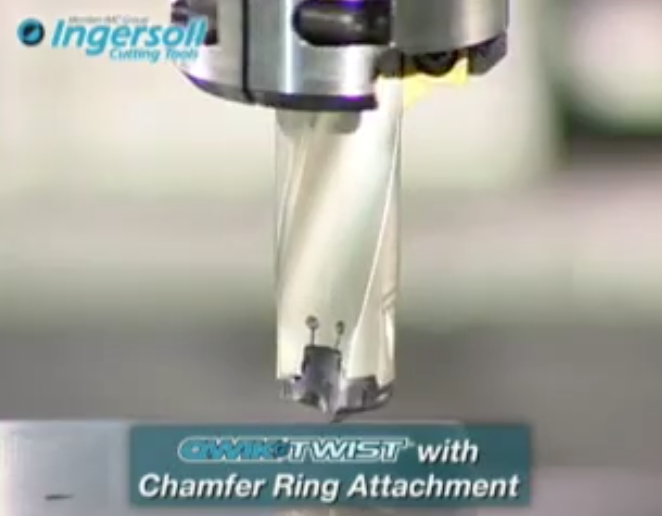


Some coatings, such as TiAlN, enable dry machining when drill ductile cast iron, but coolant is desirable to help evacuate the material’s small, curled chips. Flood coolant can be appropriate for holes less than 1.5 to 2 diameters deep, according to Bob Jennings, product manager for Ingersoll Cutting Tools, Rockford, Ill. Jennings noted that the toolmaker offers standard Qwik-Twist replaceable-point drills to drill up to 8 diameters deep.
Ingersoll also offers standard Qwik-Twist tools for drilling 3 and 5 diameter deep holes.Through-coolant is recommended for deeper holes to help evacuate the chips up the flutes and out of the hole. “With any production, high-feed drilling operation, through-the-tool coolant is certainly a requirement,” said Jennings. Through-coolant pressure should be at least 150 to 200 psi, he added, but the best performances are achieved at around 1,000 psi. “If there’s a knob where you could turn the coolant pressure up,” he quipped, “you keep turning it until you take the bark off your hand.”
n