

Deburring Debuts: Feature Article
Machining firms in North America have a couple of new toolholder options designed to help users automate and improve edge-finishing operations.
Review the print ads from this magazine to continue
This quick advertiser review unlocks the rest of the article and keeps the full-screen reader focused on the ads instead of the page chrome.
Advertisers included in this article experience
Print placements connected to this article
Schutte
sets you apart.
sets you apart. Contact Schutte at 1-800-668-4035, email [email protected], or visit schutteusa.com.
Visit Schutte View this placement in the issue recordPrint ads from this magazine
sets you apart. Contact Schutte at 1-800-668-4035, email [email protected], or visit schutteusa.com.
Continue reading
January/February 2026
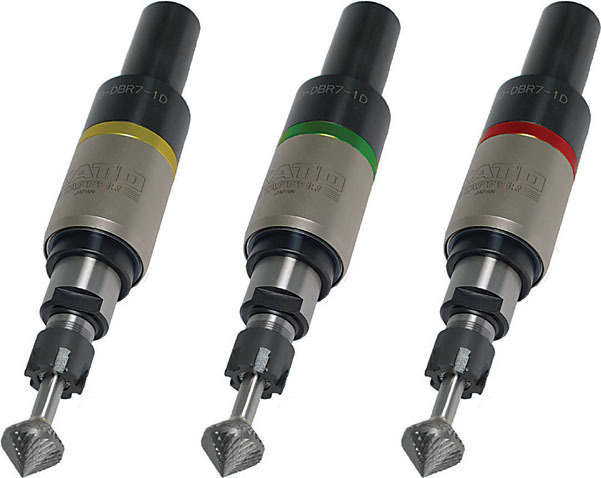
Machining firms in North America have a couple of new toolholder options designed to help users automate and improve edge-finishing operations.
The products are additions to the FM-DBR7 line of deburring holders developed by the Japanese firm Kato Manufacturing Co. Ltd. and sold in North America by Bel Air Finishing Supply Corp. in North Kingston, Rhode Island. Patented in Japan and suitable for CNC machining centers and robotic systems, FM-DBR7 holders feature special load mechanisms that enable front-, back- and dual-side deburring in a variety of production scenarios.
Traditionally, deburring has relied heavily on manual processes that require a good deal of time-consuming setup and maintenance and also produce inconsistent edge-finishing quality, noted Steve Alviti Jr., vice president of Bel Air Finishing. Alviti said the quality issues “were especially significant during high-volume production, where you get a lot of variance and rejected pieces.” So Kato’s goal was to create reliable toolholders that can adapt to some variety in part tolerance in order to allow stable deburring that can be maintained during long hours of continuous machining.
New to the North American market, Kato’s FM-DBR7-1D series deburring toolholder is designed for automated top and bottom (tension and compression) deburring of machined holes in one pass, eliminating tool changes. By compensating for workpiece dimensional changes during production runs, its telescopic compression/tension mechanism is meant to ensure consistent deburring volume and stable cutting performance even in high-mix, variable-batch operations. Originally developed for cast iron, the 1D series now includes three holder options that each provide a specific spring load — light, medium or aggressive — for the different cutting- pressure requirements of a variety of materials, including aluminum and stainless steel.
Bel Air’s other new holder offering is a product recently introduced by Kato, the FM-DBR7-SC, which is designed specifically for front-side deburring and chamfering. The SC features an adjustable spring-load mechanism that maintains consistent cutting pressure during machining of parts with minor height or dimensional variations. The unique four-stage mechanism can switch between pressures ranging from “soft” to “very hard.”
Like the 1D series, the SC has a telescopic design meant to reduce chatter and over-cutting in order to ensure smooth surface finishes and repeatable results. The telescopic motion of the Kato holders produces less runout than other products with a similar telescopic feature available in the market, Alviti said. “We’ve tested our products versus the competitor’s, and you can really see the difference at the tool point of the holder.”
In addition, Alviti pointed out that the Kato holders are short and slim. “Ours are about 80% the size of the competitor’s,” he said. “So the risk of interference is much lower, and the ability to get into the workpiece you’re deburring is greater.” He also noted that, the Kato units have a dust-proof cover that prevents chips and contaminants from getting into the holders, which helps to ensure high performance for longer periods of time.

Available accessories for both Kato holders include the company’s W616 series 90° carbide rotary burs. Alviti explained that a 90° cutting- edge offset to the center allows both top and bottom deburring of machined holes.
What impact can the Kato holders have on an actual deburring process? In one case reported by Bel Air, a machine tool manufacturer making FC200 cast iron parts with a vertical machining center switched from manual deburring to an automated process. According to Bel Air, the customer’s manual deburring operation took approximately 20 minutes per workpiece, with variations in processing time and quality depending on the operator. But by changing to an automated process that includes FM-DBR7-1D holders, the shop achieved consistent, stable quality while dropping deburring time to 1.5 minutes. The customer also noted that W616 rotary burs provide significantly longer tool life than a brush-type tool from another manufacturer that had previously been tried.
Although deburring toolholders meant for automated operation are fairly common these days, the Kato holders are unique in their ability to handle variances in edge tolerance, Alviti said. “If you need that feature and you’re doing high-volume or high-end/high-value products, these holders will be very successful for you.”
Related




Subscribers can use MFGAxis notes, saves and discussion tools with their innoNET account.


