


ID Taper: Grinding
A shop battling taper in ID grinding, especially when the hole is deep, turns to the Grinding Doc. It’s as if the wheel is just riding over the workpiece.
Dear Doc: We constantly battle taper in ID (inner-diameter) grinding, especially when the hole is deep. It’s as if the wheel is just riding over the workpiece. What can we do?
The Doc replies: ID grinding suffers from a major problem: a lack of stiffness in the spindle. When the wheel is inside the workpiece, the spindle deflects. Unfortunately, it doesn’t deflect upward, it deflects at an angle. This creates taper. Some grinders call it “bell mouth.”
Let’s examine how to cope with that taper.
The accompanying ID Spindle Deflection chart shows work done by grinding greats Robert Hahn (1916-2021) and Richard Lindsay (1934-2018). When the wheel first contacts the workpiece, it doesn’t grind. It just rubs. Material isn’t removed. Then, when the force gets to about 2 kg (4.4 lbs.), the wheel starts to plow the workpiece. Material is removed, but slowly, with a lot of rubbing and heat generation. Then, when the normal force gets to around 7 kg (15.4 lbs.), we finally start removing material.
Look at the spindle deflection at 7 kg of force. It’s 14 μm (0.0006″). That’s not insignificant; it’s causing taper. And we have to plunge even deeper (with a bigger normal force) to start to get significant material removal.
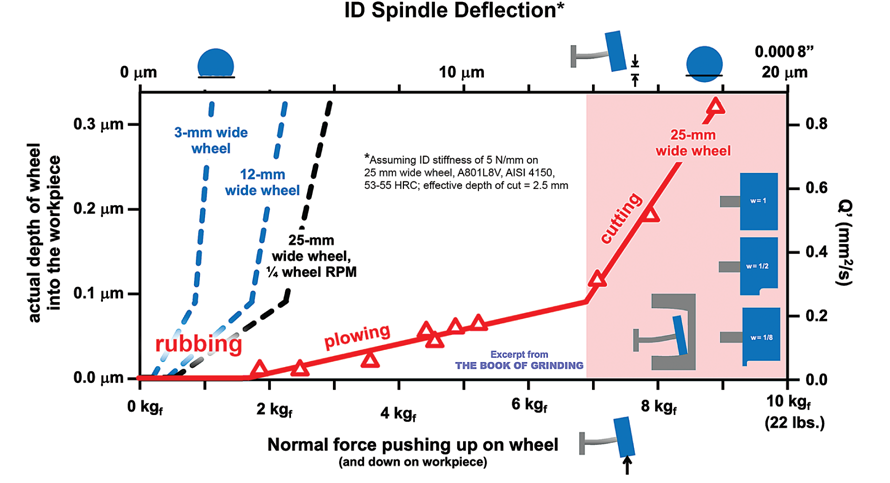
During sparkout, we’re not plunging deeper. In fact, we’re not plunging at all. So, the wheel just rides over the workpiece not removing much material. Or perhaps none. To complicate matters, we have coolant hydroplaning. This can create even more deflection than the grinding.
What can you do? Here are a few options to use during finish-grinding and sparkout:
Decrease your wheel speed — drastically. Perhaps to one-quarter of standard speed or even less. (Yes, this does violate the Grinder’s Rule of “dress & grind at the same RPM.” But we’ll live with that.)
Reduce your wheel width. An easy way to do this is to dress off a bit of your wheel width. It doesn’t need to be a lot, maybe 0.002″ to 0.003″ (50 to 75 μm). This is enough to prevent contact. These first two steps will push the characteristic curve to the left, meaning we can move from rubbing to cutting without needing a huge normal force (and huge spindle deflection). Plus, decreasing your wheel speed and reducing your wheel width increases the Grit Penetration Depth, so the grits are taking a bite out of the workpiece — not just rubbing it.
Dress sharp. If you can’t get the surface finish you want, use a smaller grit size. But at all costs, avoid a dull dress.
Reduce your cooling to a trickle. Yes, this reduces heat-sucking and lubrication. But we’re doing sparkout. We can live with it. This will reduce or eliminate coolant hydroplaning, which is a big chunk of spindle deflection.
Finally, keep the wheel on the part. Don’t exit. When you exit, the wheel contact width gets smaller and smaller, decreasing deflection to zero and creating even more taper.
Of course, the specific values for this characteristic curve change with different workpieces and different wheels. But the general trend applies to all grinding: rubbing, then plowing with low material removal, and finally cutting with significant material removal. We need cutting, and we want it at a small force.
Play around with all of these steps and see what happens. And don’t be timid about it. We’re doing sparkout, not rough grinding. Don’t reduce things by 10%. Reduce them by 75%. Or more. We can live with a super low wheel speed. We can live with a thinner wheel. We can live with poor cooling. Our primary goal is to get that wheel to bite into the workpiece.
Related


Subscribers can use MFGAxis notes, saves and discussion tools with their innoNET account.