



High-Flying Grades: Drilling Performance
Machining aerospace-grade aluminum alloys is manageable when using the proper tools and techniques.
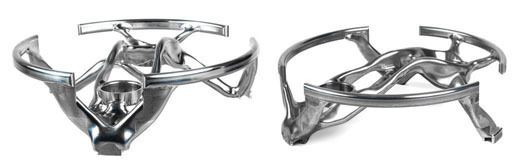
All aluminum alloys are not created equal. One of the most commonly machined aluminum alloys is 6061 because it is cost-effective and has the physical properties required for many applications.
“It’s really a baseline, go-to aluminum alloy,” said Troy Marusich, R&D engineer for Maple Plain, Minnesota-headquartered Protolabs Inc.
However, when a lightweight metal is needed to provide a higher level of tensile strength while offering outstanding fatigue resistance and enhanced corrosion resistance, such as for aerospace components, part manufacturers frequently turn to 2000 and 7000 series aluminum, such as 2024 and 7075. “They were designed for that,” Marusich said. “You will see those in a lot of airframe applications — so components that need to be lightweight and high strength. It could be drones or anything that leaves the ground.”
In addition to providing CNC machining services for a variety of industries using a host of workpiece materials, Protolabs provides injection molding, 3D printing and sheet metal fabrication services. “Today, we’re about $500 million in revenue,” he noted. “In a year, we might see 50,000 unique customers that have ordered parts from us.”
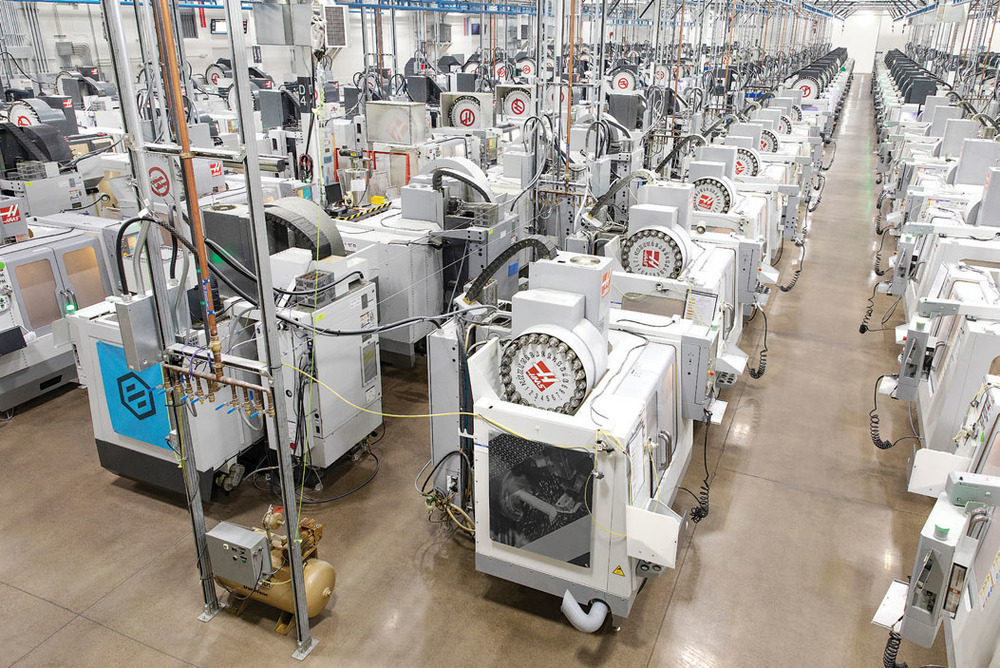
In addition, the manufacturer developed Protolabs Network, with offices in Chicago and Amsterdam. The network of independent manufacturing partners is hand-picked by Protolabs, Marusich said, to outsource work that Protolabs does not have the capabilities to perform at its facility. “We work very closely with them on making certain that they are high quality, and they are able to deliver on time. It’s all available on an e-commerce platform, so our customers come in and it’s fairly transparent to them.”
The aerospace alloys, which are also used in other industries, are stronger while consuming more power to machine them than other aluminum alloys, but the objective is still to remove material quickly while imparting a fine surface finish, Marusich explained.
“A poor surface finish can lead to degradation in strength and toughness,” he said. “We’re avoiding chatter and vibration in our systems, and because we’re doing high-speed machining on these, we want to go in and dynamically tune the processes to avoid these chatter regimens.”
Depending on the application, Protolabs also offers:
- post-processing options for machined metal parts, such as anodizing to improve part durability and add color,
- bead blasting to provide a uniform finish and light texture, and
- electroless nickel plating to deliver a wear-, abrasion- and corrosion-resistant finish.
When machining aerospace aluminum, Marusich said the manufacturer removes both material (internal bulk) stress that can cause part distortion and induced stress from the machining process. Part bending is usually driven by internal bulk stress, and part twisting is typically driven by machining stress.
Aerospace aluminum is used to produce a large array of components, but the high-performance parts often have long, slender features, deep pockets and/or thin walls, he noted. Producing those features can require a high buy-to-fly ratio — the weight of the initial workpiece material compared to the weight of the final product. The ratio might be 10-1 or even 20-1. “That would be about 95% of the parent material that you’re removing to get that final part.”
Tools of the Trade
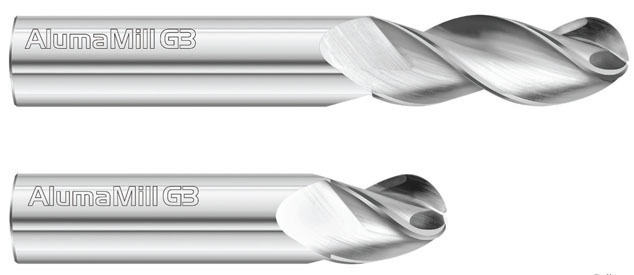
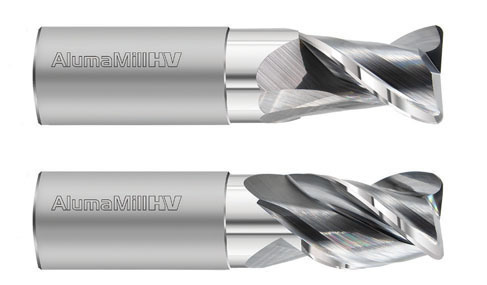
With a high buy-to-fly ratio and high-velocity machining at spindle speeds up to 30,000 rpm or more for aluminum aerospace parts, a large quantity of chips is created quickly that must be controlled and managed at that rate, said Steve Oszust, product development manager/lead tool design engineer for Fullerton Tool Co. Inc. in Saginaw, Michigan. “You start with a 1,200-or 1,800-lb. billet, and you finish with a 70-or 100-lb. part. There’s a ton of swarf that has to come out.”
To create those chips, the toolmaker produces a variety of cutting tools, with the 3833 AlumaMill G3 being the lead tool in its repertoire, Oszust said. The three-flute endmill is highly polished, has a specialty helix and an engineered rake core, and is suitable for roughing, finishing, plunging and ramping. Fullerton also offers the two-flute 3825 AlumaMill and the three-flute 3835 AlumaMill with a higher rake angle. “The G3, for the most part, is going to be our workhorse unless you’re looking at big structural components. Then it’s the 3802/3803 AlumaMillHV series.”
For ferrous applications, the rake angle is from 6° to 10°, whereas the rake angle for nonferrous applications starts at 10° or 12°, excluding high-silicon aluminum, and goes to 20°, he explained.
To drill aerospace aluminum, Oszust said Fullerton makes the 1565 AlumaDrill, which is also suitable for drilling titanium, composites, graphite, plastics, brass and copper. The three-flute “go-to” drill for nonferrous applications has a hybrid spur point where the tool’s center comes to a 90° point and backs off to about 130° to enhance penetration. “It’s easily self-centering in round or unparallel surfaces, so it’s very forgiving. Feed rates on it are very fast. It pulls chips that look like tin foil.”
What distinguishes aerospace aluminum, such as 2024 and 7075, from other aluminum alloys and can make them more challenging to machine is their percentages of alloying elements. Alloying elements such as copper, magnesium and zinc are relatively gummy, or sticky, Oszust explained, and can cause workpiece smearing. “If you don’t have a good, polished edge, you can definitely impart some of the parent materials, or alloying elements, into the cutting edge and that just leads to all kinds of issues when it comes to removing the material.”
For more information from Fullerton Tool about its AlumaMill G3 cutting tool, view a video presentation at https://qr.ctemag.com/25xzi.
According to technical data sheets from Kaiser Aluminum, 2024 has 3.8% to 4.9% copper, 1.2% to 1.8% magnesium and 0.25% zinc, while 7075 has from 1.2% to 2.0% copper, 2.1% to 2.9% magnesium and 5.1% to 6.1% zinc.
“Sometimes that magnesium or zinc can make them even stickier,” Oszust said. Because 7075 has a higher percentage of those elements, he recommends slightly reduced cutting speeds and feeds at a higher torque when machining 7075 compared to 2024. The flipside is that cutting 7075 consumes more power. “If you’re not right on top of your game with 7075, maintaining sharp tools and a proper feed rate, you can workharden it during the cut. Once you start doing that, it’s just a downward spiral from there.”
To help overcome a problem with gumminess, Fullerton makes its tools for machining aluminum using lower cobalt carbide. The material, however, is quite brittle when the cobalt content is below 5%, Oszust added. “Our feeling is that aluminum and its alloys essentially love the cobalt. Your standard 10% grade is just not where you want to be in terms of longevity.”
In addition, Oszust said the tool-maker uses nanosized-grain carbide to help with edge retention.
Many end users apply highly polished uncoated cutters when machining aerospace aluminums, he continued, with ZrN and TiCN being two effective coating options. ZrN is a bit porous and requires post-polishing to smoothen it out, and Fullerton deposits TiCN as a monolayer coating. “TiCN maintains a very good edge structure and sharpness because its monolayer is super predictable.”

He added that chip formation is more predictable when cutting 2024 than 7075 because 2024 chips tend to be uniform is size and shape while 7075 chips tend to have non-standard shapes and stick together. Also, tools experience more wear when machining 7075 than 2024, which is more forgiving.
A Balanced Approach
Regardless of the tool and what’s holding it in the spindle, a balanced tooling assembly with minimal runout is critical to effectively machining aerospace aluminum. Oszust said Fullerton offers tools that are designed and built to be completely balanced. “We send the tool to the end user, and they put it in their already balanced holder, very little adjustment — if any — is needed to maintain that. We’ve actually gotten a lot attention in the aerospace world because you send your tool balanced and the setup guy just doesn’t believe that that can be done. Software allows us to do that.”
Marusich of Protolabs concurred. Because aerospace aluminum alloys are often cut at a high rpm, he said that it’s important to minimize runout by having a balanced tooling assembly and spindle system, which Protolabs ensures. In addition, an end user should make certain that tools from a supplier conform to published specifications and maintain toolholders over their life because they get damaged during machining from normal wear and tear. “And make certain that they are free of chips. We don’t want any cutting chips getting inside the holder and disrupting the balance of the holder.”
Properly evacuating chips from the tool/workpiece interface is also beneficial to avoid recutting them and damaging the tool, Marusich added. “Once you machine a chip like that, you’ve strained it to a high degree. That’s really a different material.”
Both Protolabs and Fullerton Tool agree that it is helpful for end users to develop solid partnerships with cutting tool manufacturers, especially beyond the OEM level.
“The learning curve has to be really short,” Fullerton Tool’s Oszust said. “That’s why having the relationship with a quality tooling supplier, no matter who it is, is imperative to the success of these smaller Tier 2 and Tier 3 shops.”
Marusich emphasized the importance of having Protolabs’ manufacturing engineers work with cutting tool manufacturers’ engineering teams to be able to set up machining processes, tune them and receive ongoing feedback.
Whether an aerospace-grade aluminum alloy is machined to produce a meter shaft, gear, frame, fitting, shaft key, drone component or whatever, Marusich said more objects are in flight than ever before, and high-performance alloys are needed to achieve high-performance part designs. And these designs are more generative than in the past, with more organic shapes that are a departure from traditional ones.
“The aluminum alloys are good candidates to achieve that,” he concluded, “because it’s a lightweight, strong material.”
QR codes and videos from this issue
Print QR codes, video callouts, and in-magazine links for this article now point to the CTE video hub in the HTML version.
Related



Subscribers can use MFGAxis notes, saves and discussion tools with their innoNET account.


