

Living Large
A run-of-the-mill toolholder won’t cut it when aggressively machining with a large diameter tool.
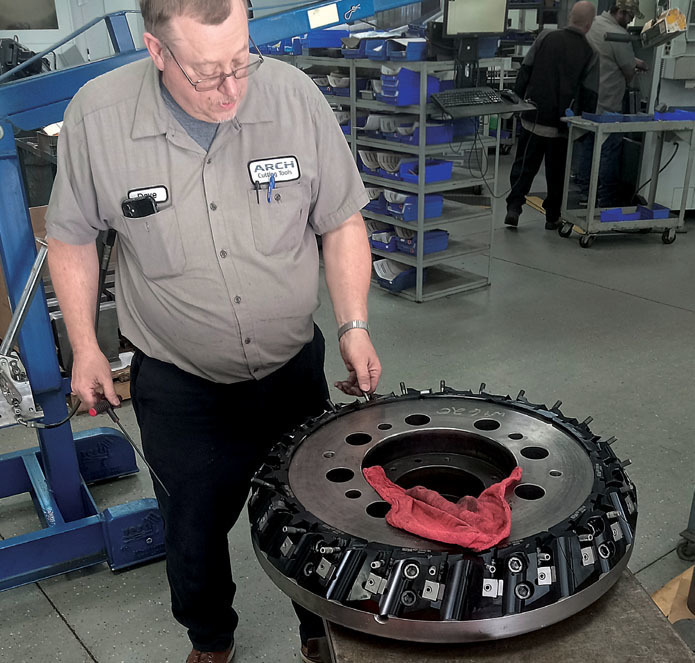
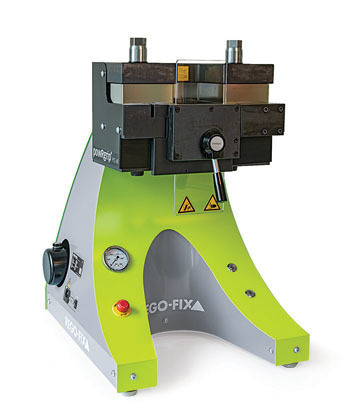
Aggressively machining a part with a large diameter cutting tool requires a toolholder that’s up to the task of handling the high metal removal rates as well as the elevated side loads and engagement. One option is the powRgrip (PG) 48 press-fit toolholder from Rego-Fix Tool Corp. in Whitestown, Indiana, which is for cutters up to 40 mm (1.57″), the toolmaker reports.
Achieving that capability did not happen overnight, said Rego-Fix Senior Engineering Manager David McHenry, who also manages the company’s Center for Machining Excellence. The company started with two smaller sizes when it launched PG about two decades ago and later added PG 32 for tools up to 25.4 mm (1″). “But there was that segment that wanted to hold inch and a quarter and inch and a half tooling for large castings, large aerospace, large defense type of projects.”
The limiting factor in quickly offering PG for that segment, he explained, was the system’s PGS tool setting press, or clamping machine, that capped out at 9 tons of clamping pressure. For PG 48 toolholders, he added, 15 tons of clamping pressure were required. “The development of that machine took years. It wasn’t something that we could just take our existing 9-ton machine and sprinkle some water on it and balloon the size up. We literally had to do lots of reengineering, lots of testing.”
McHenry added that securing a 40 mm-dia. tool requires more than 2,000 Nm (2,950 ft.-lb.) of clamping force. “That’s a lot of clamping force.”
The PG system handles a variety of tapers, including CAT, HSK, BT, Capto, Big-Plus, TC and ISO, and is reportedly quick and safe for assembling tooling. To operate, a cutting tool is placed in a collet, then the collet is inserted into a toolholder, and the toolholder is then placed into the machine and a button is pushed on the machine.
Assembling large toolholders was a safety concern for an aerospace manufacturer that approached Rego-Fix while it was still conducting internal research for PG 48, McHenry said, adding that tightening an external nut required considerable force. “One of their operators had slipped during the assembly of one of the tools they were using and broke his shoulder blade because he fell backwards into a file cabinet. Having something that’s manually loaded and tightened down to generate those forces is not the easiest.”
The smallest tool Rego-Fix designed the PG 48 to accept is 19.05 mm (3/4″) in diameter, “which is a pretty big tool to start with,” McHenry said. To provide 100% pullout protection when performing heavy material removal applications, the holders incorporate cap nuts from the secuRgrip tool locking system for powRgrip.
Although the smaller PG systems provide a TIR of less than 3 μm (0.0001″), he noted that the TIR for PG 48 is 5 μm (0.0002″). “It’s still really good for what we’re doing.”
Dual Contact
The specific runout limit for a large toolholder used in aggressive machining is important but is not as significant a concern as a TIR increase occurring over time, explained Alan Miller, senior manager, engineering, for BIG Daishowa– Americas in Hoffman Estates, Illinois. “If it continues to trend in the wrong direction, then something needs to be addressed. The harder you push the machine, catching these things early will save a lot more trouble down the road.”
The toolmaker offers a variety of toolholders for large diameter cutters, including collet, milling and hydraulic chucks, as well as shrink-fit holders. The latter, however, is not the first choice for heavy-duty applications, Miller said, adding that a milling chuck, in general, provides twice the gripping strength of a shrink-fit holder.
One heavy-duty milling chuck in the company’s line is the Hi-Power milling chuck, which has a thick walled body and provides stable performance and a high level of gripping force and rigidity, BIG Daishowa reported. Narrow slits in the body make the clamping part deform properly to ensure an even, strong gripping force and stable runout.
“In that type we can hold a 2″- dia. round cutting tool shank,” Miller said.
Miller added that a variant of that milling chuck is the Mega Double Power Chuck that features a smooth OD pre-balanced for high speed operations and a rigid design for heavy cutting. The expanded contact diameter of the chuck’s nut to the flange reportedly provides a level of rigidity similar to the chuck and nut being one solid piece, enabling aggressive machining without chatter.
“And then we take that chuck and make a Mega Perfect Grip version, which uses the Weldon flat to trap a cutting tool shank inside the milling chuck so it cannot rotate, and it cannot pull out,” he said. “It’s the ease of assembly of a milling chuck will all the anti-pullout properties.”
Whether it is CAT, HSK or Capto, all the company’s large-diameter holders feature the Big-Plus dual- contact spindle system, Miller noted. The system enables the shank to contact the spindle taper and spindle face simultaneously, increasing tool rigidity to improve surface finishes and dimensional accuracy, extend tool life, eliminate Z-axial movement at high speed and prevent fretting corrosion caused by heavy cutting. “Big- Plus uses some elastic deformation of the spindle itself to lock that face against the face of the spindle to give the base of support all the way out to the edge of the flange rather than just at the cone.”
Because heavy-duty cutting exerts a high level of stress on a machine tool, he recommends conducting more preventive maintenance checks than a machine for less-aggressive applications, including checking runout and pull stud retention force more regularly. “Make sure that everything is tip top if you are going to push the machine as hard as you can.”
Miller added that U.S. part manufacturers tend to use some of the larger tools in the world. “Our aerospace industries are one of the biggest drivers of using these larger tools. We’ll continue to see that demand for some time.”
Complete Cutter
When it comes to large diameter tooling for heavy machining, Bloomfield Hills, Michigan-based ARCH Cutting Tools pushes boundaries. “For large diameter facemills, our Flushing location currently manufactures up to 30″ cutters,” said John Carstensen, shop floor manager for the toolmaker.
“ARCH Cutting Tools in Flushing, Michigan, provides a comprehensive selection of toolholders,” Carstensen noted, “including CAT 40, CAT 50, CAT 60, as well as HSK models ranging from 40A to 125A, along with collets and shrink-fit holders. Our offering begins with BT 30 (CAT style) and extends through CAT 60.”
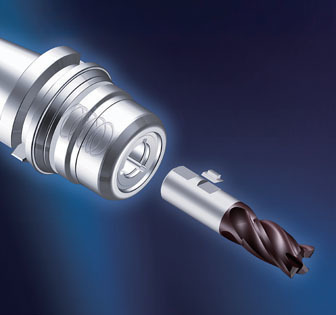
ARCH also supplies integral shank holders, which enhance repeatability by eliminating the need to mount the cutting tool and holder together, he added. In setups using indexable inserts, this configuration lets operators rapidly index or swap inserts without removing the entire cutter. “They don’t have to send the whole cutter out, recheck it, and get it reground. Many shops standardize inserts so they can order them off the shelf.”
To optimize both durability in the taper and machinability at the cutting end, the toolholders are heat treated with a proprietary process to establish hardness zones, Carstensen explained. “Our process strengthens our tools while the insert end performance withstands wear allowing precision machinability. This process also allows for our tools to endure the rigors of machining during the customers application process.”
ARCH tapers are ground precisely to an AT3 tolerance, Carstensen said. “If a holder goes out of spec, our RECON360 service restores it to like-new condition, even for other brands. Simply send the part or a photo for a quick quote, and if it’s reusable, we’ll refurbish it. RECON360 gives you the performance of a new tool at a fraction of the cost.”
Conversely, McHenry said it’s not possible to refurbish Rego-Fix’s powRgrip toolholders, which are produced using a special surface treatment process to provide an exceptionally long life.
Review the print ads from this magazine to continue
This quick advertiser review unlocks the rest of the article and keeps the full-screen reader focused on the ads instead of the page chrome.
Advertisers included in this article experience
Print placements connected to this article
Schutte
sets you apart.
sets you apart. Contact Schutte at 1-800-668-4035, email [email protected], or visit schutteusa.com.
Visit Schutte View this placement in the issue recordPrint ads from this magazine
sets you apart. Contact Schutte at 1-800-668-4035, email [email protected], or visit schutteusa.com.
Continue reading
January/February 2026
“It’s not something that you’re going to wear out the outside of the collet or the inside of the ID in any relatively short period of time,” he added. “It needs to be oiled and cleaned and put away properly so that it’s not going to rust, and that’s any tool. Just like any high-performance system, cleanliness is key.”
For more information from ARCH Cutting Tools, BIG Daishowa and Rego-Fix Tool about toolholders for large diameter tools, view video presentations: https://qr.ctemag.com/25y9q.
Keeping Clean
Refurbishing a BIG Daishowa holder is possible, but Miller said the company does not do a lot of it. Instead, he recommends always cleaning the bores and the cutters before clamping. “The one advantage we have over a lot of other milling chucks is they’re sealed in both the front and the back, so there is no real maintenance involved with them. As long as you keep the bore clean and it doesn’t get damaged, they’ll run pretty much indefinitely.”
One element of a tooling assembly that has a finite life and should be replaced regularly is the pull stud, or retention knob, he added. “Generally, we say a pull stud that’s in a production environment should be changed every three years.”
ARCH Cutting Tools manufactures retention knobs as part of its standard product line, each heattreated for maximum durability. For unique machine tool requirements, ARCH also produces specialty knobs on request. As Carstensen noted, ARCH’s business is dedicated to highly engineered custom solutions, backed up by U.S. manufacturing of solid round, indexable and PCD cutting tools, within 17 U.S locations — from more than 25,000 off-the-shelf standard tools in the “Collection” catalog, to quick turnaround custom or modified tooling.
To achieve the desired level of performance from any type of steep taper toolholder, McHenry said maintaining the proper torque on a pull stud is required. “Make sure that when it’s assembled by the toolroom, they put the pull stud on correctly, they torque it down to proper specification with some sort of locking agent like Loctite Blue and they don’t deform the taper.”
The proper torque value for a 40- taper holder was up to 90 ft.-lb., but times have changed, McHenry said. “Anything more than 36 ft.-lb., I’m deforming the taper.”
When a large diameter cutter for aggressive machining is properly assembled into the toolholder, running it at the correct speed and feed is essential in order to avoid, for example, chatter when a tool rotates too fast and rapidly across a part, Carstensen said. Following the recommended machining parameters, however, may not do the trick. “Sometimes you have to play it by ear. Watch the cutter and watch the chips. A lot of people think everything is in a book, and it’s not always that way.”
QR codes and videos from this issue
Print QR codes, video callouts, and in-magazine links for this article now point to the CTE video hub in the HTML version.
Related



 MFGAxis Discussion
Be part of the shop-floor conversation
Like, save, or comment on this CTE story.
MFGAxis Discussion
Be part of the shop-floor conversation
Like, save, or comment on this CTE story.


MFGAxis Discussion