Sandvik Coromant TechDays event covers inception to inspection
Sandvik Coromant Co. hosted its 2026 TechDays May 6-7 at the toolmaker’s U.S. headquarters in Mebane, North Carolina. The event included machine demonstrations, seminar presentations and production unit tours.
Sandvik Coromant Co. hosted its 2026 TechDays May 6-7 at the toolmaker’s U.S. headquarters in Mebane, North Carolina. The event included machine demonstrations, seminar presentations and production unit tours.
The machine demonstrations featured the DMG Mori DMU125FD duoBlock and the Okuma LB3000EX II SBB-MY/1000 for turning, the Okuma MU6300V-L for power skiving, the Mazak Integrex i450 HSTN 60″/1500U for gear gashing, the Mazak Variaxis I-700T for 5-axis machining and the Wenzel LH 108 coordinate measuring machine for gear inspection.
On May 7, the seven presentations covered a range of timely topics. After Corey Schwenke, training and centers manager-America for Sandvik Coromant, welcomed attendees, EBITDA Growth Systems’ founders Mike Watkins and Dave Capkovitz presented the second part of “Technology is the Tool. Managers are the Multiplier.” They noted that manufacturers have a woeful success rate for implementing technology, and managers build the culture that determines the outcome and whether a specific technology creates progress or chaos.
Most cultures evolve accidentally around personalities and habits, and are built according to what leaders tolerate, reward, enforce or ignore. Although technology can automate, accelerate, measure, analyze, predict and more, it cannot create ownership, trust, accountability or leadership. In addition, having effective production processes accelerate the rate of technology adoption while reducing stress and boosting profitability.
Next, Sandvik Coromant’s John Winter, global product manager – gear machining, and Mark Briel, product solutions manager – gear machining, presented “Power Skiving: From Fundamentals to Production.” Power skiving is a continuous gear-cutting process where a specially designed cutting tool meshes with a gear blank in a manner similar to a pinion and gear in a gear train, but with the tool also moving axially along the gear’s axis. Effective power skiving requires the stiffness and precise synchronization of a modern CNC machine because both the tool and workpiece rotate simultaneously. If synchronization of the machine is off, the cuts will be inaccurate and look smeared.
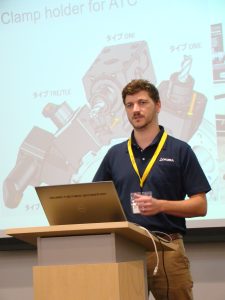
After a break, Simon Schneider, director of factory automation at Charlotte, North Carolina-headquartered Okuma America Corp., covered “The Automation Impact: Short-term Wins to Long-term Transformations.” The company builds a variety of machine tools, with 48% being machining centers, 24% lathes, 24% multitaskers, 2% grinders and 2% other types.
Schneider emphasized the need to control all variables before automating a process. A stable process should have clean clamping and machining strategies, not have any issues with bird nesting of chips, and include proper inspection of tools and parts. In addition, the machine needs an automatic door, the correct coolant for the process with the ability to clear chips and the correct interface, such as Profibus, Ethernet/IP or Anybus. An acceptable and repeatable tool life is also required.
The best approach to automation starts with taking small and simple bites, creating a gateway to lights-out manufacturing, Schneider said. “To automate a process, everything is possible, but everything comes with a price tag.”
Three production unit tours took place each day, including a well attended one during the lunch break May 7. The production unit is split into areas for creating standards and specials. Sandvik Coromant uses 15 Stama machines in its production department, such as the MC 734/M and MC 534/Twin, as well as other machines, including ones from Hermle, Makino and DMG Mori.
After lunch, Mark Backus, product solution specialist – machine integration products for Sandvik Coromant, continued with the presentation “Innovations in Machining: Automated Tool Change and Sensor-Embedded Tooling for Increased Productivity.”
Review the print ads from this magazine to continue
This quick advertiser review unlocks the rest of the article and keeps the full-screen reader focused on the ads instead of the page chrome.
Advertisers included in this article experience
Print placements connected to this article
Platinum Tooling Technologies
Platinum Tooling Technologies print ad
Print ad listed on page 9 of the June/July 2026 issue.
Visit Platinum Tooling TechnologiesView this placement in the issue recordPrint ads from this magazine
Print ad listed on page 9 of the June/July 2026 issue.
Continue reading
June/July 2026
Backus said turning center utilization is low compared to machining centers due to time-consuming manual tool changes and component handling. As such, unmanned production is not possible. Automatic tool change was only possible by using a magazine on a multitask machine or special systems.
To provide a solution, Backus said Sandvik Coromant introduced automatic tool change capability for machine-adapted clamping units (MACU) with the Coromant Capto interface for both static and driven units. The solution is for turning centers with an ATC turret option. With a fully automated CNC lathe, unmanned production is possible. No manual handling is required, increasing productivity.
Following the second break, Eric Nemitz, vice president of sales for North America at Wenzel America Ltd. in Wixom, Michigan, presented “Closing the Loop: Integrating Precision Metrology into the Digital Manufacturing Value Chain.”
His talk included information about CMM selection and the ratio of CMM measuring error to part tolerance. “Or is your CMM up to the job?” Before purchasing a CMM, it is important to determine if the CMM is really capable of inspecting the parts a manufacturer produces, he added. The measuring error of the CMM should be significantly smaller than the part tolerances. All the potential measuring errors of a CMM are described in the ISO 10360 standard. Of those, the most important ones are the volumetric length measuring error E and the volumetric probing error R.
Dan Skulan, head of metrology solutions for Renishaw Inc. in West Dundee, Illinois, continued with “Precision at Scale: Integrating Machining, Metrology, Automation and Truth-Based AI for Competitive Advantage.” He noted that 86% of companies are using or planning to use artificial intelligence, but 79% don’t trust AI. Companies need to turn a garbage-in, garbage-out process to one that is precision-in, precision-out to complete the progression to an autonomous digital manufacturer.
One topic Skulan’s presentation covered was the Productive Process Pyramid to identify and control variation before, during and after machining. The pyramid includes a process foundation in which process controls are applied in advance, followed by process setting in which predictive controls are applied just before cutting, then in-process control in which active controls are applied during metalcutting, with post-process monitoring on top in which informative controls are applied after machining is completed.
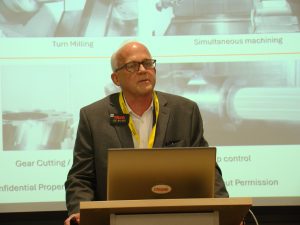
The May 7 presentations concluded with Joe Wilker, multitasking product group manager for Mazak Corp. in Florence, Kentucky, discussing “Done-in-One Gear Manufacturing: From First Cut to Final Inspection.” He emphasized that a lot of processes can be performed by a multitask machine, including gear cutting, with the focus being on low-volume parts that have a gear.
For gear cutting and measurement applications, Wilker said Mazak offers Integrex AG hybrid multitask machines. Three types of gear machining methods (gear skiving, hobbing and endmilling) are integrated to meet diverse needs, from high-mix, low-volume production to mass production. Also, conversational programming for toolpaths and measurement can be made in a short period of time.