

Machining Stainless Steel
A clear breakdown of stainless-steel subgroups—machinability traits, challenges and best practices across austenitic, martensitic, ferritic, PH and duplex alloys.
How do you define stainless steel?
Stainless steels are alloys of steel that feature a shiny finish and are highly resistant to corrosion. They are composed of iron with a minimum of 10.5% chromium, along with other alloying elements such as nickel and molybdenum.
When chromium reacts with oxygen, it creates a thin layer of Cr2O3 on the steel’s surface. This layer provides stainless steel with its corrosion resistance by preventing oxygen from reaching the underlying metal. Consequently, it stops rust from penetrating into the material.
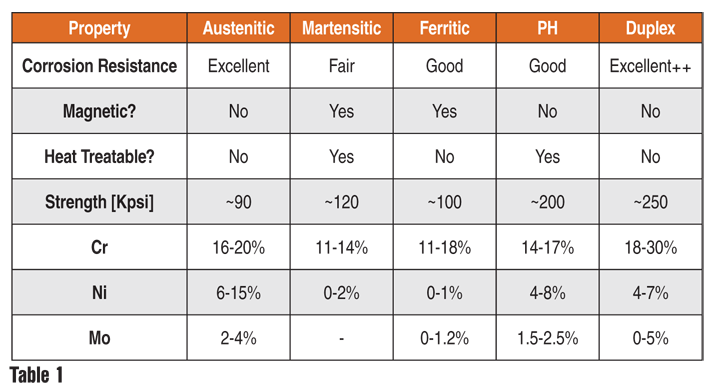
Stainless steel comes in over 150 different grades, grouped into five main subcategories.
Austenitic Stainless Steel
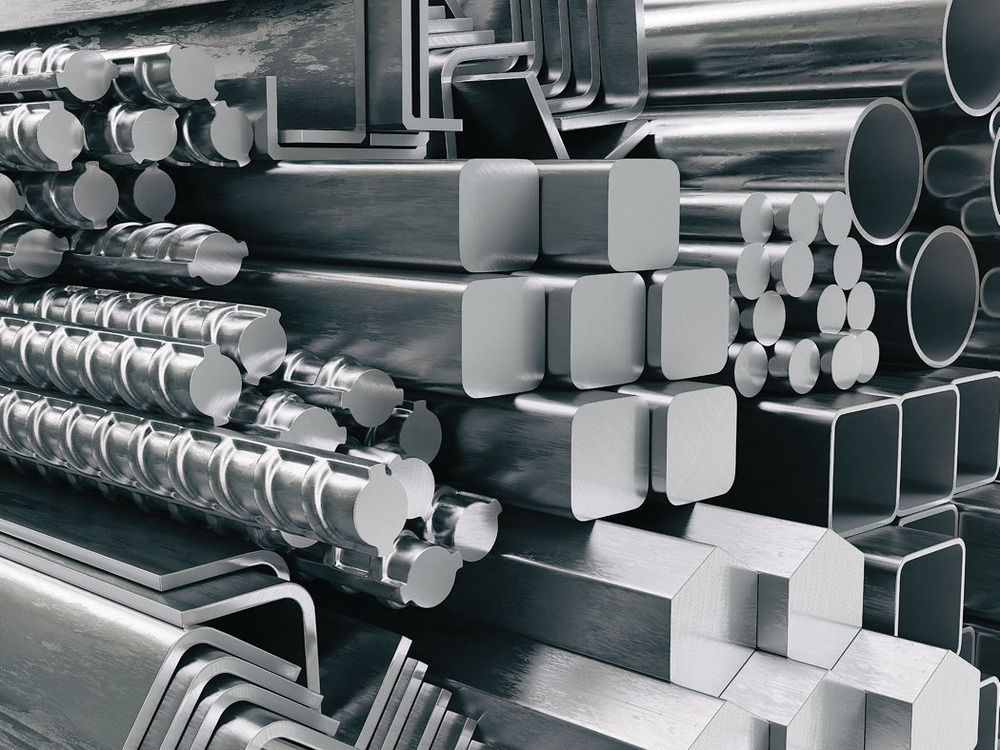
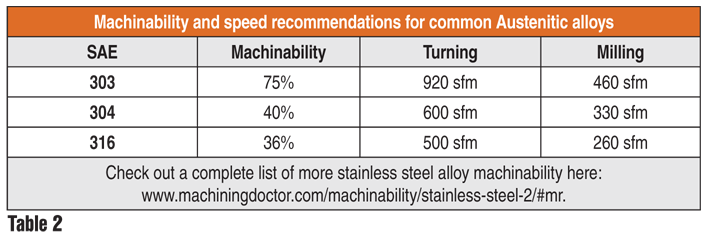
Austenitic stainless steel is the most widely used class of stainless steels. Characterized by a high chromium content of up to 20% and nickel levels reaching 15%, this group is known for its superior resistance to corrosion. The significant nickel content, however, makes these alloys pricy and very challenging to machine. Compared to other stainless steels, austenitic grades generally have lower strength and hardness. Most alloys in this category contain less than 0.1% carbon, which increases ductility and therefore requires careful attention to chip control and built-up edge (BUE). Variants marked with an “L” suffix, such as 304L or 316L, have extremely low carbon content, around 0.03%, and are even more difficult to machine (because of extra ductility). Common machining difficulties include high cutting forces, substantial heat generation and BUE, where the workpiece material adheres to the tool’s cutting edge. Notch wear frequently occurs at the depth-of-cut line, and alloys with increased nickel and molybdenum content exhibit poorer machinability.
Best practice:
- Use TiAlN PVD grades or thin-layer CVD grades.
- Don’t use very low cutting speeds, as built-up-edge forms when there isn’t enough heat at the cutting edge.
- Apply good coolant supply directed to the cutting edge.
- Vary the depth of cut to reduce notch wear risk.
Martensitic Stainless Steel
Martensitic stainless steel is the second most common category of stainless alloys. These alloys feature up to 14% chromium and contain only small amounts of nickel. They can undergo heat treatment and hardening, providing greater strength compared to austenitic alloys. However, their corrosion resistance is limited, making them suitable primarily for use in atmospheric environments.
Review the print ads from this magazine to continue
This quick advertiser review unlocks the rest of the article and keeps the full-screen reader focused on the ads instead of the page chrome.
Advertisers included in this article experience
Print placements connected to this article
Tapmatic
SYNCHROFLEX®
• Longest Tap Life. • Ultimate Thread Quality. • With High Pressure, High Volume Internal Coolant or MQL. • A full program available for all machines and tap sizes from M1 to M48. The Best Choice for Rigid Tapping! MADE IN IN U.S.A
TAPMATIC SYNCHROFLEX® • Longest Tap Life. • Ultimate Thread Quality. • With High Pressure, High Volume Internal Coolant or MQL. • A full program available for all machines and tap sizes from M1 to M48.
Visit Tapmatic View this placement in the issue recordPrint ads from this magazine
• Longest Tap Life. • Ultimate Thread Quality. • With High Pressure, High Volume Internal Coolant or MQL. • A full program available for all machines and tap sizes from M1 to M48. The Best Choice for Rigid Tapping! MADE IN IN U.S.A
TAPMATIC SYNCHROFLEX® • Longest Tap Life. • Ultimate Thread Quality. • With High Pressure, High Volume Internal Coolant or MQL. • A full program available for all machines and tap sizes from M1 to M48.
Continue reading
November/December 2025
Ferritic Stainless Steel
Ferritic stainless steel materials contain up to 18% chromium with almost no nickel. They have better corrosion resistance than martensitic grades but less than austenitic ones, and cannot be hardened by heat treatment.
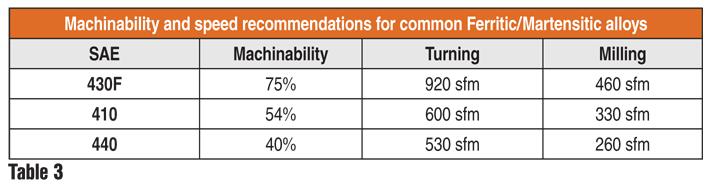
Martensitic/Ferritic stainless falls between regular steel and stainless steel materials. Carbide grades for both alloy steel and stainless steel work well on them. Typical wear includes flank and crater wear (similar to alloy steel), with occasional BUE. The machinability is better compared to austenitic stainless.
Grades with suffix F (such as 430F/420F) are free-cut materials with more sulfur and less molybdenum. This change improves machining ease but reduces corrosion resistance. Grades with suffix C, like 440C, have higher carbon levels, which increases their strength and hardness after heat treatment.
Precipitation Hardening Stainless Steel
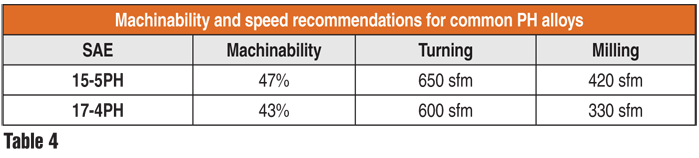
This group, referred to as PH stainless steels, offers outstanding resistance to corrosion and can be heat-treated to achieve tensile strengths up to three times greater than standard austenitic types. This is accomplished by incorporating elements like copper, aluminum and titanium into their makeup. PH alloys are commonly utilized within aerospace and the oil and gas industry sectors, where both high strength and superior corrosion resistance are essential.
PH stainless steel grades are available in two main conditions: annealed (condition A) and tempered (condition C). The annealed comes in hardness between 20-30 HRC, making it easier to machine. Once machining is complete, parts can be age-hardened to a hardness of 32-42 HRC. Tempered (condition C) alloys come in hardness up to 43 HRC and can be further hardened to exceed 50 HRC. It is important to consider the alloy’s condition and hardness when determining appropriate cutting parameters.
Duplex Stainless Steel
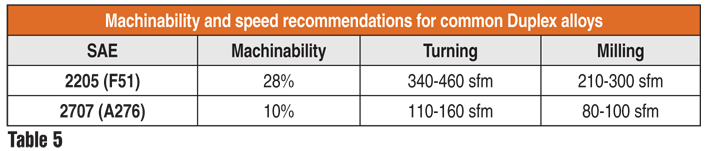
This category is referred to as duplex because these alloys possess a dual-phase structure comprising both austenitic and ferritic phases. As a result, they offer the advantages of both types, including enhanced strength, improved toughness and superior corrosion resistance. Compared to austenitic stainless steels, duplex alloys provide greater resistance to corrosion and higher tensile strength. Their chromium content can be as high as 30%, which is significantly more than that found in austenitic grades. In terms of machining, general guidelines are much like those for austenitic stainless 316, though machinability is roughly 20% lower nd greater emphasis is needed on clamping stability. These steels are generally less costly than austenitic stainless due to their reduced nickel content. However, they are much less widely used, primarily because they are harder to machine and their strength and corrosion resistance decrease at temperatures above 570°F (300°C)
Glossary terms in this article
Related


 MFGAxis Discussion
Be part of the shop-floor conversation
Like, save, or comment on this CTE story.
MFGAxis Discussion
Be part of the shop-floor conversation
Like, save, or comment on this CTE story.


MFGAxis Discussion