

Cutting Lead Time In Half
A shop turned to WFL Millturn Technologies for a mill-turn machining center capable of reducing setup, lead and machining time when producing worm shafts.
AUMA Riester GmbH & Co. KG in Muellheim, Germany, is uniting its four divisions under the slogan “AUMA – one brand.” The synergies between these areas are exploited in procurement as well as in development, design and engineering.
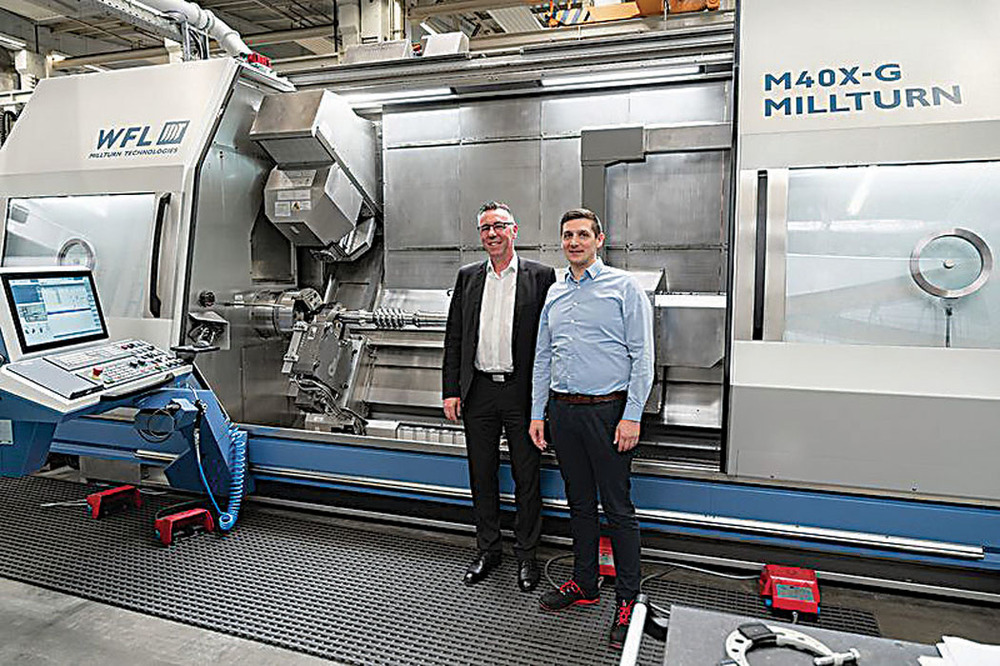
The AUMA Drives GmbH division is based in Coswig, Germany, and is an international active system supplier for custom gear units and actuators. To boost production of gear units, the company acquired a mill-turn machine from WFL Millturn Technologies GmbH & KG in Linz, Austria. (WFL Millturn Technologies Inc. is in Wixom, Michigan.)
The product life cycle is a unique selling point at AUMA. The customer’s product idea is first taken into development, followed by the creation of a product concept before a prototype is then produced and analyzed. Once quality and production planning are completed, it is on to parts procurement.
Labeling and traceability are becoming increasingly important. It is essential in concentrated solar power, for example, because 80,000 drives are delivered to this area.
“It all works using QR codes and is traceable,” said Marko Kost, technical support team leader at AUMA Drives. “In case of a failure in the gear unit, [such as] a defective worm shaft, which is due to a material defect, you search in the corresponding material batch and know exactly which gear unit this affects, and which ones have to be replaced. This is done for all standard products in the powertrain or according to customer requirements.”
The worm shaft, worm gear and housing are the most important parts made at AUMA and are located in the powertrain. This is AUMA’s main area of expertise. The goal is a product whose performance and efficiency become a competitive advantage for the customer.
The machines in the AUMA Group are procured by a cross-group project team. In the case of the M40X-G mill-turn machine, it was a project team consisting of Jochen Pfeiffer, the lathe specialist coordinator and project manager from the AUMA Riester plant in Ostfildern, Germany, and Kost, as well the production management and the shift leader for turning from Coswig, and central purchasing at the AUMA Riester plant in Muellheim.
The worm shafts are produced on the WFL machine. AUMA’s high-performance worm gear units can be found in concrete mixing plants, among other applications. The previous machining process for producing worm shafts was less than ideal, according to Kost. “The process for manufacturing this shaft part used to involve a lot of individual steps: turning, clamping, pre-machining, pre-milling the gear teeth and grinding the gear teeth — an extremely expensive process. Then it was time for the heat treatment. The part has to be annealed because the milling and turning process sometimes causes the shafts to twist. “After that, it was on to the finish milling of the shafts. We would pre-grind the gear teeth and finally carry out the heat treatment and case hardening before re-clamping the shaft on the turning machine. Both sides were turned, and slots were then milled before moving the part to yet another machine for the finish grinding of the gear teeth. Finally, we carried out finish grinding the seats externally in the cylindrical grinding machine. That’s a lot of individual processes with an extremely long lead time.”
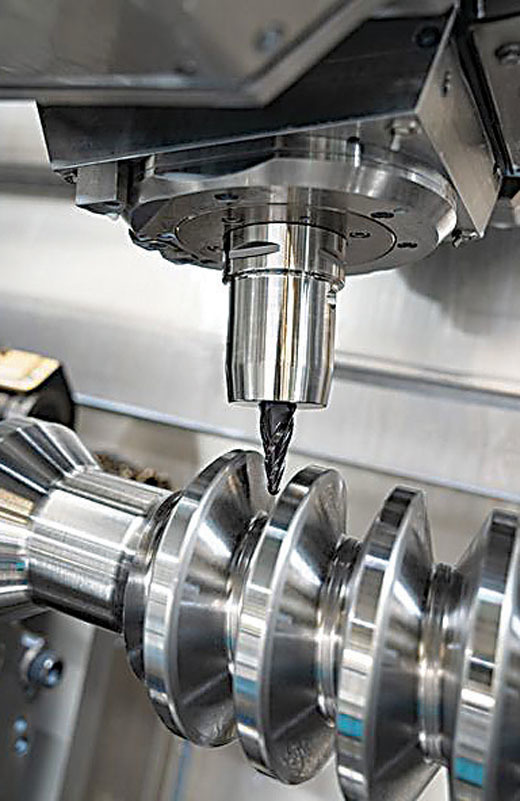
With the mill-turn machine from WFL, the worm shaft can be preturned completely in just one clamping operation. The gearing is pre-machined, which means that there is no longer any need to pregrind them. The shaft goes from the machine straight to case hardening. Once this has been completed, the rest of the machining process — right through to the finished worm shaft — continues in the M40X-G.
Review the print ads from this magazine to continue
This quick advertiser review unlocks the rest of the article and keeps the full-screen reader focused on the ads instead of the page chrome.
Advertisers included in this article experience
Print placements connected to this article
by MATE Workholding
MADE
MADE Visit mate.com to learn more.
Visit by MATE Workholding View this placement in the issue recordGuhring
Mastering Metalwork with Micro-Precision Tools:
Mastering Metalwork with Micro-Precision Tools: Visit guhring.com to learn more.
Visit Guhring View this placement in the issue recordPrint ads from this magazine
Continue reading
September 2025
Other than the case hardening, finish grinding of the gear teeth is the only remaining process still carried out on another machine. All other processes are performed on the M40X-G.
The time savings are significant, Kost said. “We have reduced the setup time by 50%. The machining time has been reduced by 15 to 20%, but we can see more potential here. The lead time has been halved. We still have the external hardening process, which sometimes prevents us from being flexible. But thanks to the WFL, we can now theoretically deliver within four weeks if a super urgent order comes in.”
The machine is designed specifically for producing worm shafts, but there are plans to also machine the sleeves that are fitted in the gear unit. These sleeves provide the output drive, which the customer chooses, in the gear unit.
“For example, we can install a shaft, but the holes are often specified by the customer,” Kost said. “We have already done this with internal gears too. We are very much guided by the customer in this area. But as for the gear unit itself, the diameters and so on, we stick to the standard.”
Batch sizes range from one to 24, Kost noted. “Due to the small batch sizes, it was extremely important to us that the machine is easy to set up. That’s why we have a large tool magazine, so that we can set up parallel to machining time. In the past, we would frequently have to change the jaws due to the jaw chuck. Now, we have the same jaw chuck on the main and counter spindles. We sometimes use face drivers for special machining during the high-precision finishing process, and we can attach these face drivers to the jaw chuck so that we are under way in no time.”
The tolerance specifications are in a narrow range, in some cases down to IT6, which AUMA machines completely using the in-process measuring probe by means of turning, Kost said. “We used to always be told that we had to grind to achieve this, but actually we can get the same result by turning. That’s a massive competitive advantage for us. And, of course, the design with the slant bed, that’s critical for stability.”
The M40X-G is also equipped with a pick-up magazine for the grinding unit. This can also be used for boring bars later on and is a huge advantage, according to Kost. “We used to use parameter software to help us produce the gear teeth on the shaft. The operator entered the data, but this was a big challenge for us because you always had to draw the tooth when programming and then simulate it in the program. WFL has developed a specific programming cycle for us for this process, so we can now program the gear teeth directly at the machine.
“You simply enter the gear teeth data and then mill or turn. There is no longer any need for external programming. The whole process runs extremely smoothly. It really was a fantastic collaboration. We can also measure the gear teeth with a measuring probe and then finish them.”
AUMA uses the machine’s measuring technology to do this. The shaft’s concentric running is also measured on the machine without turning the shaft. “That’s really great, because the part can stay in the machine the whole time,” Kost said.
As for future projects, Kost said the company has some ideas: “We definitely want to make further progress with programming and simulations, as that will save us run-in time. We need to be using the machine efficiently. Also, three machines are going to be removed from the production area in Coswig thanks to the new M40X-G. There is a growing space for machines that come with automation. And everyone always needs space.”
Glossary terms in this article
Related




Subscribers can use MFGAxis notes, saves and discussion tools with their innoNET account.


