

Cutting Tool Evolution
With so many cutting tools misapplied or underutilized, consider using interchangeable, indexable and/or a combination of the two cutting tool systems.
Being productive while maintaining consistency is paramount for success in manufacturing, but process variables related to the various manufacturing technologies in use — such as machines, material, part geometry and cutting tools — often seem to throw a wrench into metalworking success. When you think about cutting tools and all the process variables that come into play (machine, material, material hardness, part fixturing, type of toolholder, gauge lengths, cutting parameters, etc.), it’s of no surprise that a large percentage of cutting tools put into use are misapplied and/or underutilized. This is where interchangeable, indexable and a combination of the two (interchangeable- indexable) cutting tool systems can be applied. Engineered to be versatile, efficient and repeatable, these highly adaptable cutting tool systems offer powerful solutions for taking on manufacturing’s most persistent challenge — dealing with process variables.
This article will outline the difference between interchangeable and indexable cutting tools, and how these once mutually exclusive systems have been combined (e.g., interchangeable- indexable) to offer the advantages of indexable insert tooling and provide maximum customization and optimization towards various machining processes.
To set the stage, let’s start with basic definitions of indexable and interchangeable tool types, which are often confused with one another, so that readers can delineate between the two.
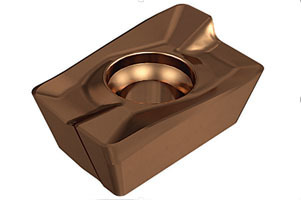
Indexable Cutting Tool: A cutting tool consisting of a body (typically made of steel) that incorporates mechanically clamped replaceable inserts (made of cemented carbide, ceramic, etc.) that can be rotated/ flipped multiple times or swapped as needed.
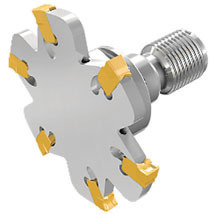
Interchangeable Cutting Tool: A cutting tool consisting of a holder/ body (steel, carbide, heavy metal) and interchangeable head attached to the shank with various, sometimes proprietary, methods (e.g., threaded connection, mechanical clamping, self-tightening mechanical pocket).
Indexable Insert Trends
Coatings & Materials: Coating enhancements are a consistent pursuit and continue to provide nice gains in productivity, especially for those companies that haven’t pursued pursued any improvements in a few years.
Substrate enhancements and more exotic insert materials such as ceramics and CBN/PCD inserts with chip formers are becoming more prevalent and improving productivity of difficult to machine materials/ applications, such as machining nickel-based super alloys (Inconel) and heat-treated (hardened) materials.
Higher Precision/Repeatability: Modern powder compaction presses provide extremely tight tolerances and precise control of the pressing cycle. This control in the first phase of insert creation leads to a higher performance on the machine.
Review the print ads from this magazine to continue
This quick advertiser review unlocks the rest of the article and keeps the full-screen reader focused on the ads instead of the page chrome.
Advertisers included in this article experience
Print placements connected to this article
by MATE Workholding
MADE
MADE Visit mate.com to learn more.
Visit by MATE Workholding View this placement in the issue recordGuhring
Mastering Metalwork with Micro-Precision Tools:
Mastering Metalwork with Micro-Precision Tools: Visit guhring.com to learn more.
Visit Guhring View this placement in the issue recordPrint ads from this magazine
Continue reading
September 2025
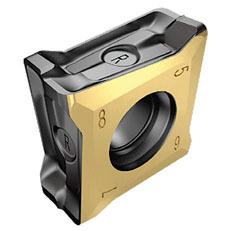
Integrated Insert Geometries: Multi-axis/level pressing and complex die sets enable the creation of complex inserts in a single pressing, such as double-sided or multisided inserts (i.e., inserts with more cutting edges) with pressed in chip forming geometry or other features such as coolant grooves.
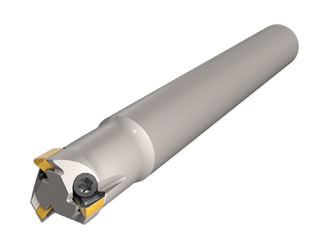
Micro-Inserts/Tooling: The modern pressing technology previously outlined provides the process control needed to create tiny inserts with geometry while maintaining the attributes and overall quality required of a sintered carbide insert. By coupling the ability to press tiny inserts with 3D metal additive technologies to create the cutter body, you now have an expanded range of indexable cutting tools — with coolant thru capability to smaller diameters (1/4″, 5/16″, 3/8″, etc.) — that previously could only be served by solid carbide tooling.
Evolution of Interchangeable Cutting Tools
Interchangeable cutting tool designs have been in play for many decades and have long been known for providing the versatility to adapt a cutting tool assembly to the task at hand. These early/ simple systems consisted of steel bodies and interchangeable steel heads possessing indexable inserts. Of course, there are inherent disadvantages of an interchangeable system, due to added connections, that reduce rigidity/accuracy and lead to reduced performance/ productivity. Some argue there’s an additional cost due to needing additional components to make a cutting tool assembly, but this is usually a short-sighted viewpoint that neglects to consider the lifecycle of their investments. If the interchangeable system is being applied correctly, the initial purchase price of the interchangeable tooling quickly reaches a breakeven point and overall cost savings are realized.
But enough about money, let’s get back to the technical. As just mentioned, the disadvantages of early interchangeable systems — a reduction in rigidity/accuracy — are mainly due to the connection and tool types that are applied. This “connection point” is where next generation interchangeable cutting tools have drastically improved and changed the game.
Enter Advanced Interchangeable Heads
Starting in the late 1980’s and early 1990’s, cutting tool manufacturers introduced more advanced interchangeable systems that incorporated solid carbide interchangeable heads, and the main benefit — besides the versatility of head adaptation — was the connection types that drastically improved accuracy/ rigidity of a modular system. For ISCAR, the MULTI-MASTER system connection incorporated a ground threaded connection, including conical taper and face contact, that has a slight interference fit when connected to a shank. The accuracy and ease of use provided by this system/connection introduced in the early 1990’s left little room to improve. That said, few people likely imagined the sheer number of possibilities/combinations (i.e., versatility) that would be added to these interchangeable systems over the years. And the additions being made to this day continue to push versatility to new heights.
Adding Indexable Heads
In recent years, these interchangeable systems have been further augmented with the introduction of interchangeable-indexable heads. This provides users with the inherent cost benefits of indexable inserts along with the added versatility of customizing the interchangeable head and its indexable inserts (geometry/grade) to the material and part geometry at hand.
Aligning With Manufacturing Trends
Consider some of the manufacturing technology trends that have emerged in recent years, such as:
- CNC machines being lighter duty with higher RPM capability but less HP;
- additive technologies or near net shape forgings and casting requiring less material to be removed with traditional roughing operations/tools;
- CAM toolpath algorithms that allow for more efficient trochoidal toolpath approaches utilizing higher speed to make metal removal gains.
It’s of no surprise that today’s advanced interchangeable cutting tool offerings are becoming the go-to solution, replacing many solid carbide tools or traditional type indexable tooling. The recent additions of advanced interchangeable- indexable heads opens the door to many new applications that users can leverage in terms of versatility and in outfitting their indexable tooling with the latest indexable insert designs, optimized grades/coatings and geometries that can make a difference in maximizing productivity from job to job — no matter the variation at hand.
Glossary terms in this article
Related




Subscribers can use MFGAxis notes, saves and discussion tools with their innoNET account.


