

The case for a new Modern Machining course
Readers of Cutting Tool Engineering have likely made two observations about the modern machining industry.
Readers of Cutting Tool Engineering have likely made two observations about the modern machining industry.
First, the industry has experienced dramatic changes over the last 20 years. This point is proven by the bewildering variety of cutting tool geometries, substrates, coatings, toolholders, specialized machine tools, automation and software solutions available to modern manufacturers. Global competition, non-traditional materials and machine tools themselves have all driven the industry toward one fact: everything is designed to optimize the performance of the cutting tool in the cut. Specialized, high-performance tooling is now normative among high-volume manufacturers. In turn, the industry has found new ways to use this tooling, and this specialization has unlocked a silent surge of innovation across aerospace, automotive, medical, semiconductor and other industries.
Second, most undergraduate-level engineering education about machining processes hasn’t kept pace with technological advancements. The industry itself is starved for talent, and new graduates have very little context for making wise business decisions or pushing the technical boundaries of what machining can accomplish. Engineering students have usually made a few aluminum parts using low-quality tools, low-quality toolholders, and low-quality machines — with machining strategies that represent the state of the industry several decades old. Today’s world is starkly different. Material removal rates are higher, tolerances are tighter, surface quality is more controlled, and machined parts are smaller (or larger!) than most graduating engineers can imagine. Machine tools, software and automation are expected to accomplish what was impossible 20 years ago. The types of materials that can be profitably machined — and the rules and tools for machining those materials successfully — go far beyond any experience that a student might have had in a university lab.
This context is the motivation behind a new engineering course at Utah Tech University. The new course aims to create a wave of engineers who possess a fascination with the machining industry and a relevant foundation to navigate real-world decisions about modern machining processes.
Called “MECH 4990 – Modern Machining,” Utah Tech’s new course is a technical elective for junior and senior engineering students with an interest in manufacturing generally and machining processes specifically. The course is a mixture of technically deep lectures and challenging labs, but the approach is markedly different from that of most other universities. The entire course is based on one fundamental question: What do engineers need to know about modern machining processes?
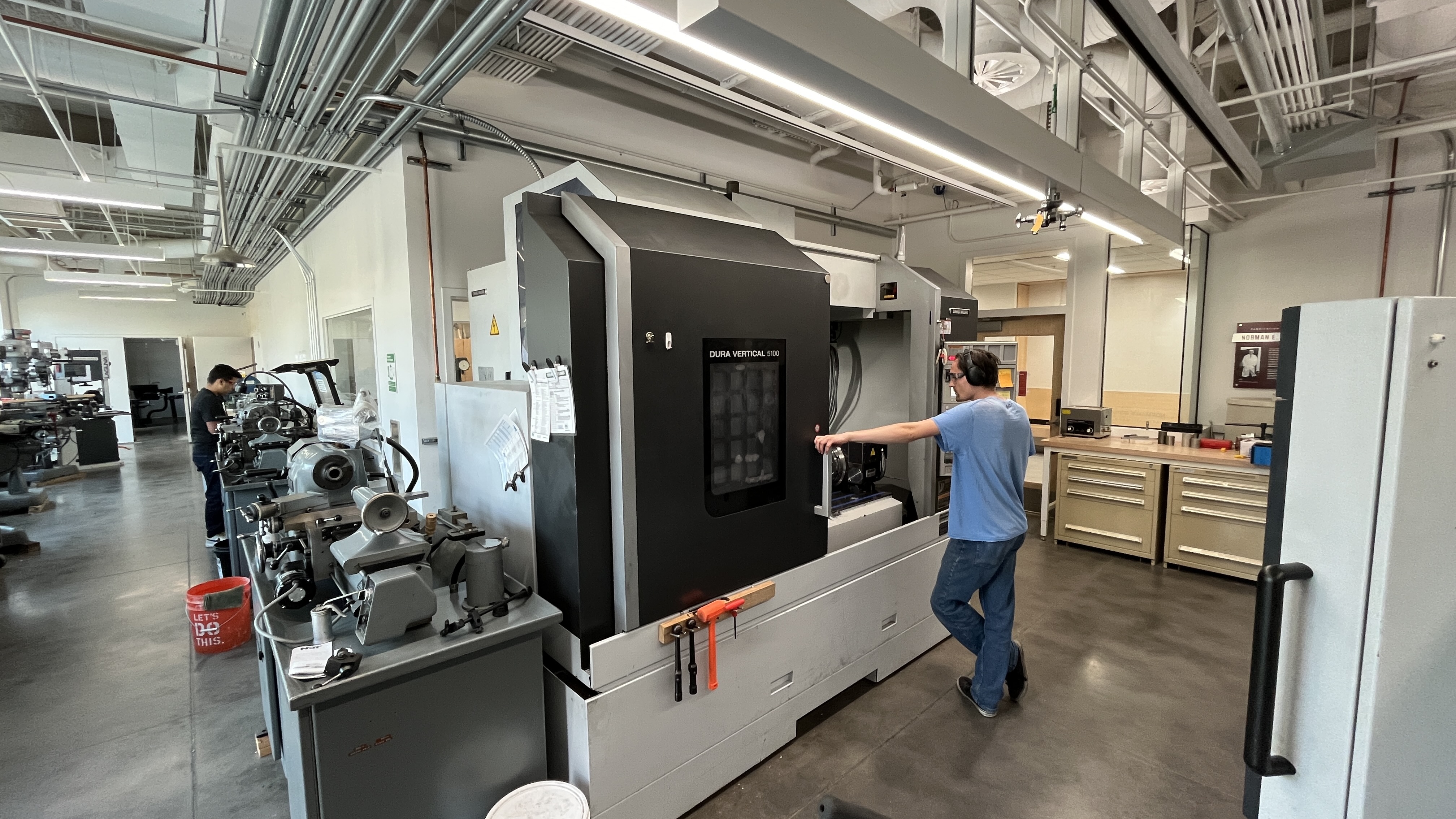
Most undergraduate-level engineering education about machining is run as if it were a crash course for would-be machinists. Typically run by ex-machinists who certainly have valuable insight, these courses can train students to design or make one or two parts with moderate success. However, they lack elements needed to prepare engineers to make engineering decisions — decisions about creating parts repeatably, reliably and profitably. In these situations, details and decisions about cutting tools, toolholding, workholding, machining strategies, automation, software, and even machine kinematics have an enormous influence on the overall success and profitability of a process. In order to help engineers make wise decisions about modern machining processes, this course is distinguished by three core ideas.
Technical Depth
First, engineering students need more technical depth. It is unfortunate how many engineers and machinists graduate without any understanding of carbide substrate quality, what phenomena actually drive chatter, when to consider PCD tooling, or even an awareness of the differences between ISO material groups. Therefore, the technical depth of this course goes beyond what most engineers (and many trained machinists) may know.
The course begins with the physics and thermodynamics of chip formation, helping students understand fundamental phenomena that constrain machining processes: temperature and force. Students will see where heat is generated as the chip is formed, how cutting forces are affected by machining strategy or chip formation, or what work-hardening actually is. These fundamentals will be used to talk about how macro- and micro-geometry affects cutting tool performance. Students also will learn to identify geometries suitable for certain materials or cutting conditions. The course will include a significant discussion of sintered carbide substrate manufacture, morphology and coating — helping students understand the reasons for choosing particular substrates and coatings for particular applications. Alternative cutting tool materials like PCD, cermets and ceramics also will be covered.
Once the cutting process and tool construction is understood, the course will move on to a broader understanding of machining processes themselves. Lectures on machine kinematics and vibration will help students understand sources of dimensional error and poor surface quality. One lecture will introduce milling toolholder technologies — both tool and spindle side — comparing their relative benefits and limitations. Specific machining strategies like trochoidal or high-feed machining will be covered, and another lecture will discuss considerations for hole making and reaming.
Pulling all this information together, several lectures cover considerations for successfully machining each ISO material group, composites and ceramics. From there, students will discuss workholding, zero-point clamping, palletization and automation — learning how and why these solutions can affect cycle time and improve dimensional repeatability.
In each case, the goal is to tie technical topics to machining economics, helping students understand how small decisions can have a big impact on the productivity of a machine tool. Since the time spent cutting material is often (or should be!) the most significant limitation for a machining process, all aspects of the process — from the design of the machine tool to the cutting fluid to the software — exist to support what happens at the cutting edge. As tool designer Viktor Astakhov is known for saying, “productivity is literally determined on the tool cutting edge.” (Astakhov, Viktor P. High-Productivity Drilling Tools: Design and Geometry. CRC Press, 2nd ed. 19-20. )
Hands-on Learning
But this course is not merely theoretical. It is profoundly hands-on, which is the second core idea that distinguishes it from typical machining education. To be fair, hands-on experience with machining is not unique among engineering curricula. But in many cases those experiences are only minimally applicable to what engineers actually do. A student who has only ever machined individual aluminum parts with low-cost tools on a low-cost machine using a vise is simply unprepared to make decisions in a high-volume role.
This course aims to make hands-on experience more relevant. Students won’t simply hear a lecture about PCD cutting tools, they’ll be running tests in a real machine to measure how PCD cutting tools can reduce cycle time and improve surface finish. After a lecture about substrate quality and cutting tool geometry, students will test multiple endmills to their breaking point to compare how substrate quality and geometry affect material removal rate and surface finish. After a lecture about vibration and harmonics, students will measure the frequency response functions of an identical tool in different toolholders, generating stability lobe diagrams for each one. By intentionally using a tool in stable and unstable conditions, students will learn why pushing tools harder and faster can sometimes make a cut more stable.
The course will also include several projects specially designed to give students relevant experiences. They will machine a titanium or nickel impeller designed by students in another course. The choice of material is intentionally difficult, and the purpose is to put students in a situation where they need to think carefully about their tool selection and approach. Another project will require students to design a multi-operation part, and then design a process (selecting workholding, designing fixtures, etc.) to make 10 of those parts repeatably. They will write work instructions for a different student to machine their 10 parts while they record data like cycle time and spindle uptime.
One project in particular deserves special mention. After discussing the details of cutting tool geometry, students will use professional endmill design software to design their own endmill for a specific cutting scenario. Since this course will have 12 students annually, the plan is to find 12 companies that would be willing to grind one of these custom endmills every year. The students then will test these endmills in a competition to see who has designed the best endmill for a specific scenario. The project is bold and full of logistical challenges; but it promises to be an amazing experience for students who are already interested in the machining industry. Imagine interviewing at a cutting tool manufacturer and being able to talk about your experience designing and testing your own endmill.
The final project is perhaps the most real-world of all. Students will find a company doing machining, anywhere in the country, and work with them to identify a problem, pain point or question. Maybe a company wants to reduce cycle time, avoid burrs on a drilled hole, improve surface finish, machine without coolant, or reduce chatter on a specific feature. Students will discuss the issue, work with tooling manufacturers, run tests using Utah Tech’s tooling and machines, and then write a report that explains the financial and technical benefits of actionable solutions. Students may suggest that companies purchase a specific tool, a new toolholder or workholding solution. This project gives students a realistic connection with actual machining processes, and it provides an opportunity for tooling and workholding manufacturers who partner with Utah Tech to put their products in front of real companies in a very personal way.
Review the print ads from this magazine to continue
This quick advertiser review unlocks the rest of the article and keeps the full-screen reader focused on the ads instead of the page chrome.
Advertisers included in this article experience
Print placements connected to this article
Mazak’s INTEGREX j-Series of
INTEGREX j-Series
THE PARTS MULTIPLIER Multi-Tasking machines performs turning, milling and drilling operations for the quick, accurate processing of simple and complex workpieces in fewer setups. Powered by the MAZATROL SmoothG CNC and known for its milling power and large tool magazine capacities, the INTEGREX j-Series delivers increased.
INTEGREX j-Series THE PARTS MULTIPLIER Mazak’s INTEGREX j-Series of Multi-Tasking machines performs turning, milling and drilling operations for the quick, accurate processing of simple and complex workpieces in fewer setups. Powered by the MAZATROL SmoothG CNC and known for its milling power and large tool magazine capacities, the INTEGREX j-Series delivers increased
Visit Mazak’s INTEGREX j-Series of View this placement in the issue recordPrint ads from this magazine
THE PARTS MULTIPLIER Multi-Tasking machines performs turning, milling and drilling operations for the quick, accurate processing of simple and complex workpieces in fewer setups. Powered by the MAZATROL SmoothG CNC and known for its milling power and large tool magazine capacities, the INTEGREX j-Series delivers increased.
INTEGREX j-Series THE PARTS MULTIPLIER Mazak’s INTEGREX j-Series of Multi-Tasking machines performs turning, milling and drilling operations for the quick, accurate processing of simple and complex workpieces in fewer setups. Powered by the MAZATROL SmoothG CNC and known for its milling power and large tool magazine capacities, the INTEGREX j-Series delivers increased
Continue reading
January/February 2025
Exposure to World-Class Tools
The third core idea behind this course stems from the first two. To get excited about the technical depth of the machining industry, and to get experiences that apply to real-world decisions, engineers ought to be exposed to world-class products. The software, cutting tools, toolholders and other equipment used in a course like this should be representative of the products used by high-precision, high-volume manufacturers around the world.
This third core idea requires some justification. In an educational setting, why insist on giving students access to expensive machine tools, software and tooling with capabilities beyond what they really need? The answer is simple: because this is what engineers need to know about modern machining processes.
Unfortunately, for the sake of simplicity and cost, educational institutions almost universally use inexpensive machines, running inexpensive endmills, held in low- or average-quality sidelock or ER-style toolholders. And they run tools conservatively to avoid breaking things. Logistically and financially, this is safe; but it cultivates a false mindset that expensive tooling or workholding is unnecessary, that details don’t matter, and that machining problems are solved by slowing down. Even worse, this approach can give the impression that machining itself is uninteresting or archaic.
At Utah Tech, students will use some sidelock and ER-style holders, but more often they will use a mix of high-quality collet chucks, milling chucks and hydraulic toolholders, some of which take advantage of Utah Tech’s dual-contact spindle with TSC. Likewise, the endmills and drills students will use are of diverse quality. When high-quality cutting tools and toolholders are paired with a very capable machine, students will be startled to learn how hard they can run the tools. The course also will encourage students to machine parts from a variety of materials that would ordinarily be considered problematic in an educational environment — 304 stainless is one of the most common materials in Utah Tech’s lab.
All of this variety serves a purpose. To be educated about machining processes, engineers don’t merely need to make parts. They need to think about how to make parts best. Engineers need experiences that help them navigate the complex choices they’ll face in a real job. To limit students to one specific type tooling or material would contradict this goal.
When students enter the workforce, why should they spend extra money on high-quality tooling, workholding, software or machine tools? Why use balanced toolholders? Why not just use the bare minimum? To answer these questions, they need to run production machines, use world-class tooling, cut materials that require careful planning, and program at the edge of a tool’s capability. Rather than aiming to be conservative, students must learn to maximize MRR by using tools the way they were designed to be used. Using world-class products will help students see why details about machining process really matter. After they graduate, it will give them the mindset and knowledge they need to thrive in the machining industry.
Industry Benefits
At a time when American manufacturing is experiencing a sort of resurgence, and when novel machining technologies are enabling innovation in other fields, the need for trained machinists is clear. But the need for deeper technical and practical expertise is often overlooked. Too many companies are unnecessarily held back by outdated notions that ultimately hurt their ability to compete. When they encounter a problem related to machining, an engineer or a machinist’s gut instinct might be to slow down. Some companies even claim not to have any problems with chatter simply because they never run their tools hard enough to find out! Others can’t justify using more expensive tooling because they’ve never seen how it can make a significant difference. Others buy machine tools purely based on capital cost, without considering how factors like dynamic stiffness, jerk or spindle rigidity might affect their cycle time. And many companies could benefit from some level of automation or palletization, but they simply don’t employ anyone who understands how to leverage these solutions wisely.
With technical knowledge to understand the root of a problem, and practical experience to make wise decisions about improving it, engineers who complete this course will have the mindset that this industry needs. When these students join the workforce and encounter a problem, they will be able to say, “I remember a time when the cutting tool geometry, the substrate, the machining parameters, the toolholder, the workholding or the machine tool made a huge difference in the success of a process. I was able to get amazing results when I used tools right. Let’s see what I can do.”
Course Challenges
Exposing students to modern machining practices sounds wonderful, but it is easier said than done. There are significant challenges, none more significant than budget. Giving students hands-on experiences with machine tools, tooling and raw materials is unavoidably costly. This point alone is perhaps one of the main reasons that machining education has fallen out of step with current trends. And this course, with its focus on world-class tooling and experience with difficult materials, will only amplify those costs. With such a prohibitive price tag, how can an engineering program hope to start a course like this?
Hopefully, with the machining industry’s help. Little by little, the manufacturing lab at Utah Tech has already been shaped by generosity. A few cutting tool, toolholder and workholding manufacturers have made donations or offered steep discounts that allow Utah Tech to use equipment that it could never afford otherwise. They do this because they see it as a win-win. They help Utah Tech do what it couldn’t do alone, and they put their products in the hands of potential future customers.
Even so, this new Modern Machining course requires further partnerships with interested companies. The needs are varied. Big or small, whether one-time gifts or annual support, used or new, Utah Tech needs tooling, raw materials, inspection equipment, access to software, discounts or even financial contributions from companies that want to see engineering education about machining changed.
Expertise also is needed. As the one teaching this course, I cannot be an expert in all things, and in order to make this course as relevant as possible, I want to work closely with industry professionals to develop lectures that are technically accurate and up to date. In fact, I want to start lectures by acknowledging the companies and individuals that helped develop them. For example, Lach Diamond will be featured in a lecture, and their tooling featured in a lab because a few of their folks spent several generous hours educating me about the history and use of PCD cutting tools. I also plan to take the students to a Sandvik Coromant facility in Utah that manufactures PCD cutting tools. For the students, the benefit goes beyond the classroom. I want them to graduate knowing real companies or real people that can help them when they encounter problems in a real job.
In the years to come, I want to improve the kind of equipment that we use to teach this course. Right now Utah Tech has two well-made machines — a mill and a lathe — both older DMG Mori models. They’re fantastic to start with, and frankly more machine than most engineering students ever see, but our capabilities are still limited. In the future, I want this course to include hands-on experiences related to micromachining, diamond turning, and 5-axis processes. I hope to acquire machine-tools that allow us to do that.
Goals
I have great hopes for this course. I want to see students become fascinated by the machining industry. I regularly speak with company representatives in the industry who describe a need for qualified engineering talent — not merely engineers who are technically capable, but engineers who are actually excited about their industry.
For too many decades, American engineering education has silently — mostly unknowingly — discouraged students from careers related to manufacturing. In some academic settings, manufacturing has a reputation as dirty, uninteresting work largely unfit for those with an advanced degree. This reputation is disconnected from both history and present reality. The humble factory has always been a massive engine of technical innovation, and I want this course to restore a sense of wonder, nobility and respect to careers in manufacturing. Specifically, I hope this course inspires students to pursue meaningful, lifelong careers in an industry that invisibly enables so many aspects of modern life and human flourishing.
If you are reading this magazine, I want these students to be excited about working at your company, helping you design better tools, run better processes, or build better machines. I want these students to pursue graduate degrees related to machining and then work at your company. Eventually, I want these students to be the ones making waves in this amazing industry.
This course represents the beginning of a larger movement to change the way that engineers are educated about machining processes. If students’ excitement about the course means anything, my hopes are high. Less than four minutes after midnight when Spring 2025 registration opened to Utah Tech students, the course and waitlist were both full.
Glossary terms in this article
Related


Subscribers can use MFGAxis notes, saves and discussion tools with their innoNET account.


