

Navigating The Artistry Of Aluminum Machining
Aluminum has numerous beneficial physical properties, among them being that it is three times lighter than iron while also having a higher strength ratio.
Aluminum has numerous beneficial physical properties, among them being that it is three times lighter than iron while also having a higher strength ratio. It’s also resistant to corrosion because of an aluminum-oxide layer on its exterior, and it offers good thermal conductivity and is relatively easy to machine.
Rick Crabtree, product solution manager for aluminum at Sandvik Coromant in Mebane, North Carolina, described those properties during a June 27 webinar titled “Navigating the Artistry of Aluminum Machining.” The webinar allowed Crabtree to address the rising demand for aluminum components, the corresponding challenges shops face when machining aluminum, and the cutting tools available to overcome those challenges.
Sandvik Coromant offers a range of cutting tools to effectively machine aluminum, including drills, milling tools and boring bars, according to Crabtree. For example, the M5R90 is a cartridge-based PCD cutter for roughing to semi-finishing in shoulder milling operations of automotive aluminum components, such as cylinder blocks, cylinder heads and transmission housings. The PCD tips are brazed in a steel cartridge, which allows axial adjustments. “We can run to 5 μm on axial runout, and radial runout we can achieve 50 μm.”
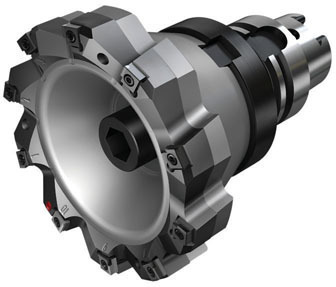
In addition, the PCD tips can be reground up to three times to prolong tool life, Crabtree said, emphasizing the need to rebalance a cutter after reconditioning the cartridge. “If they’re balanced, then we are less likely to hurt our machine spindle, and, in our instance, our balancing screws are in the side, and we can adjust those to create an even balance.”
Review the print ads from this magazine to continue
This quick advertiser review unlocks the rest of the article and keeps the full-screen reader focused on the ads instead of the page chrome.
Advertisers included in this article experience
Print placements connected to this article
through our digital edition,
GET OUR APP!
Stay informed and engaged! Access Cutting Tool Engineering magazine anytime, anywhere available on iOS and Android devices in their respective app iOS and Android Untitled-2 24 11/26/24 1:31 PM.
GET OUR APP! Stay informed and engaged! Access Cutting Tool Engineering magazine anytime, anywhere through our digital edition, available on iOS and Android devices in their respective app stores and at digital.ctemag.com. iOS and Android
Visit through our digital edition, View this placement in the issue recordPrint ads from this magazine
Stay informed and engaged! Access Cutting Tool Engineering magazine anytime, anywhere available on iOS and Android devices in their respective app iOS and Android Untitled-2 24 11/26/24 1:31 PM.
GET OUR APP! Stay informed and engaged! Access Cutting Tool Engineering magazine anytime, anywhere through our digital edition, available on iOS and Android devices in their respective app stores and at digital.ctemag.com. iOS and Android
Continue reading
December 2024
One of the drawbacks when milling aluminum with cutters in which all the cartridges are at the same height is that burrs are likely to form, he noted. To help combat burring issues, the toolmaker offers the M5B90 fixed-pocket milling cutter, which resembles a rotary broach more than a milling tool because it is designed with a unique axial and radial positioning of the inserts, the company reports. The unique design allows chips to be cut efficiently since the minimum stock removal from each insert results in burr-free milling, which is often unavoidable with conventional milling cutters.
“If we look at the projection, or the flatness,” Crabtree said, “they are all stepped down, so our wiper only cuts 30 μm of stock at the end. Every other insert is there for roughing to make the wiper last very long.”
For one-shot roughing and finishing of thin-wall aluminum parts, the M5F90 facemill is available, and provides a rotary broaching action like the M5B90 cutter, Crabtree noted. Each insert contains both a roughing edge on the OD and a finishing edge on the facing diameter. The roughing area works as a conventional cutter and all roughing edges are on the same diameter and height. The finishing area works as an M5B90 cutter and consists of radial and axial stepped cutting edges. This positioning ensures burr-free milling.
For drilling nonferrous metals, Crabtree suggested the CoroDrill 860-NM, “an optimized drill to do high-feed penetration rates in aluminum. It has a low helix angle to help with stability and chip control.”
Glossary terms in this article
Related



Subscribers can use MFGAxis notes, saves and discussion tools with their innoNET account.


