

Making Your Mark: Design & Engineering
For those who need to permanently mark products with designs, letters or numbers, the latest laser engraving machines offer significant improvements in process efficiency and marking quality. According to companies that make the machines, technological progress has improved both the process of laser marking and the results users can expect.
For those who need to permanently mark products with designs, letters or numbers, the latest laser engraving machines offer significant improvements in process efficiency and marking quality. According to companies that make the machines, technological progress has improved both the process of laser marking and the results users can expect. What’s more, manufacturers of laser marking systems point out that their systems have become more accessible to machine shops in some important ways despite the advanced features that have been added in recent years.
When it comes to accessibility, the cost of laser marking equipment has gone down “pretty dramatically” compared to what it was a decade ago, noted Rudy Lyobard, general manager at Technomark North America in Conroe, Texas, which sells laser marking systems. But it turns out that this development isn’t as much of a boon to buyers as one would think. While equipment costs have decreased, the expertise needed to implement and maintain these systems hasn’t, Lyobard explained, noting that shops still need “the staff, the engineers and the sales support … to do the work and make sure the laser is properly implemented [and] serviced. So the total solution cost is not going down dramatically.”
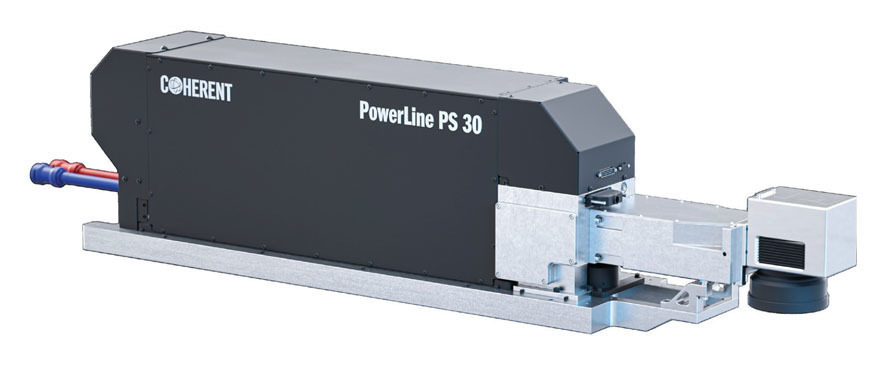
Better news for those in the market for new laser engraving equipment can be found on the software side. Software in advanced laser marking systems makes it easy for process developers to program their workflow, according to Roland Mayerhofer, product marketing manager at Coherent Munich in Gilching, Germany. Mayerhofer pointed out that the software in Coherent’s laser marking systems guides users through the programming process step by step and allows them to establish the sequence of events simply by arranging some icons.
Software Divide
Some manufacturers of laser marking equipment “don’t care too much about the software,” Lyobard noted. “As long as it works, it’s going to be okay.” These companies tend to opt for standard software from Chinese sources, he added.
On the other hand, “we are seeing that most of the leading companies are developing their own software,” he said. At Technomark, “we took the approach of rethinking the way the software was done.” This, he noted, led to a focus on user-friendly features that simplify the task of selecting values for speed, frequency and other settings that control a laser marking process in order to allow non-experts to operate the equipment.
As a result, he said, “the laser is so easy that even 30 minutes of offline training is enough for any operator to get the point and start selecting the marking they want.”
Combined with advanced hardware, the latest software also gives users the flexibility to easily change a key laser marking parameter. Mayerhofer points out that laser pulse widths can range from longer (measured in nanoseconds) to very short (measured in picoseconds or even femtoseconds). With fiber lasers, he noted, users can change the pulse width with a single click—allowing a quick transition, for example, from slower, higher-quality engraving to higher-volume, lower-quality marking that may require more post-processing.
When space is tight on the shop floor, the size of a laser system can be an important consideration for potential buyers. According to Lyobard, the portable lasers currently on the market come almost exclusively from China. Though small, he pointed out that these lasers are not designed for marking in high-volume production settings.
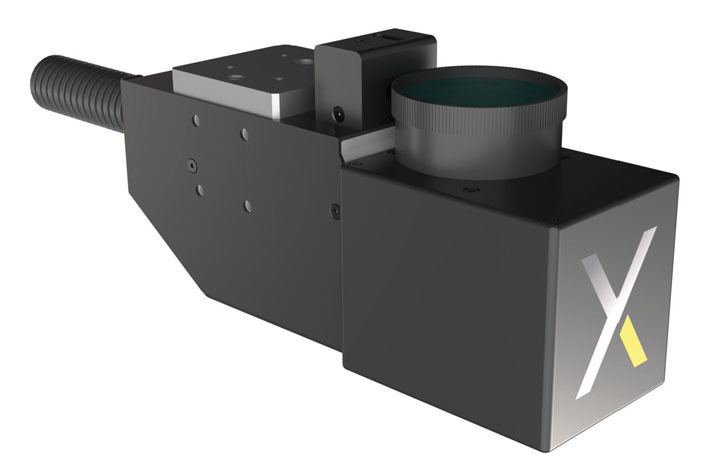
By contrast, Technomark’s new Graphix XS Inline laser is, as the name suggests, aimed at inline industrial applications, mainly in the automotive industry. Measuring 10″ x 2.9″ x 4.3″—about half the size of the company’s previous comparable product—the unit should be relatively easy to position along a production line, Lyobard noted. And once it’s in place, he added, users will find that compact system is up to the task of continuous, high-volume marking. “We are not talking about a laser which has limited capabilities because it’s smaller,” he said. “It’s a laser that is able to do whatever the other lasers are doing.”
Marking Milestones
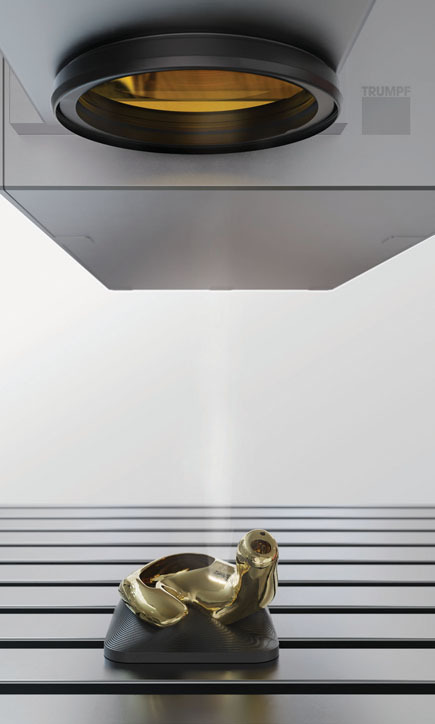
Lasers capable of marking a wide variety of materials are particularly prized in job shops. Many of these shops are now using fiber lasers featuring MOPA (master oscillator power amplifier) technology, which can handle most material applications and are especially good at removing material for deep engraving, said Clinton Coleman, TruMark product and project manager at Trumpf Inc.’s Laser Technology Center in Plymouth Township, Michigan. But in cases where shops only want a surface marking on highly reflective materials such as copper, aluminum and brass, Coleman noted that fiber lasers sometimes don’t provide consistent marking due to a combination of high surface reflectivity and the laser’s low pulse energy. Also problematic, he added, is the fact that fiber lasers can’t provide a dark contrast when marking highly reflective materials. So for these applications, he said, the systems of choice are new solid-state YAG lasers such as Trumpf’s TruMark 6030, which offers a combination of high average power (starting at 25 W) and high peak pulse power (40 kW). “This allows you to mark every metal, even reflective metals, and still get a nice dark contrast and a fast cycle time,” he said.
Another significant advancement in recent years has been the introduction of 3D laser marking technology. The TruMark 6030 and Trumpf’s TruMicro Mark 1020, another solid-state YAG laser, are equipped with this technology, as are laser markers made by other companies, noted Bill Holtkamp, manager of Trumpf’s technology center in Santa Clara, California. Typically, the curved surface of a round tool would be laser marked by putting the tool on a rotary axis and then creating the desired mark a little at a time as the tool is rotated on the axis, Holtkamp explained. With 3D marking, by contrast, users can mark 120 degrees around the curved tool surface without rotating the tool or moving the head of the laser.
Review the print ads from this magazine to continue
This quick advertiser review unlocks the rest of the article and keeps the full-screen reader focused on the ads instead of the page chrome.
Advertisers included in this article experience
Print placements connected to this article
Nissei Industry
Nissei Introduces Double-Disc Grinder to the U.S. Market
Nissei highlights the VP3-400RW vertical double-disc grinding machine for the U.S. market.
NISSEI INDUSTRY Nissei Introduces Double-Disc Grinder to the U.S. Market Nissei VP3- 400RW vertical double-disc grinding machine.png 30 JANUARY 2025
Visit Nissei Industry View this placement in the issue recordPrint ads from this magazine
Nissei highlights the VP3-400RW vertical double-disc grinding machine for the U.S. market.
NISSEI INDUSTRY Nissei Introduces Double-Disc Grinder to the U.S. Market Nissei VP3- 400RW vertical double-disc grinding machine.png 30 JANUARY 2025
Continue reading
January 2025
“This opens things up for larger fixtures that can accommodate more parts,” Holtkamp noted. “So you’re reducing labor costs by marking a whole tray of parts instead of putting each one in a rotary axis.”
One key to 3D laser marking is the use of a 3D scan head with an added galvanometer for the Z axis as well as galvos for the X and Y axes. “3D galvos have been around, but only in the past two or three years have they really been pushed into laser marking applications,” Holtkamp said. “The cost has come down enough, and the software has advanced enough.”
Coleman explained that the development of 3D software has simplified the task of marking curved and slanted surfaces. “Traditionally, with 2D software, you would have to try to program a 3D part in 2D CAD, which is very difficult,” he said. “Now with 3D software and 3D scan heads, you’re able to import a 3D model and it automatically compensates for the curvature of the part as well as the slope.”
Vision Added
For improved accuracy, many buyers of advanced laser marking equipment are opting to add some sort of machine vision system that helps the operator or the machine itself locate parts and precisely create the desired mark. “That’s almost the standard nowadays,” Mayerhofer said. “It involves adding hardware and software and, therefore, it drives up the cost of a system. On the other hand, it’s very helpful in avoiding scrap, so it will pay back quite fast.”
In addition, Mayerhofer pointed out that vision systems can eliminate the need for expensive fixturing that is sometimes required for precise marking. Instead, much simpler and less costly options may suffice, such as a checkerboard or tray into which parts can be loosely loaded for marking. “You only have to know where the parts are within a certain range,” he said. “The vision system will (determine) the precise location.”
According to Lyobard, vision equipment in a laser marking system can take two forms. A marking workstation run by an operator will have an embedded camera that helps the operator locate parts and mark them in the right place. For an inline laser, on the other hand, no camera is necessary because the marking process is automatic. Instead, a 2D reader is embedded in the machine. If the mark is a 2D code, the reader will check to see if the code is readable and accurate. “This is a brand-new capability for us,” Lyobard said, adding that a 2D reader is one of the options offered for Technomark’s new XS Inline.
Notable Trends
Laser marking can also benefit greatly from two trends that are top-of-mind today among many in industry. One of these is the move toward automation. In traditional laser marking, “the operator normally stands there doing one tool at a time, which can be quite a mundane process,” said Darren Fox, product manager at ANCA CNC Machines in Bayswater North, Australia. “So we’ve removed the manual handling side of laser marking.” As it does in many other industrial processes, Fox points out that automating laser marking operations frees up operators for more valuable tasks and eliminates human errors.
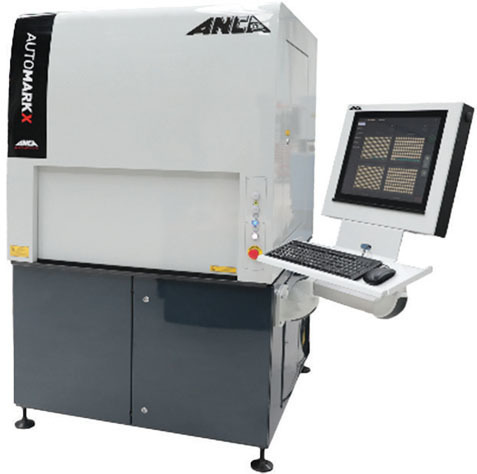
ANCA’s automated laser marking machine, called the AutoMarkX, features a six-axis Fanuc robot that moves cutting tools between a pallet and the system’s laser. Once users create their marking program and set up a job sequence, the robot automatically picks up the tools one by one and presents them to the laser for marking. (With an optional rotary workholding station, the system can mark around a tool circumference as well.) After a tool is marked, the robot puts it back in the pallet. When all tools in the pallet are marked, the machine opens and an operator removes the pallet of marked tools and puts in a pallet of unmarked ones to start the process again.
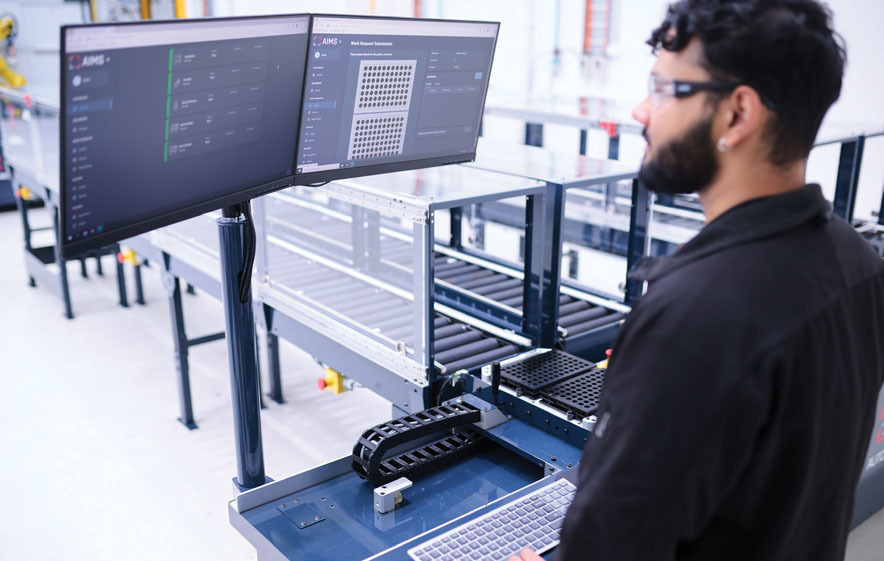
In addition to functioning as a standalone marking machine, the AutoMarkX can be a part of a process that connects and automates all steps in the production of cutting tools. Called the ANCA Integrated Manufacturing System, or AIMS, the process can include grinding machines and laser markers, as well as additional stations for activities such as measurement and washing.
“The beauty of AIMS is that it’s configurable,” Fox said. “You can start small and continually build by introducing new stations.” Once the user has produced a program and set up the necessary stations, AIMS can carry out the program in a lights-out environment, with an autonomous mobile robot moving workpieces from one station to another.
In addition to automation, laser marking seems destined to be positively impacted by the technology obsession of the moment, artificial intelligence. According to Fox, ANCA is using a form of AI in some of its other machines, but not currently in laser marking. He sees that changing over the next year or so, however, as AI is slowly introduced into ANCA’s laser marking process. Eventually, he said, “I see it being able to help generate and set up programs, to check the quality of the marking, and to adjust settings—power, frequency, pulse rates—to increase the overall efficiency of the process and make the finished product a much better product for the end user.”
Glossary terms in this article
Related



Subscribers can use MFGAxis notes, saves and discussion tools with their innoNET account.


