Gripping advice: Turning Performance
By Michael Larson
By Michael Larson
Continuing advances in materials, geometries, coatings, and toolholding capabilities have resulted in vastly improved cutting performance and tool life, albeit along with adding significantly to manufacturers’ expenditures on tooling. What is less generally discussed is the other side of the equation: namely, that in order to achieve optimization in performance, tool life and return on investment, high-precision workholding systems are indispensable. At Hainbuch America Corp. in Germantown, Wisconsin, a comprehensive line of products is engineered to address highly specific turning requirements for both ID and OD machining. And the company urges shops to keep the following considerations in mind because of their impact on the most effective tooling equation.
Performance over extended life
Whether the tool is designed for high metal removal rates or surface finish in the micron range, the rigidity of the workpiece and repeatability over the parts run are essential. Standard chucks supplied with new turning centers frequently lack the strength and capability to prevent the misalignment that results in chatter, which in turn causes out-of-tolerance parts and excessive tool wear. This is especially true in complex operations such as ID turning and threading. As more manufacturers have incorporated the use of high-value specialized tooling, the need for stability and repeatability becomes a major economic factor.
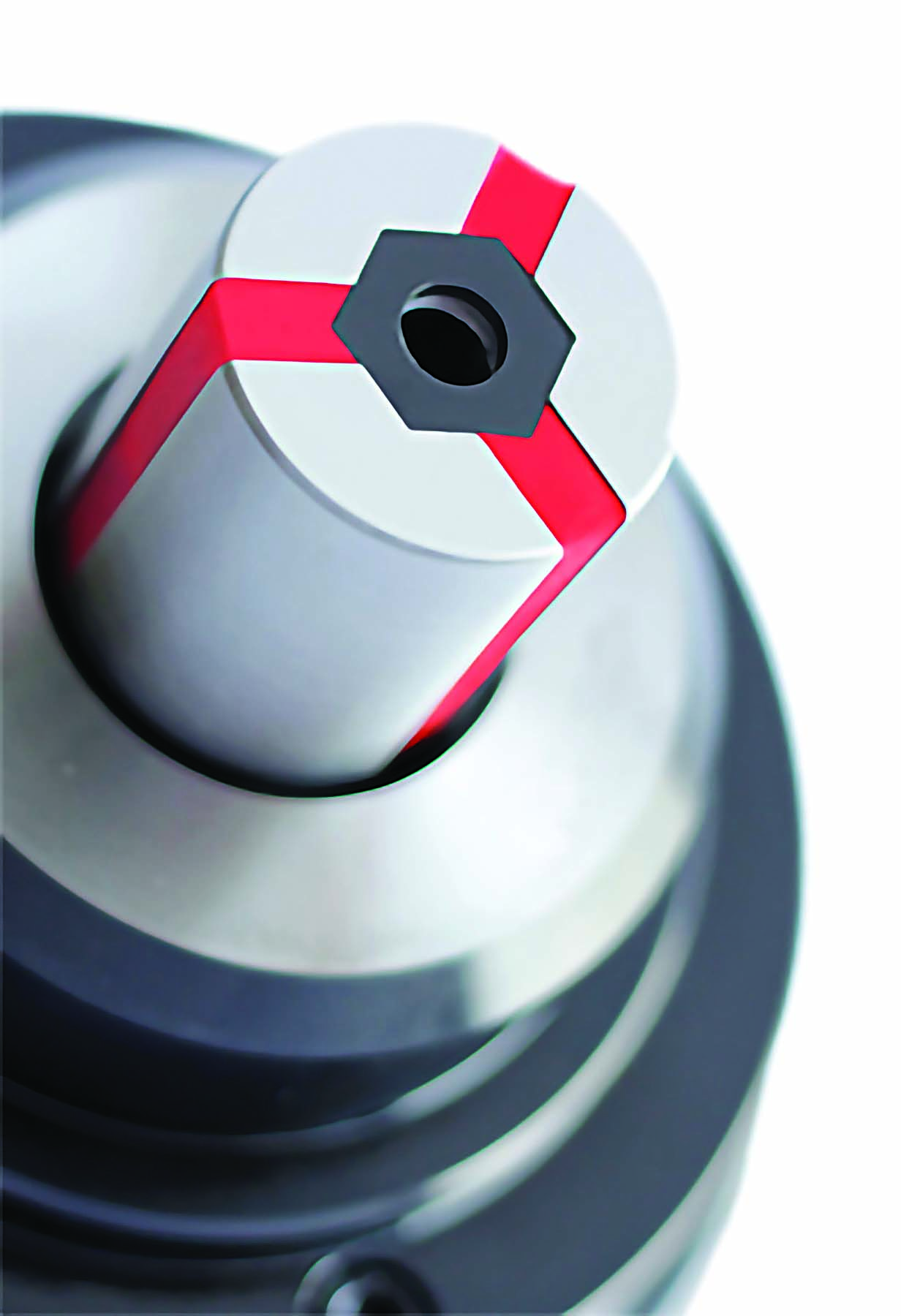
Image courtesy of Hainbuch America
Precision
As parts have become more complex, and materials harder to machine, precision and repeatability are indispensable, both to part quality and to the need for higher speeds and feeds over the production run. When used for higher production of multiple parts, standard chucks tend to age fast, and the effects of wear may not become apparent until problems surface. An increasing number of shops and manufacturers who have experienced the problems associated with wear on older legacy machines have realized substantial savings by adding high-precision workholding equipment in place of the older traditional chucks. In some cases, new equipment has resulted in “better than new” repeatability and increased tooling performance, while negating the need for new machine purchases.
Quick-change capability and flexibility
The need to transfer a part from one machine to another or, in the case of multi-spindle machines, from one workstation to another can frequently result in misalignment. Further, successfully transferring parts requires expertise and experience on the part of the machine operator. Look for workholding systems designed for fast and foolproof change-over, whether changing from different parts in the same spindle or moving the workpiece for a secondary operation. Changes can be accomplished in a matter of seconds with maximum repeatability and require no special operator training. An example of this is Hainbuch’s new MAXXOS hexagonal mandrel that maximizes transmission forces, results in less tool wear, and delivers up to 57% higher rigidity with a possible achievable runout of ±2 µm.
The centroteX S AC interface is designed for automated change-over of chucks and mandrels. Image courtesy of Hainbuch America” data-entity-type=”file” data-entity-uuid=”99eb4a0b-a02f-4273-9278-6040ad1ede37″ height=”456″ src=”/wp-content/uploads/legacy/inline-images/centroteX%20AC%20%28automated%20change%29_1.jpg” width=”324″ />
Automation
From turning multiple parts from barstock to a full-scale lights-out installation, the success of any degree of automation depends on the ability to deliver targeted production goals while meeting stringent quality standards. When it comes to rotational parts, this can only be achieved with application-specific tooling and stable, high-precision workholding. The singular demands of automated production have resulted in Hainbuch’s development of products geared to system requirements. For instance, the company’s AC (Automated Change) line allows automatic change-over of clamping heads and workpiece end stops to enable the setup and manufacturing of workpieces with different clamping diameters, profiles and lengths. The centroteX S AC interface is designed for automated change-over of chucks and mandrels, and the new TOPlus IQ chuck delivers real-time measurements of workpiece diameter, temperature, rpm, clamping force and workpiece contact to maximize tooling and machining effectiveness.
Size ranges
Historically, many high-precision operations were performed on smaller parts. As complexity in every size workpiece has grown, Hainbuch has extended the size range of our line to ensure that the tooling/workholding application is available over virtually all common parts sizes.
Over the years, in many manufacturing applications, the capability of tooling has evolved, while conventional workholding has remained largely static. The increased demands for tolerances, finish and production efficiency have resulted in an increasing appreciation for, and adoption of, superior workholding methods. At Hainbuch, our engineers are continually in contact with our customers working to ensure that the best and latest tooling can achieve its full potential.
about the author: Michael Larson, marketing director at Hainbuch America, can be reached at mlarson@hainbuchamerica.com.