

Calculating CNC automation ROI
Here are nine key factor to help determine the financial viability of automation.
Calculating the return on investment for CNC automation involves various factors. Here are nine key ones that can affect calculations:
1. Initial investment. The upfront investment required for implementing CNC automation is a crucial factor in ROI calculations. This includes the cost of equipment, software, installation and staffing. For a deeper look at The truth about robotic ROI, see this supporting resource.
2. Operational costs. Assessing the ongoing operational costs associated with automation is essential for ROI calculations. These costs include maintenance, repairs, energy consumption, software licensing and any necessary training or support.
3. Labor cost savings. One significant advantage of CNC automation is the reduction of labor costs. By automating the repetitive tasks of picking and placing parts, the need for human labor can be reduced or redirected to higher-value roles.
4. Increased production capacity. CNC automation can substantially increase production capacity by enabling continuous operation, allowing off-shift (lights-out) production, reducing cycle times and minimizing CNC downtime.
5. Improved product quality and reduced scrap. CNC automation often results in improved product quality due to precise control, consistency and reduced error rates. This reduction in waste can lead to cost savings for raw materials and disposal expenses. Higher-quality products may increase customer satisfaction, cause fewer returns or recalls and enhance brand reputation.
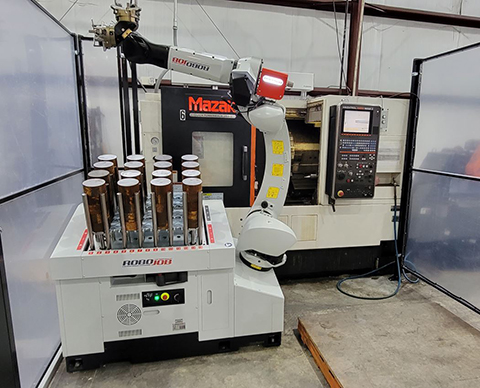
Automated systems can operate at higher speeds, perform tasks simultaneously and optimize resource utilization. Image courtesy of C. Zoberis
Review the print ads from this magazine to continue
This quick advertiser review unlocks the rest of the article and keeps the full-screen reader focused on the ads instead of the page chrome.
Advertisers included in this article experience
Print placements connected to this article
Platinumtooling
THE NAME TO KNOW FOR...
LIVE TOOLS / ANGLE HEADS / SPEED MULTIPLIERS SWISS COMPONENTS / MARKING TOOLS / KNURLING TOOLS Platinum Tooling is the exclusive North American importer of Heimatec Live Tools and Angle Heads, Tecnicrafts Swiss Collets and Guide Bushings, Henninger Spindle Speeders, AMF Cleaners and Markers and Quick Knurling and Marking Tools
THE NAME TO KNOW FOR... LIVE TOOLS / ANGLE HEADS / SPEED MULTIPLIERS SWISS COMPONENTS / MARKING TOOLS / KNURLING TOOLS Platinum Tooling is the exclusive North American importer of Heimatec Live Tools and Angle Heads, Tecnicrafts Swiss Collets and Guide Bushings, Henninger Spindle Speeders, AMF Cleaners and Markers and Quick Knurling and Marking Tools. Platinum Tooling offers a wide selection of machine tool accessories for most machine brands, including standard and custom tools to help with the most challenging applications. If you need live tooling, we’re here to help. 16 E. Piper Lane, Ste.128 | Prospect Heights, IL | 847-749-0633
Visit Platinumtooling View this placement in the issue recordPrint ads from this magazine
LIVE TOOLS / ANGLE HEADS / SPEED MULTIPLIERS SWISS COMPONENTS / MARKING TOOLS / KNURLING TOOLS Platinum Tooling is the exclusive North American importer of Heimatec Live Tools and Angle Heads, Tecnicrafts Swiss Collets and Guide Bushings, Henninger Spindle Speeders, AMF Cleaners and Markers and Quick Knurling and Marking Tools
THE NAME TO KNOW FOR... LIVE TOOLS / ANGLE HEADS / SPEED MULTIPLIERS SWISS COMPONENTS / MARKING TOOLS / KNURLING TOOLS Platinum Tooling is the exclusive North American importer of Heimatec Live Tools and Angle Heads, Tecnicrafts Swiss Collets and Guide Bushings, Henninger Spindle Speeders, AMF Cleaners and Markers and Quick Knurling and Marking Tools. Platinum Tooling offers a wide selection of machine tool accessories for most machine brands, including standard and custom tools to help with the most challenging applications. If you need live tooling, we’re here to help. 16 E. Piper Lane, Ste.128 | Prospect Heights, IL | 847-749-0633
Continue reading
August 2023
6. Increased efficiency and throughput. Automated systems can operate at higher speeds, perform tasks simultaneously and optimize resource utilization. This increased efficiency might result in higher throughput and reduced production time, leading to cost savings and revenue gains.
7. Flexibility and ease of use. The ability of a CNC automation system to adapt quickly and easily to changing batch sizes impacts the ROI calculation. If your CNC production is in a high-mix, low-volume environment, an automation solution that offers flexibility and ease of use will provide a higher ROI by accommodating evolving demands without requiring significant setup for the next job.
8. Technology life span and obsolescence. Assess the expected life span of the automation technology and the risk of obsolescence. Technology develops fast, and investing in outdated or rapidly depreciating systems may affect ROI. Consider the future compatibility, upgrade options and potential for integrating emerging technologies to ensure a favorable ROI over the life cycle of the system.
9. Risk assessment. Evaluate the risks associated with CNC automation implementation and their potential impact on ROI. Risks could include technical challenges, operational disruptions during implementation, integration issues or workforce resistance. Mitigating risks and factoring in their potential costs will provide a more accurate ROI calculation.
Consider these factors in your ROI calculations. This exercise will help you make informed decisions regarding CNC automation and assess the financial viability of the investment.
An ROI robotic system value calculator at the website of the Association for Advancing Automation is a tool that sums up some of the information discussed here. That calculator is at www.automate.org/a3-content/robotics-roi-calculator.
Related

 MFGAxis Discussion
Be part of the shop-floor conversation
Like, save, or comment on this CTE story.
MFGAxis Discussion
Be part of the shop-floor conversation
Like, save, or comment on this CTE story.


MFGAxis Discussion