High-speed holemaking: Drilling Performance
Although high-speed machining and holemaking initially were employed largely by defense and aerospace manufacturers working with nonferrous materials, increasing demand for higher production and the use of new alloys and harder metals have resulted in vastly improved high-speed holemaking tools.
Although high-speed machining and holemaking initially were employed largely by defense and aerospace manufacturers working with nonferrous materials, increasing demand for higher production and the use of new alloys and harder metals have resulted in vastly improved high-speed holemaking tools.
The Need for Speed
The definition of high-speed holemaking varies widely depending on the material, the tool, the application and other considerations.
For general purposes, Steve Pilger, North American product manager for holemaking at YG-1 Tool (USA) Co. in Vernon Hills, Illinois, defines high-speed holemaking as “having a minimum of 5,000 rpm spindle speed based on popular diameters of carbide drills.”
Martin Hobbs, drilling product specialist at Sandvik Coromant Co. in Mebane, North Carolina, measures high-speed holemaking in terms of cubic inches or millimeters of material removed per minute.
“In terms of spindle speed,” said Bill Ruegsegger III, product manager at Allied Machine & Engineering Corp. in Dover, Ohio, “I would place the threshold at 20,000 rpm. Another way to express it would be three to 10 times faster than conventional drilling.”
Among the primary considerations for successful holemaking are the characteristics of the machine and the fixturing.
“Stability is paramount,” Hobbs said. “Both the fixture and the machine, as well as the toolholding method, have to be capable of resisting the feed forces.”
Ruegsegger agrees.
“High speeds require higher horsepower and the ability to generate torque at higher rpm,” he said. “Reserve power is also necessary in that a machine operating at 100% will wear out more quickly.”
Pilger said requirements go far beyond speed.
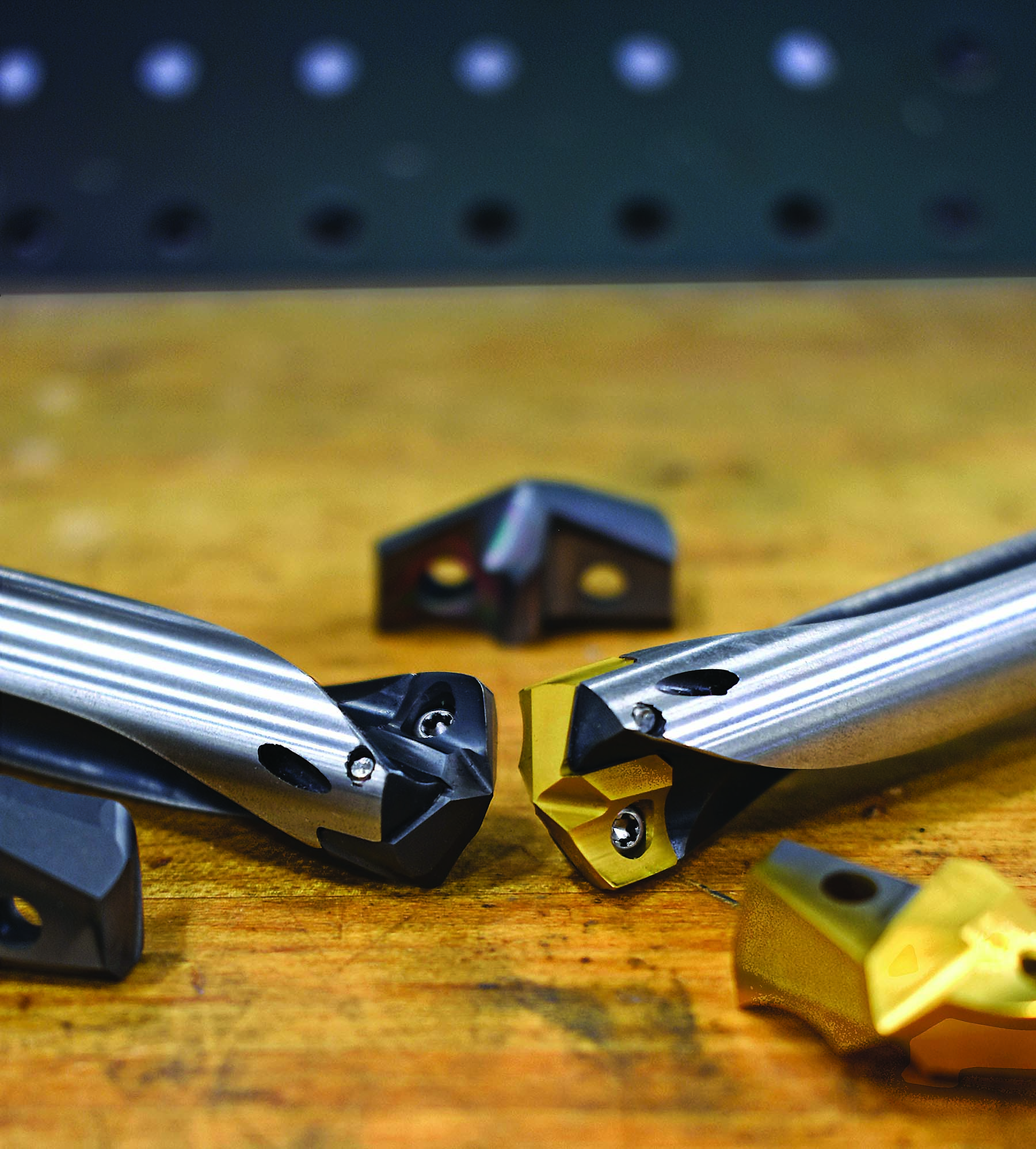
The material-specific GEN3SYS XT Pro insert combines a substrate coating and geometry designed to achieve optimal results in different ISO material classes. Image courtesy of Allied Machine & Engineering
“Machine capability, coolant considerations, including pressure and volume, and the need for precision-ground spindles all come into play” he said. “It’s also essential to know the machine spindle runout.”
Rigid fixturing is likewise necessary to prevent vibration and chatter. This is true even in five-axis applications.
“Early five-axis machines can have ‘give’ in the tables,” Ruegsegger said, “but this has been largely remedied. Still, the fixturing must be adequate to the application.”
Pilger said the material affects both the tooling and programming of a machine.
“In aluminum applications,” he said, “it’s possible to drill at speeds of up to 650 sfm. When it comes to materials like Inconel, titanium or special alloys, the speed has to be substantially reduced — sometimes to 70 to 100 sfm. Drilling some types of high-temperature alloys too fast will literally result in enough heat to workharden the part. On the other hand, running carbide drills too slow in many types of steels can result in a built-up edge and destroy the coating.”
Hobbs said successful drilling of heat-resistant alloys calls for the correct speed and higher feed forces.
“In the automotive industry,” he said, “ISO P (steels), ISO K (cast and ductile irons) and ISO N (aluminum) are used extensively. These materials can range from short-chipping to long-chipping materials with a variety of compositions that require a vast range of cutting edges and coatings. This makes indexable drilling solutions very popular.”
Other Challenges
New alloys and increasingly complex part requirements, especially involving deep-hole drilling, have resulted in demand for new tooling materials and techniques.
“Carbide substrates have been vastly improved, and coated carbide with post-coat treatment is the tooling of choice for deep-hole drilling in the 1 mm (0.04″) to 20 mm (0.79″) range,” Pilger said. “Beyond these diameters, we typically go to other tool designs, including modular replaceable tip, indexable insert drills and spade drills. For larger-diameter holes, a steel-bodied holder with a carbide tip is effective because the steel body is not brittle and inclined to break.”
Ruegsegger said in the past, deep-hole drilling always was done with solid carbide.
“Today,” he said, “inserts are increasingly favored because, thanks to improved coatings and geometries, they perform extremely well in hard or abrasive materials.”
Hobbs cites advances in multipurpose tooling.
“Tools that can perform more than a single function,” he said, “such as creating the pilot hole while then drilling to spec, chamfering and counterboring, not only save tool-change times but deliver greater accuracy because multiple operations can be performed in the same cycle.”
Successful holemaking depends highly on matching the drill to the correct toolholder. For routine operations, a collet holder is sufficient, but deep-hole drilling demands both increased strength and vibration dampening.
“We’ve seen a good deal of progress in conventional holders,” Hobbs said. “For instance, our ISO 9766 holder reduces the runout that you would find in a traditional Weldon holder. When it comes to deep-hole drilling, the choice would fall between shrink fit and a hydraulic chuck. The hydraulic chuck is the better choice over the long term because it is more economical and safer since it does not require high temperatures to connect the tools to the holders.”
Pilger recommends a hydraulic chuck with a sleeve for solid-carbide drills over eight times diameter.
“The hydraulic reduces runout to within 2.5 microns,” he said, “and the hydraulic fluid also acts as a vibration dampener. We’ve also found that tool life improves up to 25%.”
Few areas affecting tooling have advanced as fast as coatings.
Review the print ads from this magazine to continue
This quick advertiser review unlocks the rest of the article and keeps the full-screen reader focused on the ads instead of the page chrome.
Advertisers included in this article experience
Print placements connected to this article
Nskamericacorp
EXPERIENCE SPEED
Nakanishi Electric Spindles 80,000 RPM 30,000 RPM Electric Fully Tool-Changeale Coolant-Through Spindle Electric Spindle for CNC Mills 80,000 RPM Compact Electric Motor Spindle for Swiss CNC Machines NORTH BUILDING - BOOTH 237311.
EXPERIENCE SPEED Nakanishi Electric Spindles 80,000 RPM 30,000 RPM Electric Fully Tool-Changeale Coolant-Through Spindle Electric Spindle for CNC Mills 80,000 RPM Compact Electric Motor Spindle for Swiss CNC Machines NORTH BUILDING - BOOTH 237311 www.NSKAmericaCorp.com | Phone: (847) 843-7664 | Toll Free: (800) 585-4675
Visit Nskamericacorp View this placement in the issue recordPrint ads from this magazine
Nakanishi Electric Spindles 80,000 RPM 30,000 RPM Electric Fully Tool-Changeale Coolant-Through Spindle Electric Spindle for CNC Mills 80,000 RPM Compact Electric Motor Spindle for Swiss CNC Machines NORTH BUILDING - BOOTH 237311.
EXPERIENCE SPEED Nakanishi Electric Spindles 80,000 RPM 30,000 RPM Electric Fully Tool-Changeale Coolant-Through Spindle Electric Spindle for CNC Mills 80,000 RPM Compact Electric Motor Spindle for Swiss CNC Machines NORTH BUILDING - BOOTH 237311 www.NSKAmericaCorp.com | Phone: (847) 843-7664 | Toll Free: (800) 585-4675
Continue reading
September 2022
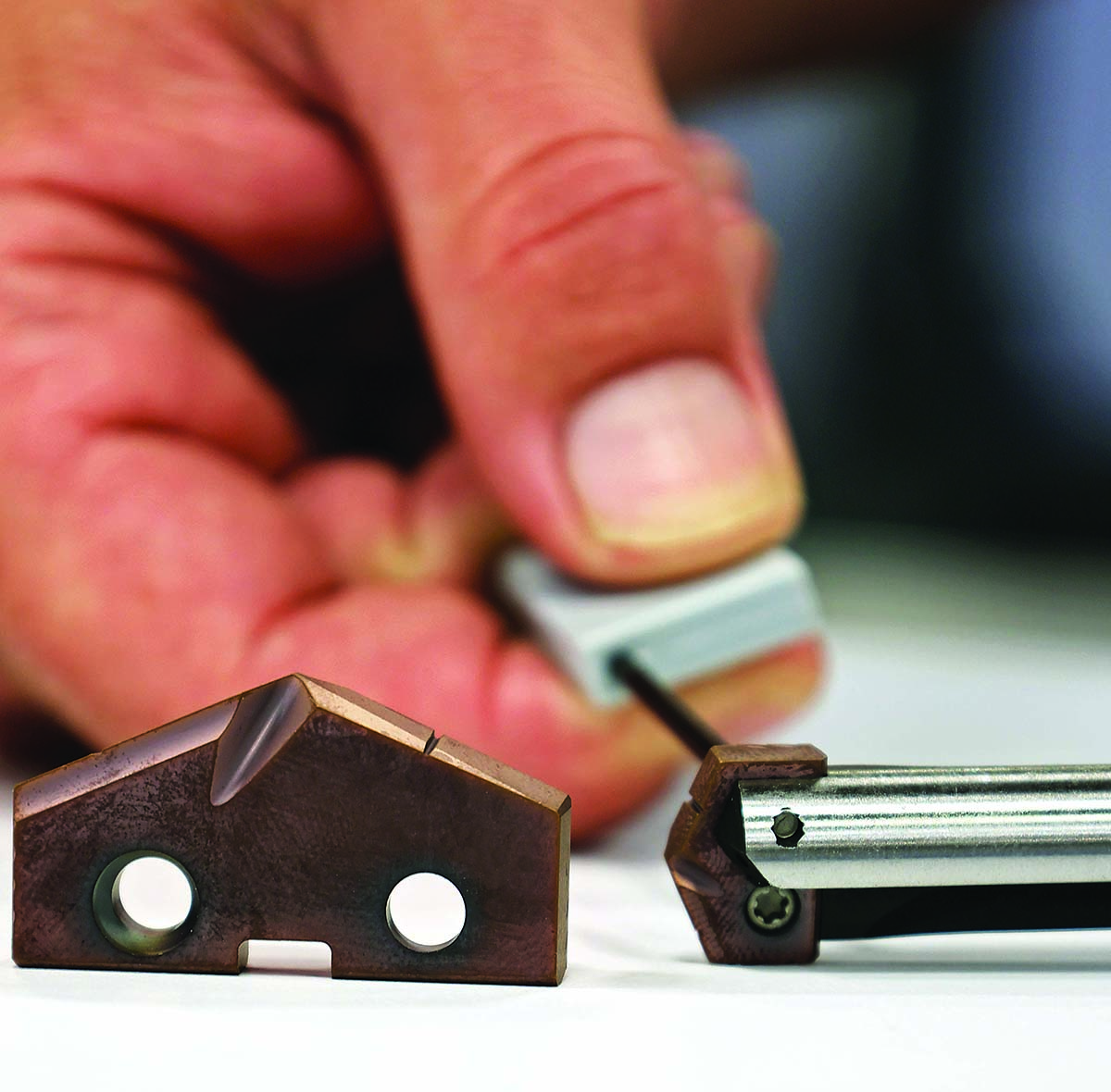
The T-A Pro stainless steel (M) geometry insert with AM460 coating is optimized for improved chip formation in stainless steels and heat-resistant superalloys. Image courtesy of Allied Machine & Engineering
“Typically formulated for wear and heat resistance, coatings must take into account both the substrate on which they are deposited, as well as the workpiece material,” Hobbs said. “When first developed, coating typically consisted of a single material, such as TiN or TiAlN, but now better results can be obtained by combining several coatings. Thanks to nanotechnology, we are able to apply coatings that are designed to be compressed together in ways not previously achieved. When two or more of these are compressed together, it’s possible to obtain the highly efficient result that is specific not just to the application but also for the user attempting to understand the wear
mechanism that affects insert performance and tool life.”
Pilger observes that the technology has gone beyond coating to post-coating operations.
“Microscopically,” he said, “many coatings typically put peaks and valleys in the flutes. By polishing drill flutes after coating, we can reduce friction and heat, extending tool life by 10% to 20%.”
Coolant pressure and application are further considerations in reducing heat, increasing lubricity and facilitating chip removal in high-production drilling.
“A key element in coolant is the flow rate,” Hobbs said. “The correct flow rate does a much better job of chip evacuation than high-pressure coolant. Flooding is all right for shorter holes, but high pressure can restrict the flow rate and reduce flow and chip evacuation. With regard to coolant composition, we recommend a higher-viscosity oil-based compound for high-speed applications. It not only acts as coolant but improves lubricity. Water-soluble and synthetic or semisynthetic coolants can create friction, resulting in poor hole quality.”
Pilger said coolant always is recommended for improving carbide holemaking tool life, but coolant through the spindle is absolutely the best practice when drilling with carbide.
“Through-the-spindle coolant delivers coolant directly to working cutting edges, as well as ‘flushing’ enhancing chip evacuation,” he said. “Although both oil- and water-based coolants will work in general applications, selecting the right coolant is most important in finishing operations, such as reaming, where we recommend an oil base. Under normal conditions, applications involving holemaking in three times the diameter can be effectively accomplished with flood coolant. But depending on the material being drilled, operations at five times the diameter or greater demand coolant through the spindle.”
Ruegsegger said through-spindle coolant invariably is preferred, generally at 450 to 800 psi.
“The latest advance in coolant involves minimum quantity lubrication,” he said, “which is becoming increasingly popular. Simply stated, MQL delivers a precise amount of aerosol coolant that is directed by the machine program in line with the cutting operation. MQL not only reduces coolant cost but is a cleaner and safer process.”
Many advances in new materials for drilling have brought about new challenges, some of which are caused by “not putting all the pieces together,” Hobbs said.
This often results from misapplication of the tool caused by factors being overlooked in the programming or selection process.
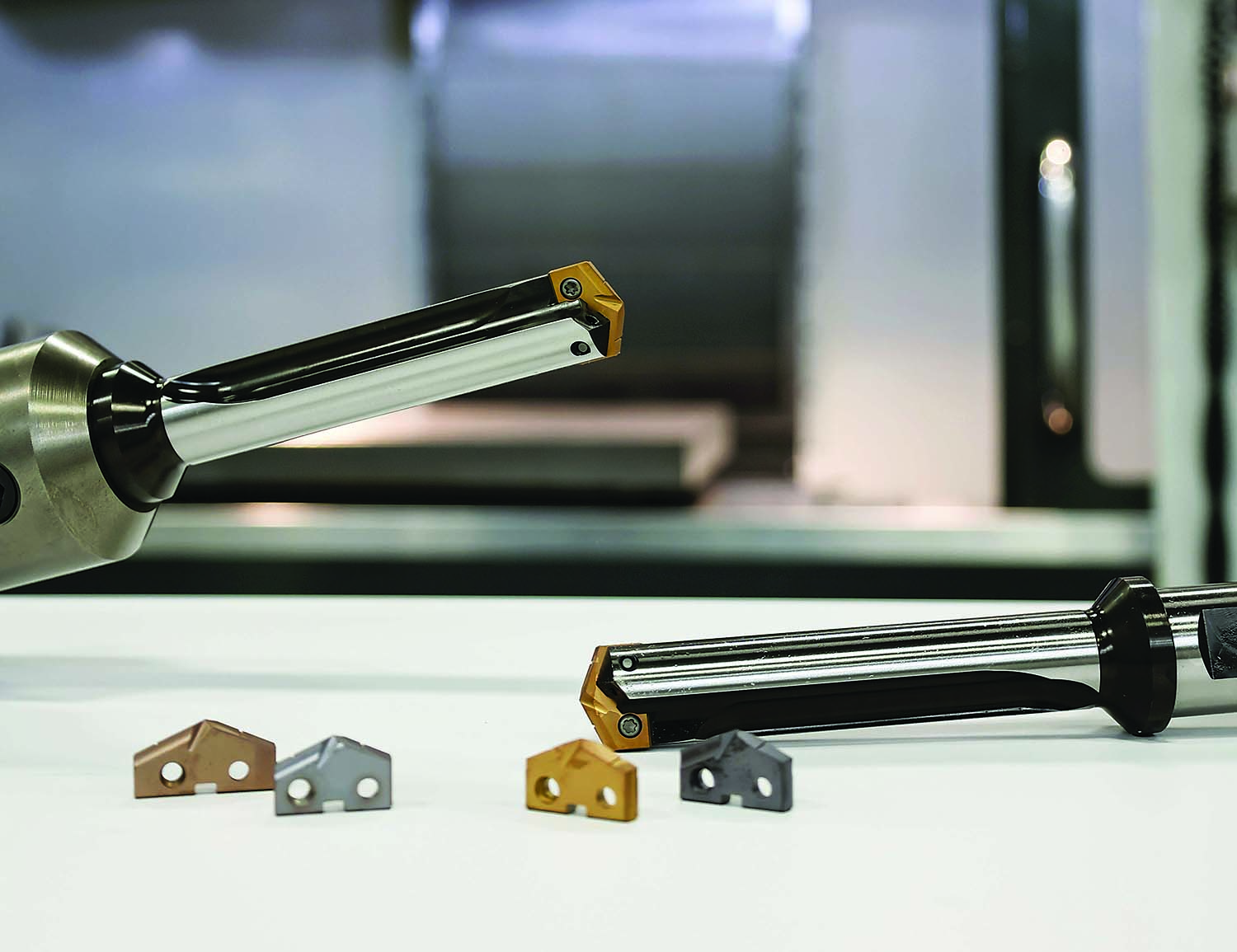
The PCD tip on the T-A PCD drill insert is designed specifically for carbon-reinforced polymer material.Image courtesy of Allied Machine & Engineering
“The latest advance in coolant involves minimum quantity lubrication,” he said, “which is becoming increasingly popular. Simply stated, MQL delivers a precise amount of aerosol coolant that is directed by the machine program in line with the cutting operation. MQL not only reduces coolant cost but is a cleaner and safer process.”
Many advances in new materials for drilling have brought about new challenges, some of which are caused by “not putting all the pieces together,” Hobbs said.
This often results from misapplication of the tool caused by factors being overlooked in the programming or selection process.
“The demands of high production frequently result in placing extra loads on the tools,” Ruegsegger said. “This results in excess wear due to heat. It is also important to remember that there are some things that are beyond control, such as today’s shortages.”
Hobbs sees a further problem in the area of chip control.
“The material is key when it comes to handling chips,” he said. “It is essential to have the knowledge of how it will behave, and sometimes the solution requires out-of-the-box thinking. For instance, some low-alloy steels and stainless steels are tough to break chips in. But we found that if you turn the feed rate down and the speed up, you can create a chip that is thinner, hotter and more brittle. It breaks more easily.”
Ruegsegger said re-cutting chips can cause breakage.
“We found the solution in developing geometries that move the chips faster and more efficiently,” he said.
Future Developments
The desire for greater manufacturing efficiencies has resulted in increased demand for special tooling. Hobbs predicts that the need for engineered solutions will keep rising.
“We have to adapt to new technologies and are incorporating things like 3D metal printing,” he said. “Automotive valve bodies are so complex that specials save both time and money.”
Ruegsegger likewise foresees increased use of 3D printing.
“We can make the tool in half the time that it takes using traditional methods,” he said, adding that there will be a need for “finishing precast holes in new materials, such as composites. Further, finishing operations, including reaming, will become more important.”
Looking to the future, technological advances will affect holemaking in terms of both response to market needs and product innovations.
“Traditional industrial segments continue to grow with new innovations,” Pilger said. “For the future, the automotive segment is quickly evolving. The impact of electric cars will result in new opportunities for holemaking. … Clearly, we’re going to be dealing with higher production and tighter tolerances across the board. This is truly an exciting time to work in holemaking.”
Hobbs said there always will be new materials that demand new processes.
“As the old saying goes,” he said, “the speed of change will never be this slow again.”
Glossary terms in this article