


Simpler setups: Supply Chain & Logistics
The Toyota Production System, lean manufacturing and associated concepts have become ubiquitous in modern manufacturing. Reducing or removing activities that do not add value for end customers is the foundation of lean manufacturing. Anything that does not add value is waste, or muda in Japanese.
The Toyota Production System, lean manufacturing and associated concepts have become ubiquitous in modern manufacturing. Reducing or removing activities that do not add value for end customers is the foundation of lean manufacturing. Anything that does not add value is waste, or muda in Japanese. Eliminating muda lowers costs, which improves profitability and makes a company more competitive in the market.
A significant source of waste is setup time. In the 1950s, Toyota Motor Corp. started working to reduce the time needed to set up the large stamping presses used for making car bodies. After a while, the business was able to shorten changeover time from hours to minutes, improving efficiency and delivering substantial cost savings. Eventually, the primary pioneer of this concept named it “single-minute exchange of die,” or SMED.
Lean experts often speak conceptually about SMED and talk about muda, single-part flow, inventory turns and work in process. It is easy to glaze over when lean folks get started, but all machinists — regardless of whether they know the terms — understand that reducing setup time means an improved bottom line.
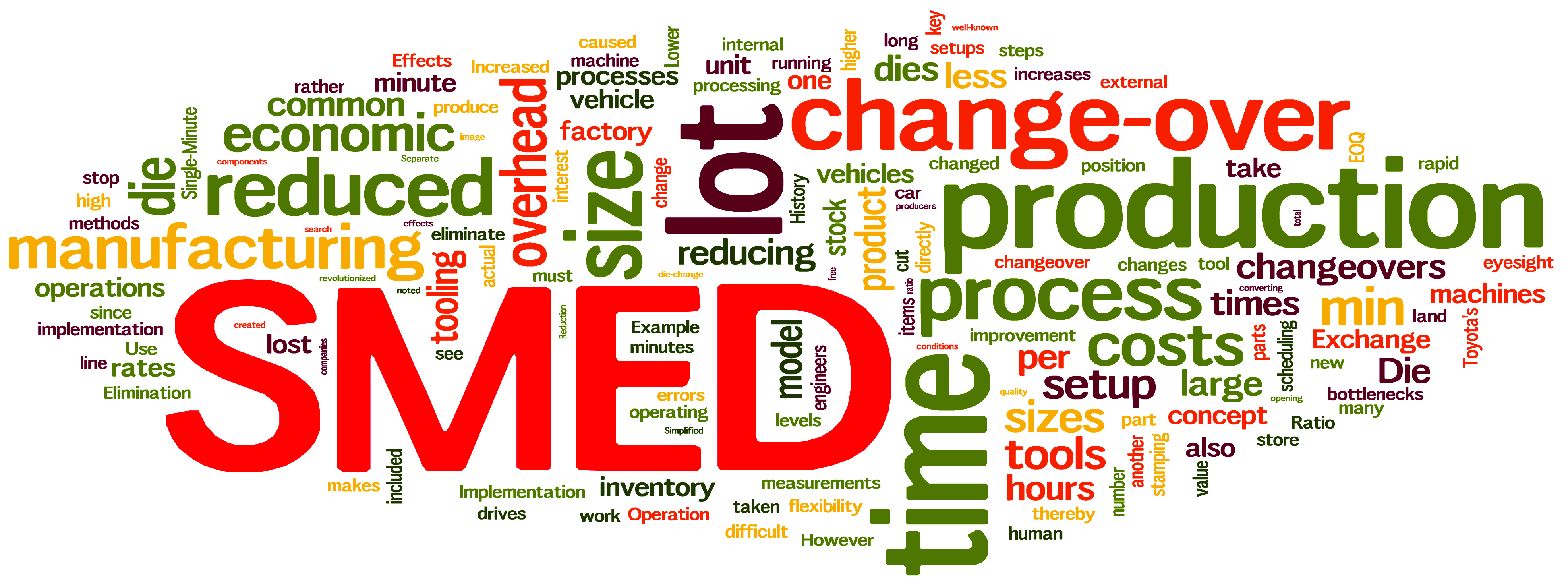
Reduced cost of setups at a machine is the most obvious positive impact from SMED. However, there are less obvious and possibly more meaningful ways that SMED impacts efficiency and shop performance.
Successfully implementing SMED means that a machine can be changed from producing product A to product B in a matter of minutes, which does not allow time for someone to chase dimensions and other quality requirements by adjusting the setup across multiple iterations. Achieving changeovers that can be done in minutes and delivering 100% first-pass yields require developing precise tooling, careful process planning and creative methods.
Setting up in minutes and producing a good first part with no adjustments demands precise workholding and toolholding that can be moved on the machine and located quickly. Many devices, such as quick-change chuck jaws, Capto toolholders and pallet changers, aid fast changeovers. A shop serious about SMED will commit to the expense of these tools and implement their use throughout the shop, thereby creating a standard method. Standard methods not only reduce costs of setup but create flexibility, which lowers lead times and inventory costs.
Discipline is the most significant hurdle to overcome when implementing SMED. Machining operations must be planned so that a system is developed. Workholding fixtures have to be designed to incorporate the quick-change features and built with precision to ensure accuracy and repeatability when loaded on the machine. Cutting tools need to be arranged and stored so they can be accessed and loaded quickly, and the dimensions of raw materials must be controlled to eliminate variation.
The disciplined approach to process design needed to execute SMED can seem daunting. But once the system is designed, the cost of development and part introduction is reduced. In many cases, the need for multiple fixtures is eliminated and changeover can be completed by changing a few fixture components, which lowers the cost of workholding. Improved fixturing lessens the overall cost of workholding development, making a shop more competitive when quoting jobs.
Advancing toward SMED at the machine shop requires engineers and machinists to rethink hardware and tools, as well as programming and machine tools.
CNC programmers — I am one, so don’t be offended — have strong opinions about how a program should be structured. All programs are different, and everyone thinks that his or hers is the best. Multiple people create programs at most shops, so there is a tremendous amount of variation in the structure, which can cause delays in work. Program variation forces machinists to decipher code. Many times, they must slowly step through a program to understand what is happening. For SMED to succeed, a program has to run flawlessly when a machinist pushes the green button. Getting to that point requires a standard program format so there is zero variation. Standard formatting means that machinists get into a routine and that setups become rhythmic, which drives efficiency.
Flawless execution of a program also means that machinists, programmers and engineers need to perfect techniques that eliminate human intervention in the setup process. Using part probes, parametric programming and tool setting devices drive manual intervention out of the process and reduce opportunities for errors, thereby shortening setup times.
When part volume is extremely high and pockets are deep, as in automotive manufacturing, SMED can morph into a process that has no setup time. Large manufacturing cells can be set up with multiple machine tools and big collections of workholding devices. The fixtures are loaded with workpieces and go into a queue for machining. The shop scheduler simply tells the manufacturing cell which parts are needed, and the machine tools operate without needing changeovers. Humans merely support cell operations by loading parts on fixtures, changing cutting tools, filling fluids and doing other similar activities.
Most people can see the obvious savings associated with SMED, but there are hidden benefits. First, machining process development is simplified and becomes faster. Because variation is reduced, there are fewer opportunities for decisions, which lowers opportunities for errors.
Using automation like probing helps employees who lack the necessary experience to accurately perform setups. Quick-change fixtures combined with probing activities and parametric programming may eliminate the need for fixture adjustments at setup, again empowering lesser-skilled employees.
While a shop might not reach single-minute exchange of die, the actions discussed in this article will drive out process variation, build in automation and end the need for human intervention. All this lessens the impact of the skills gap in the labor market. So when achieved, SMED has a clear, positive impact on changeover costs. But there still are significant benefits to be found in the pursuit of SMED — whether achieved or not.
Glossary terms in this article
Related



Subscribers can use MFGAxis notes, saves and discussion tools with their innoNET account.