


Better heat-resistant materials: Research & Innovation
U.S. Department of Energy researchers devise method to study melting points of refractory oxides.
Argonne National Laboratory scientists across several disciplines have combined forces to create a process for testing and predicting the effects of high temperatures on refractory oxides.
Cast iron melts at about 1,200 degrees Celsius (2,192 degrees Fahrenheit). Stainless steel melts at around 1,520 C (2,768 F). If someone wanted to shape these materials into everyday objects, such as a skillet for a kitchen or a surgical tool for a doctor, it stands to reason that one would need to create furnaces and molds out of something that could withstand these extreme temperatures.
That’s where refractory oxides come in. These ceramic materials can stand up to blistering heat and retain their shape, which makes them useful for all kinds of things, from kilns and nuclear reactors to heat-shielding tiles on spacecraft. But considering the often dangerous environments in which these materials are used, scientists want to understand as much as they can about what happens to the materials at high temperatures — before components built from those materials encounter such temperatures in the real world.
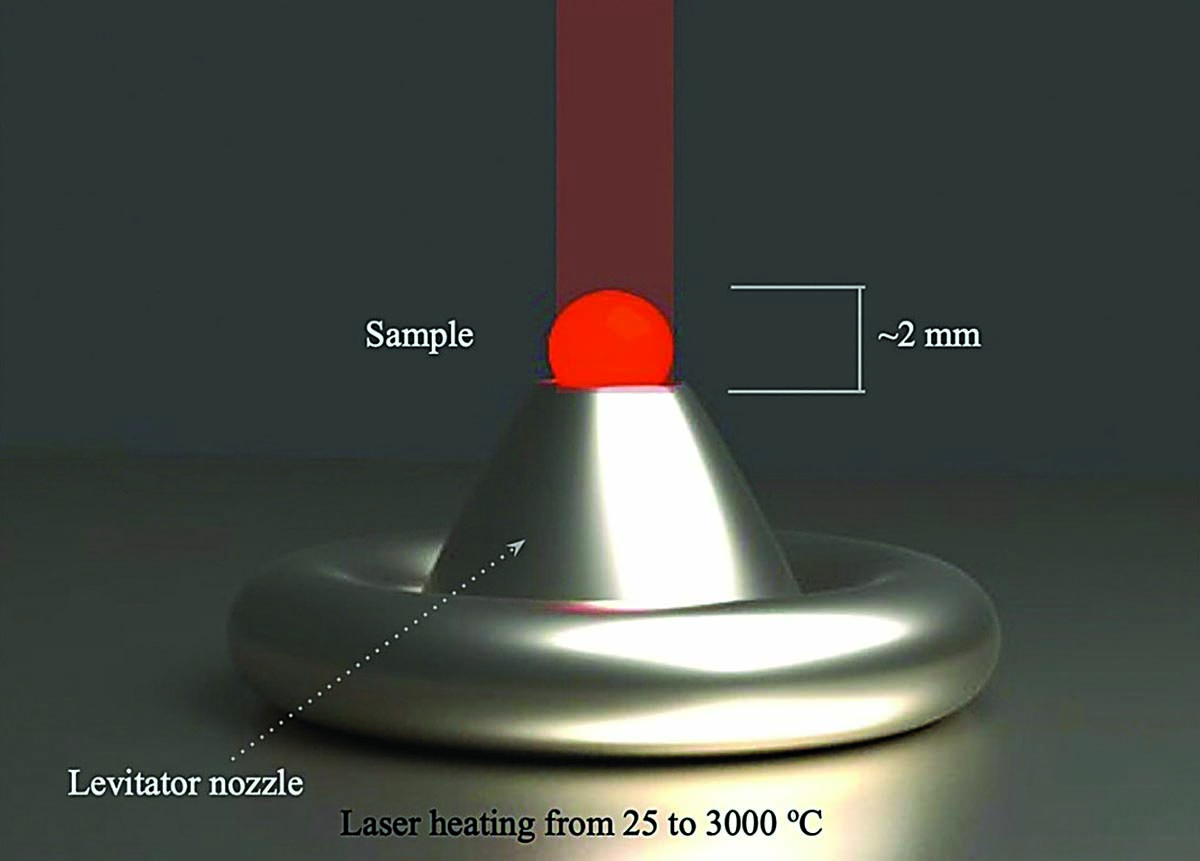
Shown is an illustration of the aerodynamic levitation process for studying refractory oxides at their melting points at the Advanced Photon Source office. A small bead of material is buoyed by gas and heated by an overhead laser before X-rays examine the structure. Image courtesy of G. Sivaraman/Argonne National Laboratory
A team of researchers from the U.S. Department of Energy’s Argonne National Laboratory has come up with a way to do just that. Using innovative, experimental techniques and a new approach to computer simulations, the group has devised a method of not only obtaining precise data about the structural changes that these materials undergo near their melting points but more accurately predicting other changes that can’t be measured currently.
The work of the team has been published in Physical Review Letters.
Ganesh Sivaraman, lead author of the paper and an assistant computational scientist with the data science and learning division at Argonne National Laboratory, describes this work as a proof of concept, one that can feed back into further experiments. He said it’s a nice example of collaboration among different parts of Argonne National Laboratory, as well as research that could not be done without the resources of a national laboratory.
“We will repeat this experiment on other materials,” he said. ”Our (Advanced Photon Source office) colleagues have the infrastructure to study how these materials melt at extreme conditions, and we are working with computer scientists to build the software and streaming infrastructure to rapidly process these datasets at scale. We can incorporate active learning into the framework and teach models to more efficiently process the data stream using (Argonne Leadership Computing Facility) supercomputers.”
For Marius Stan, leader of the intelligent materials design program at Argonne National Laboratory’s applied materials division, the proof of concept may replace the necessary tedium of people working out these precise calculations. He has watched this technology evolve during his career, and now what once took months takes only a few days.
“I’m not saying humans aren’t great,” he chuckled, ”but if we get help from computers and software, we can be greater. It opens the door for more experiments like this that advance science.”
— Andre Salles
Related



Subscribers can use MFGAxis notes, saves and discussion tools with their innoNET account.