Automation for the next generation
Robots can not only improve working conditions for existing personnel but help attract new, young colleagues.
Like much of the world, the U.S. economy has struggled for more than a year. The pandemic significantly impacted many industries, and the gross domestic product decreased 3.5% last year — the biggest drop since 1946. On top of that, the skills gap in the manufacturing industry is increasing due to retiring baby boomers and a low rate of young, skilled workers joining the workforce.
The industry will have to evolve, and CNC automation can play a vital role in the process.
For several years, there has been increased talk of reshoring, or bringing back production from low-wage countries. Reshoring can reduce dramatically the risks that companies face in the event of a pandemic. Although the idea of returning production to the United States sounds promising, the growing skills gap poses a big challenge to the feasibility.
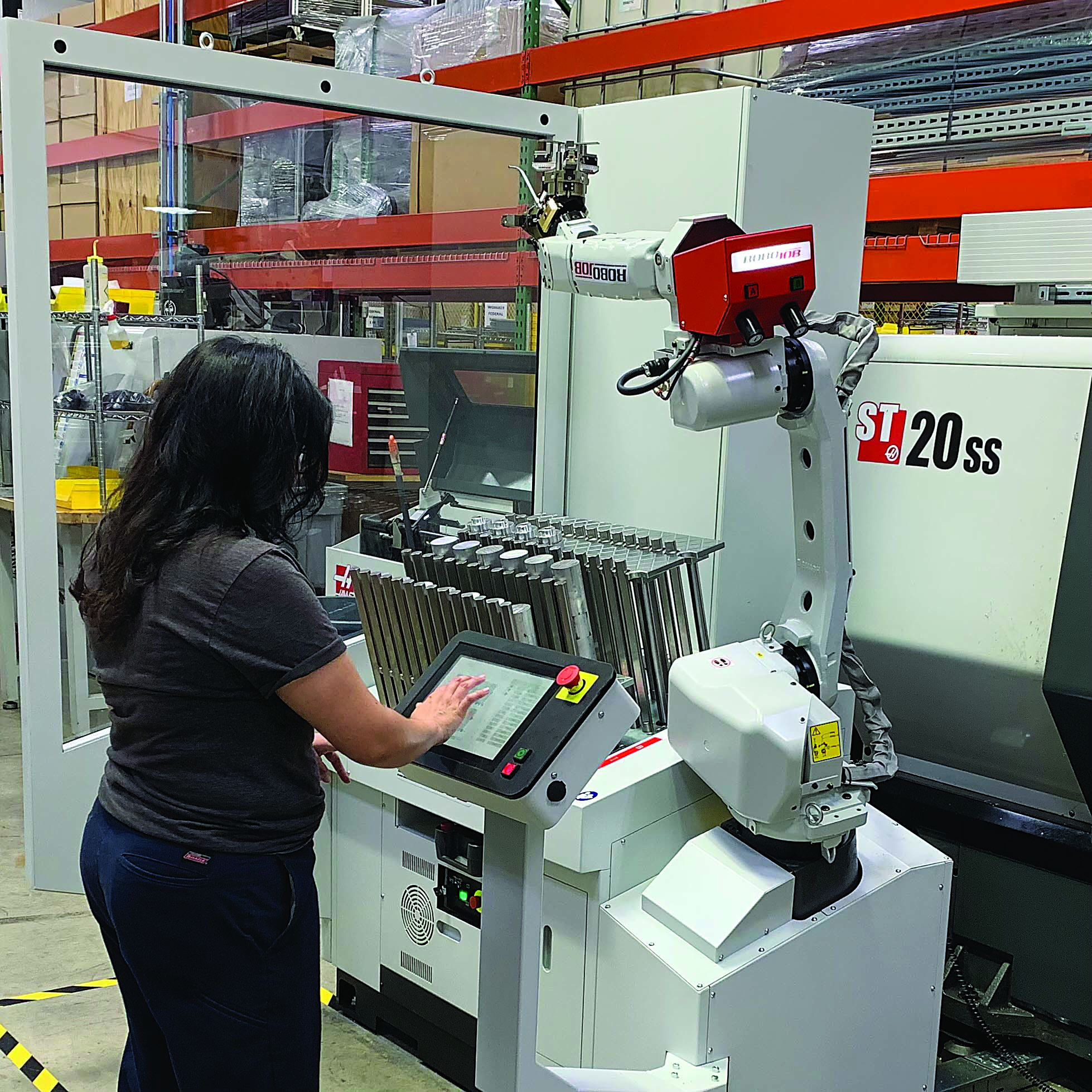
Equipment make: RoboJob NV
Equipment model: Turn-Assist 200i
CNC machine make: Haas Automation Inc.
CNC machine model: ST-20SS
CNC machine model year: 2012
Shifts per day: one
Shifts per week: five
Productivity increase: 43%
My experience running a job shop for turning and milling work provides a good perspective. Anyone who has walked into a typical machine shop knows that the average age of staff members is often over 50. Younger workers are difficult to come by as fewer young people are studying technical courses. Many people also view shops as dull, dark environments where hard physical labor is part of the daily routine. Reality, however, is far from that perception. Today’s shops are modern companies with state-of-the-art technology, including robotics, which has a crucial role in closing the skills gap.
Why have job shops changed so much, and why will that continue? In the past 15 or 20 years, shops all over the country have seen order volumes decline. Customers no longer want to invest in expensive stocks of spare parts. Rather than ordering large quantities, these businesses started ordering smaller batch sizes of components to be delivered just in time. On the other hand, market tariffs have been capped because of a global economy. Whereas shops used to compete with companies in their backyards, so to speak, now they find themselves in a global market.
The only way for a U.S. company to succeed is through automation. When an order for machined parts arrives at a job shop, automation can come into play. An operator even may set a robot to produce the order overnight without stressing the operator or requiring overtime to be paid by the business owner. But automation can serve another role. Robots could become machinists’ best friends by assuming the hard labor and the dull, repetitive work, freeing up time for people to handle more creative tasks, process optimization or training.
I am convinced that robots can not only improve working conditions for existing personnel but help attract new, young colleagues. We can show that the reality of working at a job shop is very different from what young talent believes. Manufacturing is a beautiful industry to work in. We simply owe it to the next generation to improve working conditions through CNC automation and to improve the attractiveness of our industry for young talent.
To view a video of this robotic automation at www.ctemag.com, visit cteplus.delivr.com/2zybn.