Turning on a budget
Both hobbyists and professionals looking for an economical option for machining small parts can turn to the 127 mm (5") slant-bed lathe from Palmgren.
Both hobbyists and professionals looking for an economical option for machining small parts can turn to the 127 mm (5″) slant-bed lathe from Palmgren.
“When we launched it, everybody loved the little 5″ for space savings and overall ease of use,” said Donald Yonkers, parts and service manager at Naperville, Illinois-based C.H. Hanson Co., which owns the Palmgren brand. “You can put this in your garage and be making parts in an hour.”
Suitable for parts 31.75 mm (1.25″) or less in diameter, the 5″ turning center also can be used at machine shops for short production runs, one-offs and prototyping. The small size and footprint of the lathe — it measures 1.4 m (55″) long, 0.77 m (30.25″) wide and 1.6 m (63″) high — make it a good choice for shops in need of a secondary machine or an additional chuck, according to Palmgren. For larger parts, the company offers a 203.2 mm (8″) version of the lathe measuring 2.08 m (82″) long, 1.65 m (65″) wide and 1.8 m (71″) high.
Priced at about $26,000, the 5″ lathe certainly falls into the budget category. But Yonkers maintains that users won’t be compromising on part quality.
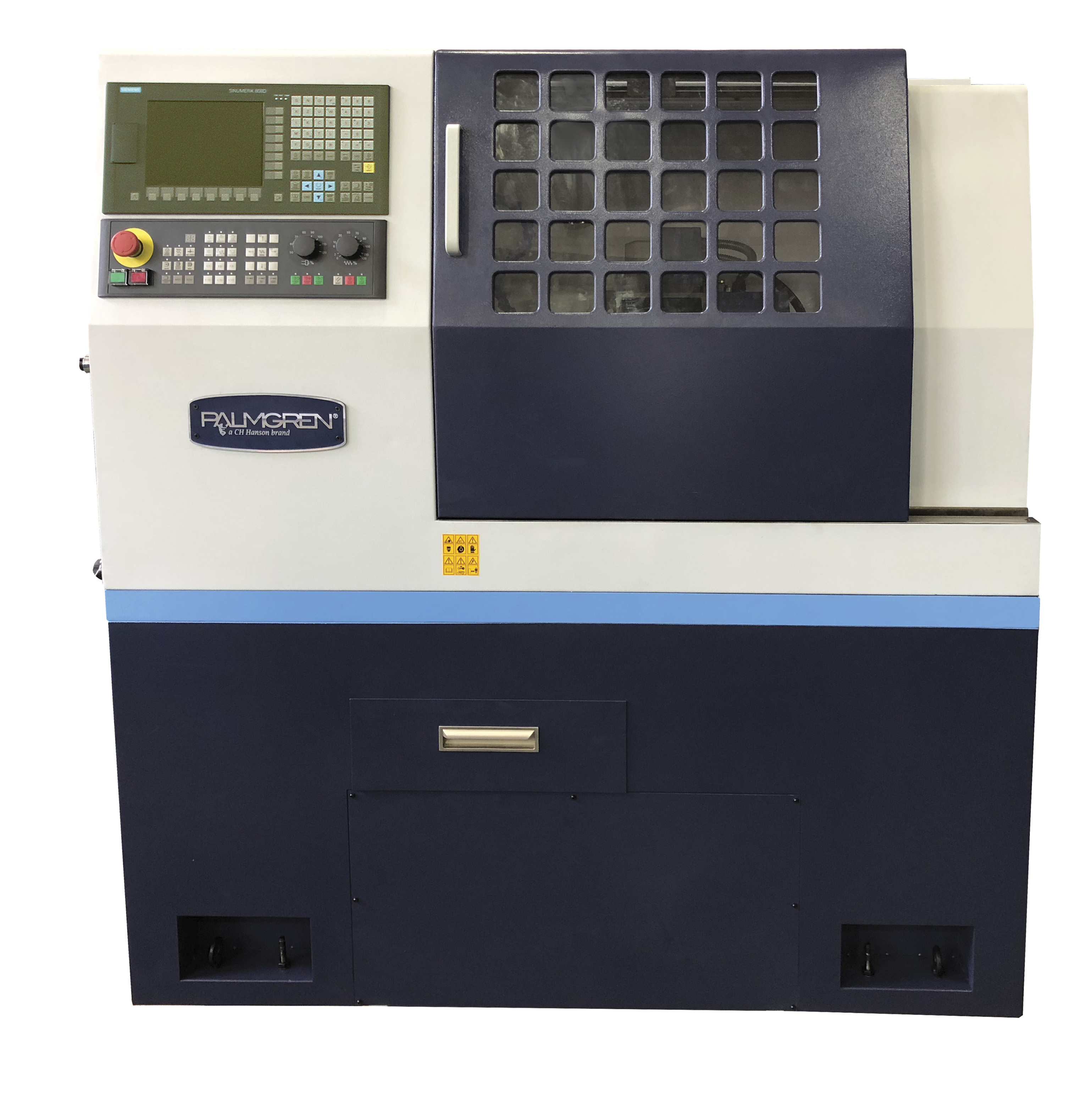
The 5″ slant-bed lathe is a compact, low-priced machine for making small parts at a garage or machine shop. Image courtesy of Palmgren
“If I put this machine next to a (high-end) CNC machine,” he said, “it would do the same part at the same time and you wouldn’t notice a difference between the two.”
In China, every one of the slant-bed lathes is manufactured and tested to ensure that it meets high quality and accuracy standards, according to Palmgren. When the machines arrive at Yonkers’ facility, he tests them as well and reports repeatability accuracy of around ±0.000381 mm (0.000015″).
The company attributes this accuracy in part to the use of high-precision linear rails for positioning the x- and z-axes. Another key factor is the rigid construction of the machines.
“They’re built like big CNC machines with accuracy in mind,” Yonkers said. “They have a full cast-iron frame and base, so they don’t twist and move around a lot like some lower-end CNCs do when their frames are bolted together.”
Review the print ads from this magazine to continue
This quick advertiser review unlocks the rest of the article and keeps the full-screen reader focused on the ads instead of the page chrome.
Advertisers included in this article experience
Print placements connected to this article
Tungaloy America | [email protected] | 888.554.8394
New high precision shoulder milling inserts
E-class insert with MJ chipbreaker AJ chipbreaker for a mirror for excellent surface finish finish in aluminum machining.
New high precision shoulder milling inserts E-class insert with MJ chipbreaker AJ chipbreaker for a mirror for excellent surface finish finish in aluminum machining Tungaloy America | [email protected] | 888.554.8394 www.tungaloy.com/us
Visit Tungaloy America | [email protected] | 888.554.8394 View this placement in the issue recordPrint ads from this magazine
E-class insert with MJ chipbreaker AJ chipbreaker for a mirror for excellent surface finish finish in aluminum machining.
New high precision shoulder milling inserts E-class insert with MJ chipbreaker AJ chipbreaker for a mirror for excellent surface finish finish in aluminum machining Tungaloy America | [email protected] | 888.554.8394 www.tungaloy.com/us
Continue reading
June 2021
In addition, the 5″ machine weighs almost 635 kg (1,400 lbs.), so it’s no lightweight even though it’s compact. The 8″ version weighs 1,497 kg (3,300 lbs.).
“It is not something you are going to put on a benchtop, which will affect accuracy,” Yonkers said.
The lathes also feature an easy-to-use Siemens 808 control, according to Palmgren.
Although the control lacks conversational features, “it will guide you through what you need to do,” Yonkers said. “So it is very easy to set up and run even for a beginner.”
He added, however, that the control also offers many advanced features that allow experts to program complex parts. In addition, he said it does a good job of handling third-party programs.
“You can take any program for a two-axis lathe and put it in this control, and it will run with no hesitation,” Yonkers said.
Both the 5″ and 8″ lathes come with a three-year warranty that includes the control. For users needing expert assistance, Palmgren offers a free app that can be downloaded onto a phone or tablet. These devices serve as a microphone and camera for users as they communicate with him or one of his colleagues, who provide help with programming parts and solving machine-related problems.
Although they offer a number of attractions, these budget lathes have limitations and are not meant to be a low-cost replacement for expensive machines with high-end features.
“If a customer is looking for a multi-axis lathe, (the 5″ lathe) doesn’t have that capability,” Yonkers said. “But if there is someone who is looking for a simple two-axis lathe, this is it.”