

EDMing pros outweigh the cons
When electrical discharge machining is required, the disadvantages don't mean a thing.
Machining operations like milling, turning, drilling and sawing are familiar to most people in manufacturing. Even those who are not machining experts typically know the basic functions of each of these activities and when they are used. Less familiar are some nontraditional machining operations, such as electrical discharge machining.
EDMing is sometimes called spark erosion machining, and toolmakers routinely use the word “burning” to describe what happens in the machine. The process removes material with an electric arc. The system has two electrodes, one of which is the workpiece, and the other is the tool. The work area is submersed in a dielectric fluid that electrically insulates the components from each other. A high-voltage charge is applied to the tool, causing the dielectric properties of the fluid to break down until an electric arc is created between the tool and workpiece. Material from the tool and workpiece is melted and carried away by the fluid, thereby generating the cutting action.
EDMs come in one of two varieties: ram-style or wire cut.
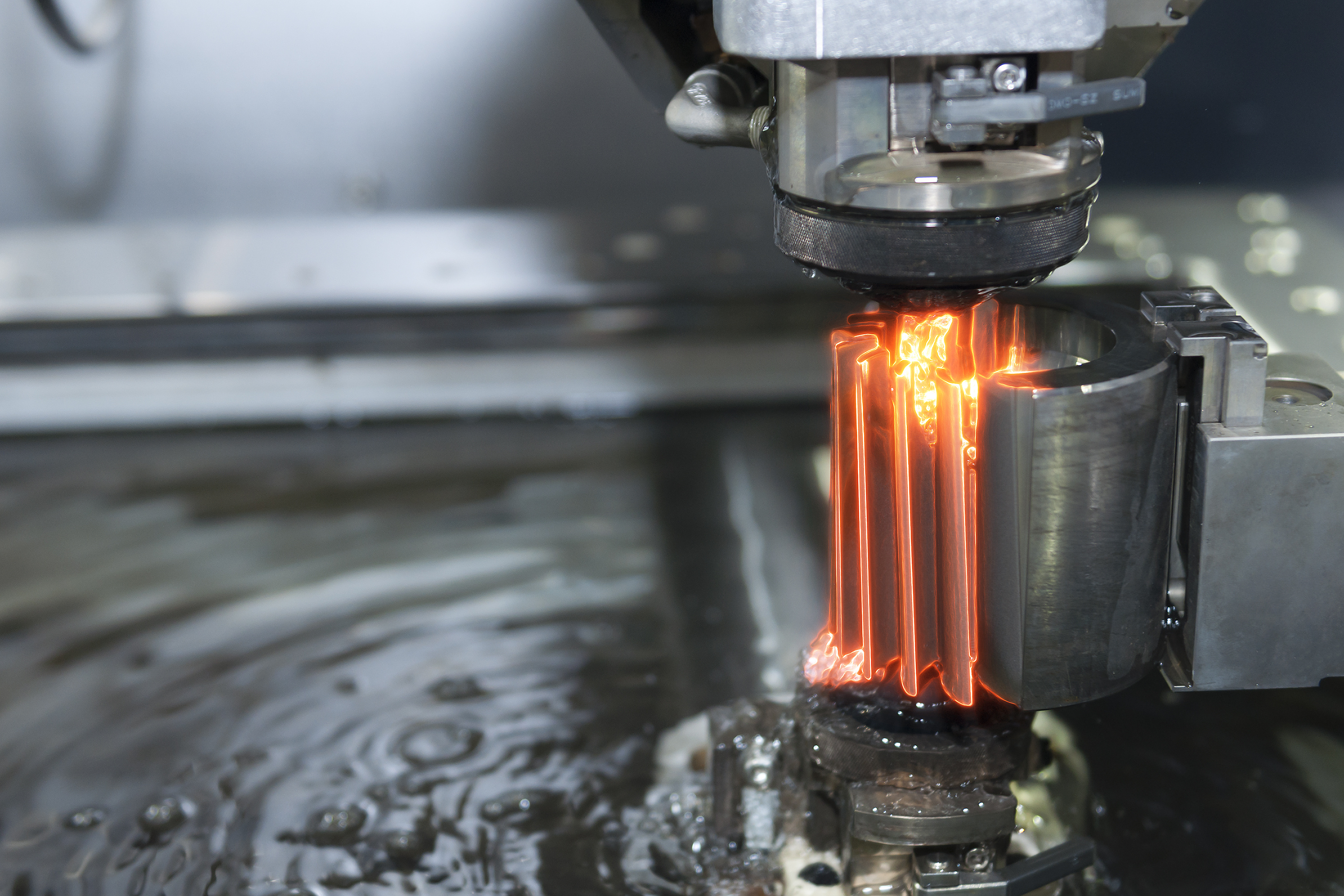
EDMing processes have numerous advantages, and accuracy is the most significant.
Ram-style machines sometimes are called die sink, sinker or conventional. Ram-style EDMs use a solid tool cut from copper, graphite or other conductive materials. The tool is machined so that it matches the desired shape of the workpiece in reverse. Shaped electrodes then are fed slowly into the workpiece, resulting in a cavity with the desired shape. Ram-style EDMing is used extensively in the tool and die industry to build sheet metal forming tools and in the injection molding industry to make injection dies.
EDMing drilling machines — or hole poppers as some people call them — are a subset of the ram-style machines. These machines use hollow cylindrical electrodes to drill holes. The electrodes are hollow so fluid can be pumped into the work zone to remove swarf and supply fresh dielectric fluid. Hole poppers are an integral part of gas turbine blade and vane manufacturing. Cooling air holes that protect the surfaces of these turbine parts are small, usually very deep and made often in curved surfaces. Drilling these holes by conventional means would be impossible.
Wire-type EDMs use the same technology and physics as ram machines. Although the cutting action of the arc and the flushing of the work zone are much like ram-style machines, the tool is different. Wire machines use — as you probably guessed — a wire electrode. Wire machines are CNC-controlled and programmed like machining centers. A small-diameter wire is driven along a programmed path, and the arc between the wire and the workpiece generates a small kerf along the path. Wire is consumed during the process as the wire continuously is unspooled and fed through the cut zone while traversing the programmed path. Wire cutting is used when there is no need to leave a cavity in the workpiece. Making complex punch and die sets is a common use of wire EDMs.
Advantages
EDMing processes have numerous advantages, and accuracy is the most significant. Unlike conventional machining, which relies on contact between a tool and workpiece to form a chip, EDMing is noncontact. Because the cutting action is completed without contact between the component and tool, no pressure is exerted on the tool, workpiece or machine. No contact means no deflection, so only a few variables can introduce errors into the cutting path. The result is an extremely accurate process. Working to 0.0025 mm (0.0001″) tolerances with EDMs is routine.
Zero cutting force means that EDM tools can be small and that workholding does not need to be complex or rigid. This makes EDMing ideal for tiny parts, such as those found in medical devices and miniature mechanical assemblies.
Ram-type machines can create geometries that would not be possible by any other means. Cavities with small corner radii, deep undercuts and other complex workpiece geometries may be impossible to make with conventional machining techniques. Ram machines are capable of multi-axis interpolation, which gives the ability to make threads and other complicated shapes.
Review the print ads from this magazine to continue
This quick advertiser review unlocks the rest of the article and keeps the full-screen reader focused on the ads instead of the page chrome.
Advertisers included in this article experience
Print placements connected to this article
30 Years Of Excellence I Bluco.Com ®
HOLD IT A Modular Fixturing System Doesn’t
Cost Money - IT MAKES MONEY. Get your setup done in less than half the time with a modular base plate paired with a kit of precision fixturing components. Our fixtures assemble in minutes, not hours or days like outdated manual setups. Show us what you need to machine, and we’ll help you hold onto your parts — and your profits
HOLD IT A Modular Fixturing System Doesn’t Cost Money - IT MAKES MONEY. Get your setup done in less than half the time with a modular base plate paired with a kit of precision fixturing components. Our fixtures assemble in minutes, not hours or days like outdated manual setups. Show us what you need to machine, and we’ll help you hold onto your parts — and your profits. Call 800.535.0135 for Solutions 30 YEARS OF EXCELLENCE I BLUCO.COM ®
Visit 30 Years Of Excellence I Bluco.Com ® View this placement in the issue recordPrint ads from this magazine
Cost Money - IT MAKES MONEY. Get your setup done in less than half the time with a modular base plate paired with a kit of precision fixturing components. Our fixtures assemble in minutes, not hours or days like outdated manual setups. Show us what you need to machine, and we’ll help you hold onto your parts — and your profits
HOLD IT A Modular Fixturing System Doesn’t Cost Money - IT MAKES MONEY. Get your setup done in less than half the time with a modular base plate paired with a kit of precision fixturing components. Our fixtures assemble in minutes, not hours or days like outdated manual setups. Show us what you need to machine, and we’ll help you hold onto your parts — and your profits. Call 800.535.0135 for Solutions 30 YEARS OF EXCELLENCE I BLUCO.COM ®
Continue reading
May 2021
Wire machines, like ram-style ones, can produce geometries that cannot be created by conventional machining processes. However, wire machines are not capable of working in cavities as the wire must extend through the part, making wire EDMing ideal for tools like extrusion and punch dies.
As with other CNC machines, wire EDMs can be outfitted with rotary devices, quick-change workholding and robotic loading and unloading, which makes wire machines appropriate for many applications. A quick search on the internet for wire-cut parts will show creative uses of wire EDMing.
Disadvantages
EDMing has a lot of benefits but also drawbacks.
EDMing is slow compared with other machining processes, making it inherently more expensive.
Using a ram machine usually means that someone needs to machine the electrode before EDMing begins, thereby adding costs and lead time.
The machines are expensive. A machining center with a 508 mm × 762 mm (20″×30″) work envelope can be purchased for less than $100,000. A wire machine with the same envelope costs over $200,000.
Recast forms when the molten metal on the cut surface solidifies. This undesirable condition is thought to harm the mechanical properties of the metal. Concerns about recast often disqualify EDMing from consideration in some industries, such as aerospace.
EDMing does not work on nonconductive material. When a workpiece cannot conduct electricity, there cannot be an arc between the part and electrode.
But once you realize that EDMing is needed, you will have recognized that it is the only process that will get the job done, so its unfavorable aspects are never really a concern.
It may sound negative to say EDMing is the machining process of last resort, but this actually is a testament to the effectiveness of the operation. When nothing else will work, burn it.
Glossary terms in this article
Related


 MFGAxis Discussion
Be part of the shop-floor conversation
Like, save, or comment on this CTE story.
MFGAxis Discussion
Be part of the shop-floor conversation
Like, save, or comment on this CTE story.


MFGAxis Discussion