

Designing metal alloys: Design & Engineering
Massachusetts Institute of Technology research study finds that many alloy combinations previously ruled out as unviable are in fact feasible.
By David L. Chandler, MIT
Advanced metal alloys are essential to modern life. But creating them for specific uses, with optimized strength, hardness, corrosion resistance, conductivity and so on, has been limited by fuzzy understanding of what happens at the boundaries between the tiny crystalline grains that make up most metals.
When two metals are mixed, the atoms of the secondary metal might collect along these grain boundaries or spread out through the lattice of atoms in the grains. The overall properties of the material are determined largely by the behavior of these atoms, but until now there has been no systematic way to predict what they would do.
Using a combination of computer simulations and a machine-learning process, researchers at Massachusetts Institute of Technology have found a method to produce the kinds of detailed predictions of these properties that could guide the development of alloys for a wide variety of applications.
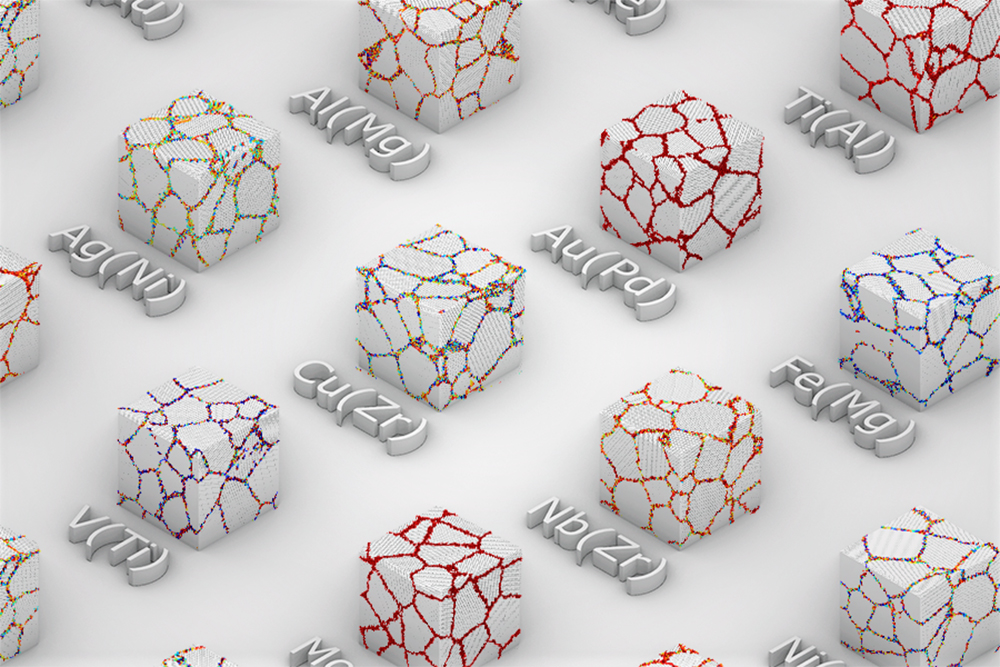
Researchers have found a way to predict the properties of metal alloys based on reactions at the boundaries between the crystalline grains of the primary metal. In this image, colored dots indicate the likelihood that atoms will collect along these boundaries rather than penetrating them. Image courtesy of MIT researchers
Christopher Schuh, professor of materials science and engineering, said understanding the atomic-level behavior of polycrystalline metals, which account for the vast majority of metals used, is a daunting challenge. Whereas the atoms in a single crystal are arranged in an orderly pattern so the relationship between adjacent atoms is simple and predictable, that’s not the case with the multiple tiny crystals in most metal objects.
“You have crystals smashed together at what we call grain boundaries,” he said. “And in a conventional structural material, there are millions and millions of such boundaries.”
Review the print ads from this magazine to continue
This quick advertiser review unlocks the rest of the article and keeps the full-screen reader focused on the ads instead of the page chrome.
Advertisers included in this article experience
Print placements connected to this article
Greenleafcorporation
This is the amplitude sticker for Walther
Trowal’s CM circular vibratory finishing machine. Direction of angle of the linear amplitude Amplitude to be read in mm Example: = 6 mm Walther Trowal 10X HIGHER PRODUCTIVITY! XSYTIN®-360 CERAMIC END MILLS • Delivers tremendous cost savings! • High removal rates on a wide range of materials L • Capable of significantly.
This is the amplitude sticker for Walther Trowal’s CM circular vibratory finishing machine. Direction of angle of the linear amplitude Amplitude to be read in mm Example: = 6 mm Walther Trowal
Visit Greenleafcorporation View this placement in the issue recordPrint ads from this magazine
Trowal’s CM circular vibratory finishing machine. Direction of angle of the linear amplitude Amplitude to be read in mm Example: = 6 mm Walther Trowal 10X HIGHER PRODUCTIVITY! XSYTIN®-360 CERAMIC END MILLS • Delivers tremendous cost savings! • High removal rates on a wide range of materials L • Capable of significantly.
This is the amplitude sticker for Walther Trowal’s CM circular vibratory finishing machine. Direction of angle of the linear amplitude Amplitude to be read in mm Example: = 6 mm Walther Trowal
Continue reading
April 2021
These boundaries help determine material properties.
“You can think of them as the glue holding the crystals together,” Schuh said. “But they are disordered. The atoms are jumbled up. They don’t match either of the crystals they’re joining.”
He said this means that there are billions of possible atomic arrangements compared with just a few in a crystal. Alloy designers usually skip over the problem or look at the average properties of grain boundaries as if they’re all the same.
The research team approached the issue by examining the actual distribution of configurations and interactions for a large number of representative cases and then used a machine-learning algorithm to extrapolate from these cases and provide predicted values for a whole range of possible alloy variations.
In some cases, the clustering of atoms along grain boundaries is a desired property that can enhance a metal’s hardness and resistance to corrosion, but this sometimes leads to embrittlement. Depending on the intended use of an alloy, engineers try to optimize the combination of properties.
For the study, the team examined over 200 combinations of a base metal and an alloying metal based on combinations that had been described in the literature. Researchers then simulated some of the compounds to study grain boundary configurations. These were used to generate predictions using machine learning, which were in turn validated with more focused simulations. The machine-learning predictions closely matched the detailed measurements.
As a result, researchers were able to show that many alloy combinations that had been ruled out as unviable in fact were feasible. The database compiled from this study, which is available in the public domain, could help anyone working on designing alloys.
Glossary terms in this article
Related




Subscribers can use MFGAxis notes, saves and discussion tools with their innoNET account.


