Lean grinding machine
The GT-610 EZ from Glebar Co. is designed to provide slide motion control and other key ingredients to grinding success at a lower price point.
Billed as an entry-level version of a feature-rich centerless grinder, a new machine is designed to provide slide motion control and other key ingredients to grinding success at a lower price point.
Developed by Glebar Co. in Ramsey, New Jersey, the GT-610 EZ costs 15% less than the company’s GT-610 grinder.
“We wanted to incorporate elements from our more sophisticated automated machines in a more affordable package for the shop that just wants to do basic through-feed grinding,” said Chief Technology Officer John Bannayan.
The EZ has four axes of motion compared with at least five offered by its higher-end counterpart. Another difference is that the position of the EZ’s regulating wheel is controlled manually, which he said makes setup easier. With a footprint measuring just 1,041 mm × 1,270 mm (41″×50″), he said the EZ also takes up much less floor space than its competitors.
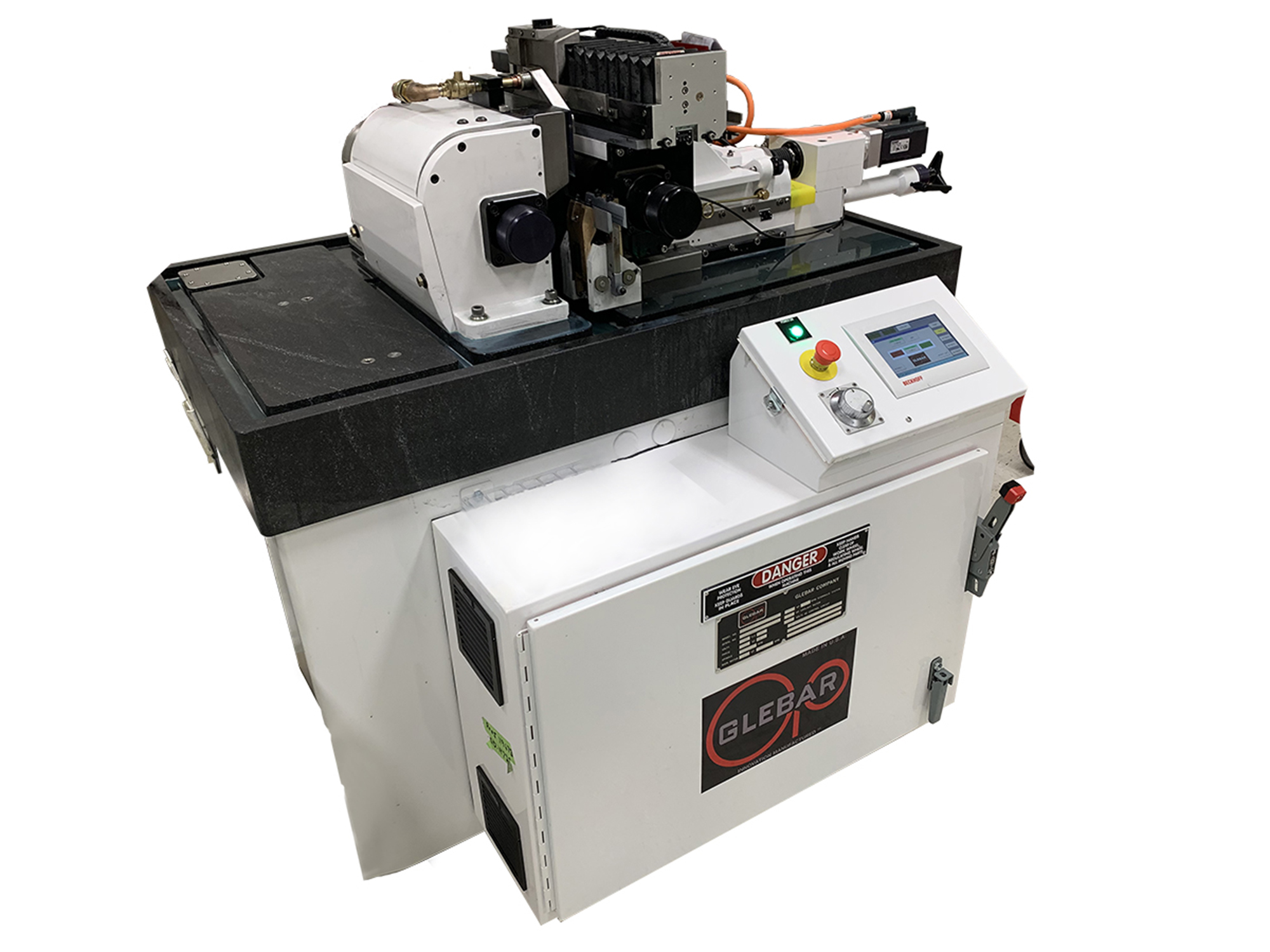
Glebar says the GT-610 EZ provides some of the key capabilities of higher-end centerless grinders but costs significantly less. Image courtesy of Glebar
Equipped with a 15-hp main spindle motor, which Bannayan said is unusual for such a small machine, the EZ is suitable for grinding components under 25 mm (1″) in diameter. He said people who need to take a lot of material off large-diameter components must opt for a much larger machine with a 20-hp motor.
Although grinding parts with complex geometries requires a GT-610, he said diameter reduction or producing simple geometries, such as chamfers on drill blanks, are ideal applications for the EZ. He said the new machine can reduce rods made of hard materials like steel, carbide, diamond, PCD and technical ceramics to small diameters while holding tight tolerances.
Despite being economical, the EZ features a wide 203 mm (8″) grinding wheel.
“In applications where you are grinding carbide,” Bannayan said, “the more wheel you have, the fewer passes you have to take.”
Other features that also are offered by the GT-610 include spindles held by two sets of bearings.
Review the print ads from this magazine to continue
This quick advertiser review unlocks the rest of the article and keeps the full-screen reader focused on the ads instead of the page chrome.
Advertisers included in this article experience
Print placements connected to this article
Oerlikon Balzers is one of the world’s Address
The largest coating center
in the Western US is open! leading suppliers of surface technologies Oerlikon Balzers Coating USA, Inc. 10285 Indiana CT that significantly improve the performance Rancho Cucamonga CA – 91730 as well as tools for the metal and plastics processing industries. Contact us Jim Casteen Territory Account Manager Angel Castro.
The largest coating center in the Western US is open! Oerlikon Balzers is one of the world’s Address leading suppliers of surface technologies Oerlikon Balzers Coating USA, Inc. 10285 Indiana CT that significantly improve the performance Rancho Cucamonga CA – 91730 and service life of precision components Tel: +1 909-360-5622 as well as tools for the metal and plastics processing industries. Contact us
Visit Oerlikon Balzers is one of the world’s Address View this placement in the issue recordTungaloy America | [email protected] | 888.554.8394
New grades AH8005 and KS05F for incredible
reliability in grooving heat-resistant alloys DGS geometry with 0.05 or 0.1 mm corner radii.
New grades AH8005 and KS05F for incredible reliability in grooving heat-resistant alloys DGS geometry with 0.05 or 0.1 mm corner radii Tungaloy America | [email protected] | 888.554.8394 www.tungaloy.com/us
Visit Tungaloy America | [email protected] | 888.554.8394 View this placement in the issue recordPrint ads from this magazine
in the Western US is open! leading suppliers of surface technologies Oerlikon Balzers Coating USA, Inc. 10285 Indiana CT that significantly improve the performance Rancho Cucamonga CA – 91730 as well as tools for the metal and plastics processing industries. Contact us Jim Casteen Territory Account Manager Angel Castro.
The largest coating center in the Western US is open! Oerlikon Balzers is one of the world’s Address leading suppliers of surface technologies Oerlikon Balzers Coating USA, Inc. 10285 Indiana CT that significantly improve the performance Rancho Cucamonga CA – 91730 and service life of precision components Tel: +1 909-360-5622 as well as tools for the metal and plastics processing industries. Contact us
Continue reading
April 2021
With these twin-grip spindles, Bannayan said, “you have a much stiffer setup, so you can control your diameter much better.”
Another feature is a granite machine bed.
“The older version of the GT-610 was built on a cast-iron bed, which flexes and is not stiff enough to handle carbide tool tolerances,” Bannayan said. “With a granite base, you have much better rigidity and stiffness than you would on cast iron and also better vibration-dampening characteristics.”
Like the GT-610, the EZ is equipped with glass scales that provide submicron slide feedback for better wheel positioning. In addition, the EZ allows connection to gauges for automatic size compensation.
“You can take a gauge that’s used on the (shop) floor and plug it into a USB port on the machine for automatic diameter compensation,” Bannayan said. “So if you are grinding a particular diameter and you want to compensate by a couple of tenths, this takes the operator out of the equation.”
Developed by Glebar, the EZ’s control software can be customized to suit different applications and processes. Among other things, the control system enables remote monitoring of the machine when vibration and temperature monitors are placed on the spindles.
“We can remotely diagnose (problems) in all of our machines,” Bannayan said, “but now we can also diagnose anything on a manual machine.”
EZ users also have the option of connecting to Glebar Advanced Analytics, a cloud-based system that collects data from Glebar machines, interprets and synthesizes the data and delivers actionable real-time analytics to operators and managers via easy-to-read dashboards. He said Glebar Advanced Analytics now can provide basic overall equipment effectiveness data, such as machine uptime and downtime.
“The objective,” Bannayan said, “was to get a manual machine into (the GT-610) family from a control and data acquisition standpoint and let users leverage OEE information.”