

Surface finish on A36 steel
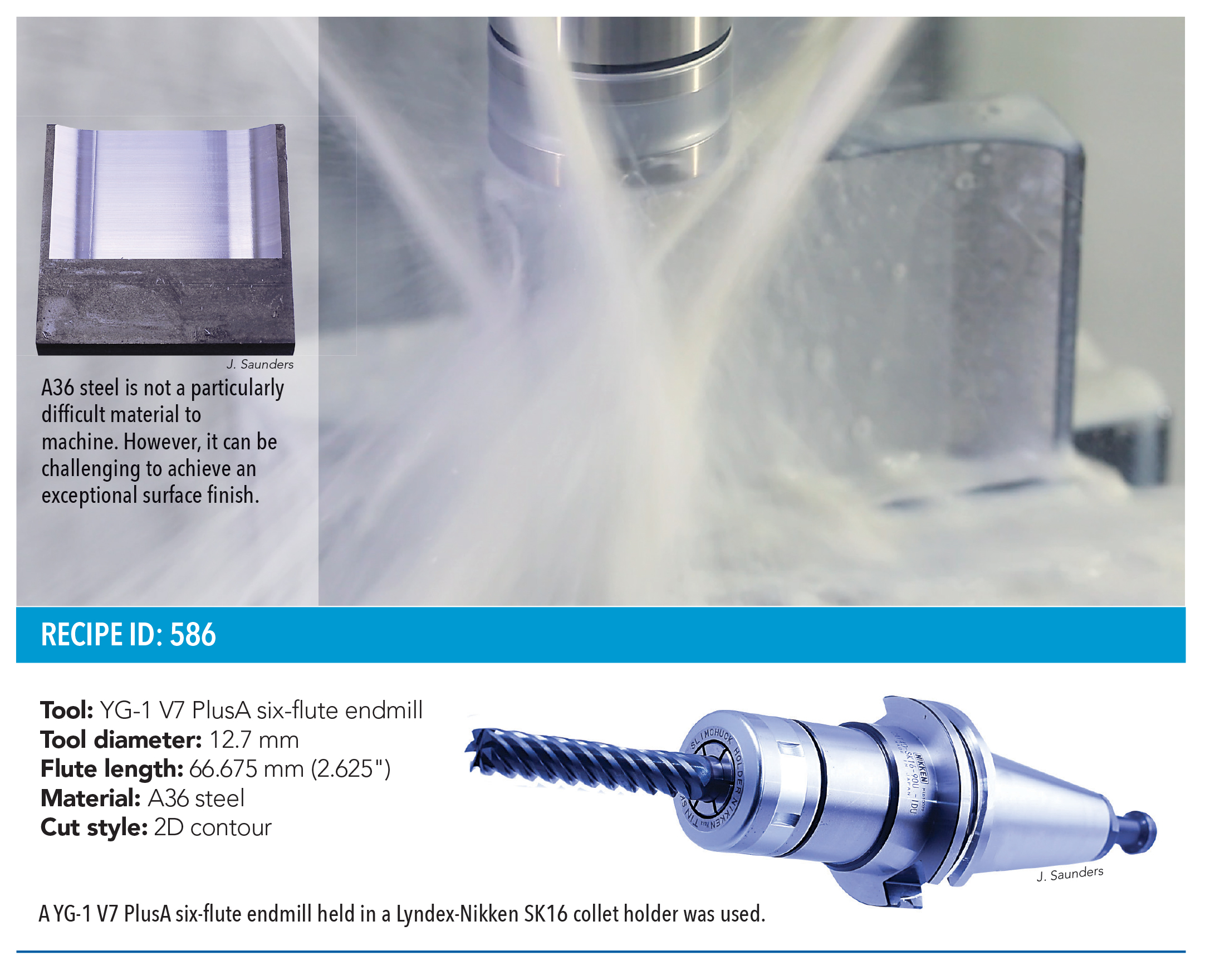
A 36 steel is not a particularly difficult material to machine. However, it can be challenging to achieve an exceptional surface finish, especially when a part calls for a 63.5 mm (2.5") axial depth of cut. The challenge for this ProvenCut recipe was to achieve an acceptable — or even excellent — finish with a tool length-to-diameter ratio of 5-1.
A 36 steel is not a particularly difficult material to machine. However, it can be challenging to achieve an exceptional surface finish, especially when a part calls for a 63.5 mm (2.5″) axial depth of cut. The challenge for this ProvenCut recipe was to achieve an acceptable — or even excellent — finish with a tool length-to-diameter ratio of 5-1.
The larger a tool is, the stiffer it is. But large-diameter carbide cutting tools present problems. The cost goes up drastically. A 19.05 mm (0.75″) tool may cost over twice the price of a 12.7 mm (0.5″) tool — and rightfully so, as the former has 2.3 times the amount of carbide. For that reason, large-diameter endmills rarely are purchased or kept in inventory as frequently as smaller-diameter ones. Setting aside tool price, larger-diameter endmills also create more tool pressure, making them difficult to run on many common 40-taper machining centers.
Review the print ads from this magazine to continue
This quick advertiser review unlocks the rest of the article and keeps the full-screen reader focused on the ads instead of the page chrome.
Advertisers included in this article experience
Print placements connected to this article
Nachiamerica
RE-Think Your
Carbide Oil Hole Drills with Nachi’s Aqua REVO Drill Unique patented design for coolant directed at the cutting edge Conventional Aqua REVO Keep your drill cooler while drilling ~ Allowing you to extend tool life. REVO lutionizing Drilling Area with low cooling effect Area with high cooling effect.
RE-Think Your Carbide Oil Hole Drills with Nachi’s Aqua REVO Drill Unique patented design for coolant directed at the cutting edge Conventional Aqua REVO Keep your drill cooler while drilling ~ Allowing you to extend tool life. REVO lutionizing
Visit Nachiamerica View this placement in the issue recordPrint ads from this magazine
Carbide Oil Hole Drills with Nachi’s Aqua REVO Drill Unique patented design for coolant directed at the cutting edge Conventional Aqua REVO Keep your drill cooler while drilling ~ Allowing you to extend tool life. REVO lutionizing Drilling Area with low cooling effect Area with high cooling effect.
RE-Think Your Carbide Oil Hole Drills with Nachi’s Aqua REVO Drill Unique patented design for coolant directed at the cutting edge Conventional Aqua REVO Keep your drill cooler while drilling ~ Allowing you to extend tool life. REVO lutionizing
Continue reading
October 2020
A key to this recipe was finding a stiff 12.7 mm dia. endmill. That’s right: The diameter of an endmill isn’t the only factor in determining the stiffness of a cutting tool. The higher a flute count is, the thicker the core of a cutting tool is. However, higher flute counts must be balanced with increased tool pressure, which can lead to chatter due to more points of contact with raw material.
ProvenCut recipe 586 struck a wonderful balance, machining a piece free of chatter and yielding an extraordinary finish using a YG-1 V7 PlusA six-flute endmill held in a Lyndex-Nikken SK16 collet holder. The 2D contour finishing operation was programmed with Autodesk Fusion 360 and run at 210 m/min. (690 sfm) at 0.015 mm feed per tooth (0.0006″ feed per tooth) with a 0.203 mm (0.008″) radial DOC and 63.5 mm axial DOC.
To view a video of machining A36 steel at www.ctemag.com, enter this URL on your web browser: cteplus.delivr.com/2gpv6
Glossary terms in this article
Related




Subscribers can use MFGAxis notes, saves and discussion tools with their innoNET account.


