Digging into data mining: Drilling Performance
Shops can strike process improvement gold with tools that gather and analyze machining information.
Technology for automated data collection and analysis isn’t new and sounds like something that would have broad appeal in a machining industry bombarded by talk of the industrial internet of things and Industry 4.0. Thus far, however, many shops have taken a pass on the tech.
This may be a costly mistake judging by the advertised capabilities of the latest data collection and analysis products. Product developers say they can improve machining operations, boost productivity and provide timely notification of problems, among other things that would be welcome at any shop.
One such product is FASData software from Fanuc America Corp. in Rochester Hills, Michigan. Working with Fanuc CNCs, FASData allows users to collect and analyze shop floor data. Key process and maintenance information can be viewed on a simple dashboard. Displayed data includes machine status (up or down), alarm information, cycle time and part count. Collected data can be stored for later analysis or passed along in real time to other software programs.
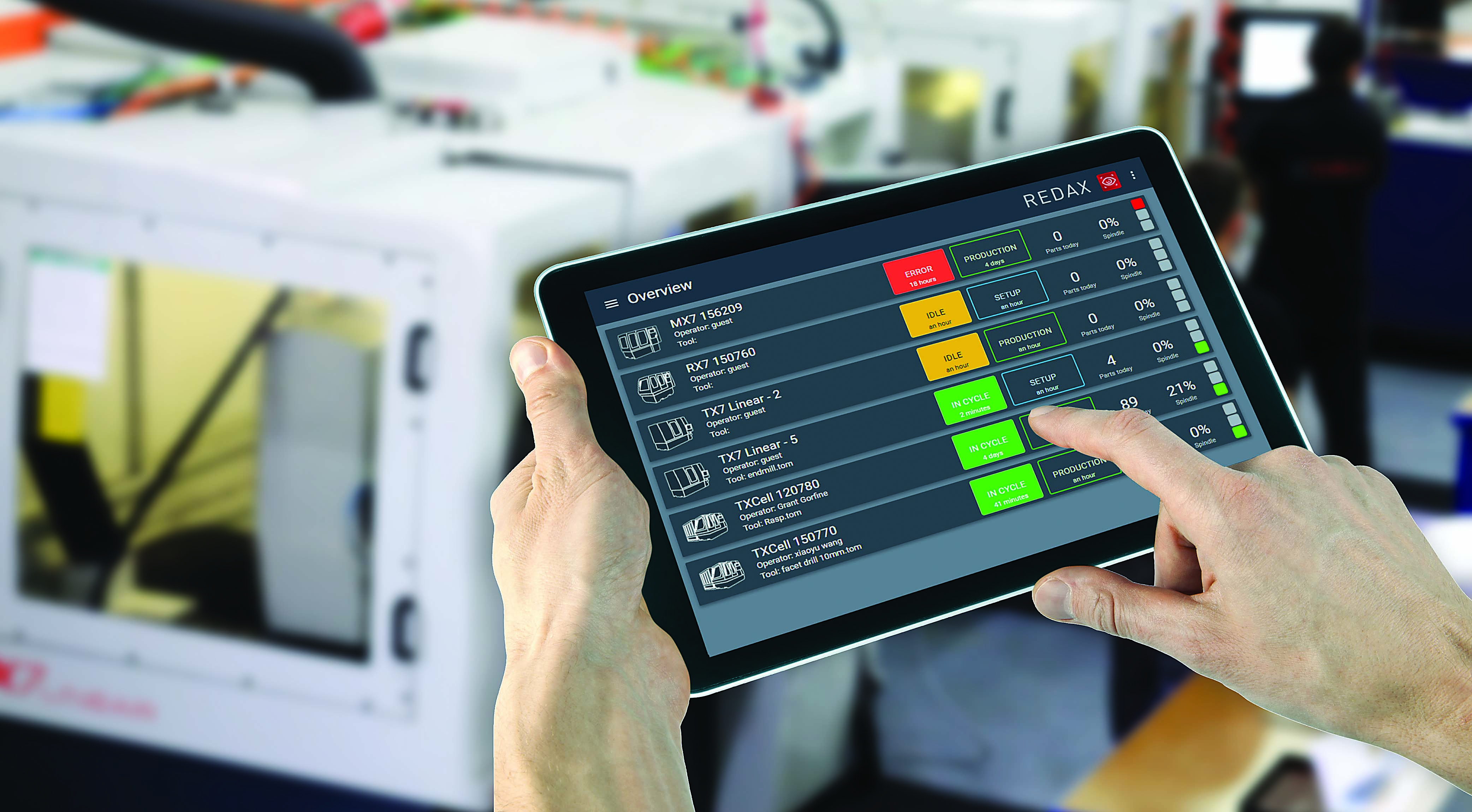
Redax users enter a web address that brings up the system’s dashboard on any type of display. Image courtesy of Anca
FASData is installed on a single computer — for example, a desktop or a small-business server — connected to a shop’s network. Data is viewed on webpages shown by a variety of displaying devices, including PC screens, phones and tablets.
In many cases, complicated analytics isn’t required to produce valuable information, said CNC Engineering Manager Paul Webster of Fanuc America.
“Probably 80% of the issues in shops are relatively straightforward, (like) you had an alarm on your machine for 10 minutes before somebody realized it,” he said. “(An alarm) is a simple thing for software like this to pick up. The same with production data. Maybe the feed rate override is turned down to 50% because an operator doesn’t want to run it at 100%. There are hundreds of examples of data that a simple dashboard, simple analytics, simple reporting can pull out to identify maintenance problems or slowdowns in your production process.”
Grinder Networking
Similar to FASData is Redax software, which is used to network grinding machines to send and receive data. Developed by Melbourne, Australia-based Anca Pty Ltd., Redax allows users to view, analyze, manage and generate reports on production and maintenance data from all machines at a shop. (Anca Inc. is in Wixom, Michigan.) Data is accessible anytime, even when machines are shut down, using any web browser on a desktop computer, mobile phone or tablet, as well as a monitor on a shop floor. Shop personnel also can receive email or text message notifications when machines are down so immediate action can be taken.
On a screen, Redax users see at a glance how all their grinding machines are operating. Displayed data includes machine availability, uptime and time spent in setup. Redax also collects information that lets users calculate overall equipment effectiveness, a common measurement of how well a manufacturing operation is performing compared with its full potential.
By showing which machines at a shop are most productive, Redax makes it possible for shops to identify their best operators.
“Then they can get those operators to train the others so they can have best practices on their whole site,” said Global Marketing Manager Lucas Hale of Anca.
Redax comes in on-site and cloud versions. The on-premises package consists of an Intel minicomputer with a Redax 2.0 server pre-installed for plug-and-play connectivity to a shop’s network.
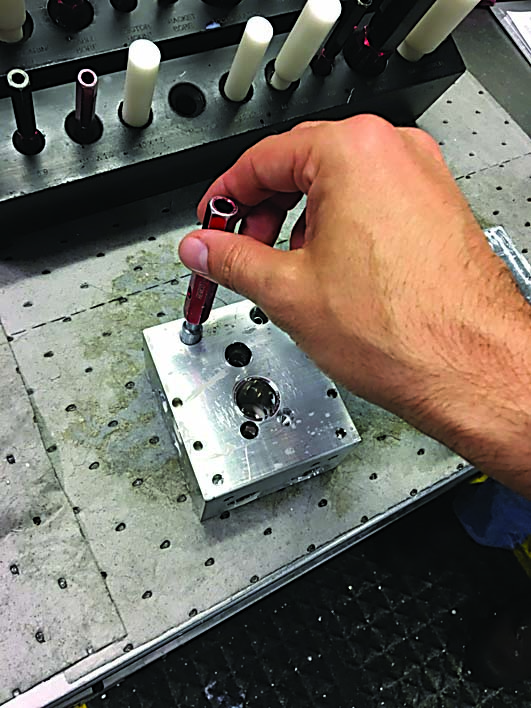
At an automotive parts plant, manually checking holes for chips is time-consuming. Image courtesy of Bosch Rexroth
Hale said some machine shops had a hard time installing the first version of Redax, which was strictly software.
“Small and medium-size shops typically don’t have in-house IT or the skill sets needed to set up a server and install the software, and they struggled to find someone locally who could do it cost-effectively for them,” he said. “So now we provide a turnkey solution that they just plug in to a socket to connect to their network.”
Those who opt for the other version of Redax install software that allows them to connect all their machines to the cloud. This makes their machine and production data available anytime and anywhere.
“If you’re outside of your business network,” Hale said, “you can still pull out your phone and check what’s happening on your machines.”
To receive preventive maintenance advice, users of the cloud version also could let Anca’s service engineers access machine data. But because an insufficient number of shops have opted for the cloud version thus far, he said this service hasn’t been launched fully.
Although it offers more capabilities, the cloud version of Redax has been less popular than the on-premises option. The reason is concern about data security, Hale said, despite the fact that Anca’s cloud provider employs sophisticated security measures.
“Opening up their networks to the outside world is something a lot of companies aren’t comfortable doing,” he said.
Not Connecting
Review the print ads from this magazine to continue
This quick advertiser review unlocks the rest of the article and keeps the full-screen reader focused on the ads instead of the page chrome.
Advertisers included in this article experience
Print placements connected to this article
30 Years Of Excellence I Bluco.Com
HOLD IT A Modular Fixturing System Doesn’t
Cost Money - IT MAKES MONEY. Get your setup done in less than half the time with a modular base plate paired with a kit of precision fixturing components. Our fixtures can be assembled in minutes, not hours or days like outdated manual setups. Show us what you need to get done, and we’ll help you hold onto your parts — and your profits
HOLD IT A Modular Fixturing System Doesn’t Cost Money - IT MAKES MONEY. Get your setup done in less than half the time with a modular base plate paired with a kit of precision fixturing components. Our fixtures can be assembled in minutes, not hours or days like outdated manual setups. Show us what you need to get done, and we’ll help you hold onto your parts — and your profits. Call 800.535.0135 for solutions 30 YEARS OF EXCELLENCE I BLUCO.COM
Visit 30 Years Of Excellence I Bluco.Com View this placement in the issue recordPrint ads from this magazine
Cost Money - IT MAKES MONEY. Get your setup done in less than half the time with a modular base plate paired with a kit of precision fixturing components. Our fixtures can be assembled in minutes, not hours or days like outdated manual setups. Show us what you need to get done, and we’ll help you hold onto your parts — and your profits
HOLD IT A Modular Fixturing System Doesn’t Cost Money - IT MAKES MONEY. Get your setup done in less than half the time with a modular base plate paired with a kit of precision fixturing components. Our fixtures can be assembled in minutes, not hours or days like outdated manual setups. Show us what you need to get done, and we’ll help you hold onto your parts — and your profits. Call 800.535.0135 for solutions 30 YEARS OF EXCELLENCE I BLUCO.COM
Continue reading
August 2020
A major obstacle to using either form of Redax is the sorry state of networking at many shops.
“To set this up, you need connectivity to all your machines,” Hale said. “But often, there is no hard-wired network (at a shop). Or if there is, it’s in very poor condition.”
Anca offers a plug-and-play USB Wi-Fi adapter that allows machines to be hooked up wirelessly. He said this arrangement works “pretty well” for relatively small sites.
“But once you get big, you need to set up a hard-wired network, and that tends to be a challenge for a lot of companies,” Hale said. “They don’t have people with those skills, so it can be very expensive for them to install a network.”
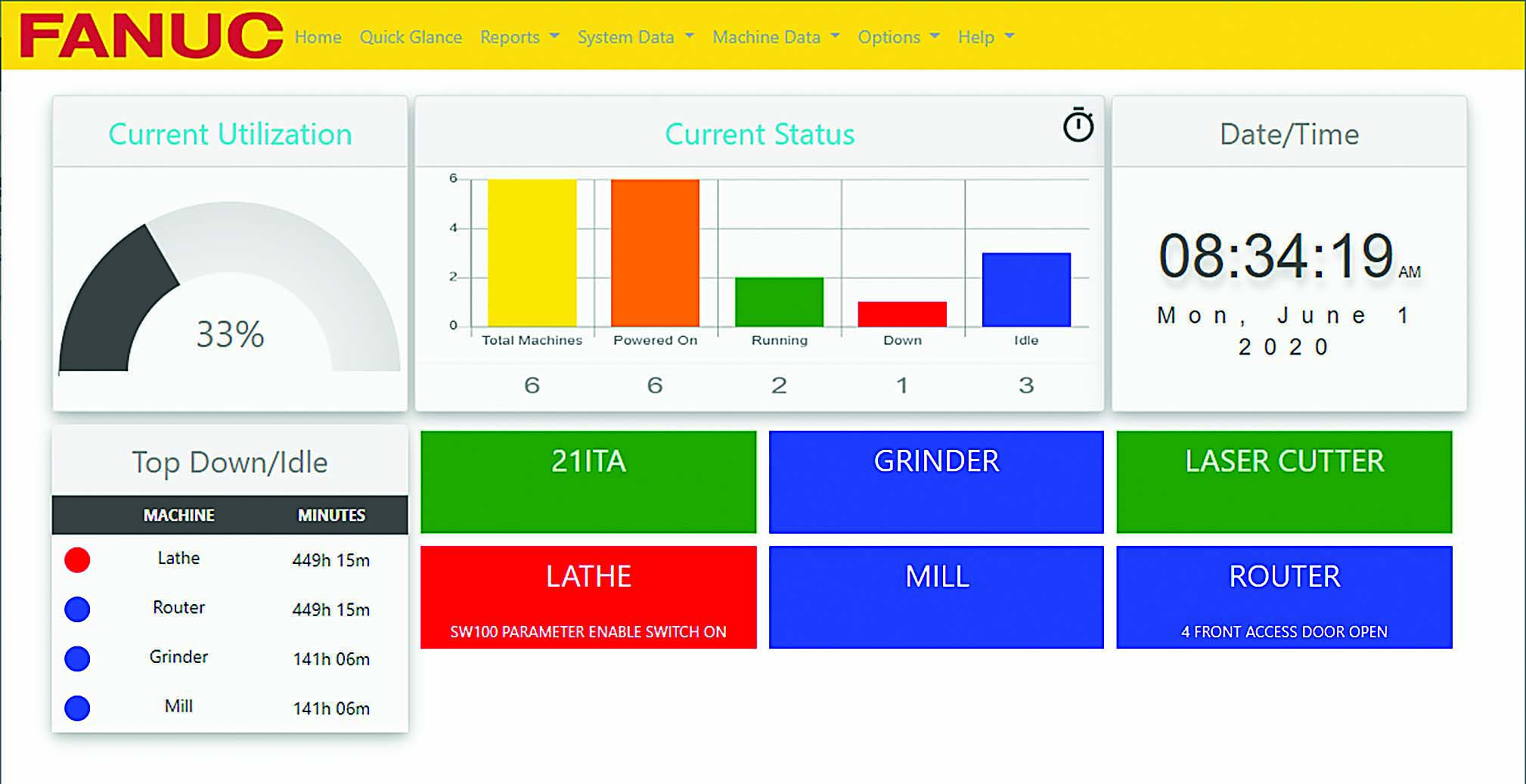
FASData allows machine users to view snapshots of operations on any PC or tablet, as well as on monitors on a shop floor. Image courtesy of Fanuc America
Getting machines connected and communicating on a network is the biggest problem for many users of Fanuc America’s data collection products, Webster reports. Complicating matters is the fact that shops often have different generations of equipment that require different types of connection hardware. Large companies have in-house resources to handle situations like this, he said, but small and midsize shops may not and therefore could require the services of a consultant.
Data Developments
A new product that simplifies equipment networking and communication is the Fanuc Field system. Currently being used by early adopters in Japan but not yet in North America, Field is an edge computing system that allows users to connect machines of different generations and from manufacturers other than Fanuc. The system is compatible with OPC Unified Architecture and MTConnect, both of which are widely accepted standards for industrial machine-to-machine communication.
An open platform, Field also lets users connect devices, such as robots, programmable logic controllers and sensors from different suppliers, to networks. In addition, the system can link to common in-plant programs like those for enterprise resource planning, supply chain management and manufacturing execution.
“Field takes care of data collection and allows other applications to do analytics,” Webster said, adding that the system can download and install applications written by other vendors, including some machine-learning apps. “The amount of data it collects is quite large, and applications could be written to leverage all that data.”
While Redax was developed specifically for users of Anca’s tool and cutter grinders, the software allows the machines to connect to other equipment at a plant, Hale said. Anca is involved in the ongoing effort to develop umati, which is short for universal machine tool interface, a companion specification for OPC UA. The purpose of umati is to permit easy, secure connections of machine tools and related equipment to user IT systems to facilitate transmission of machine- and production-related data. Last year, Anca took part in an umati demonstration involving about 60 companies that shared machine information.
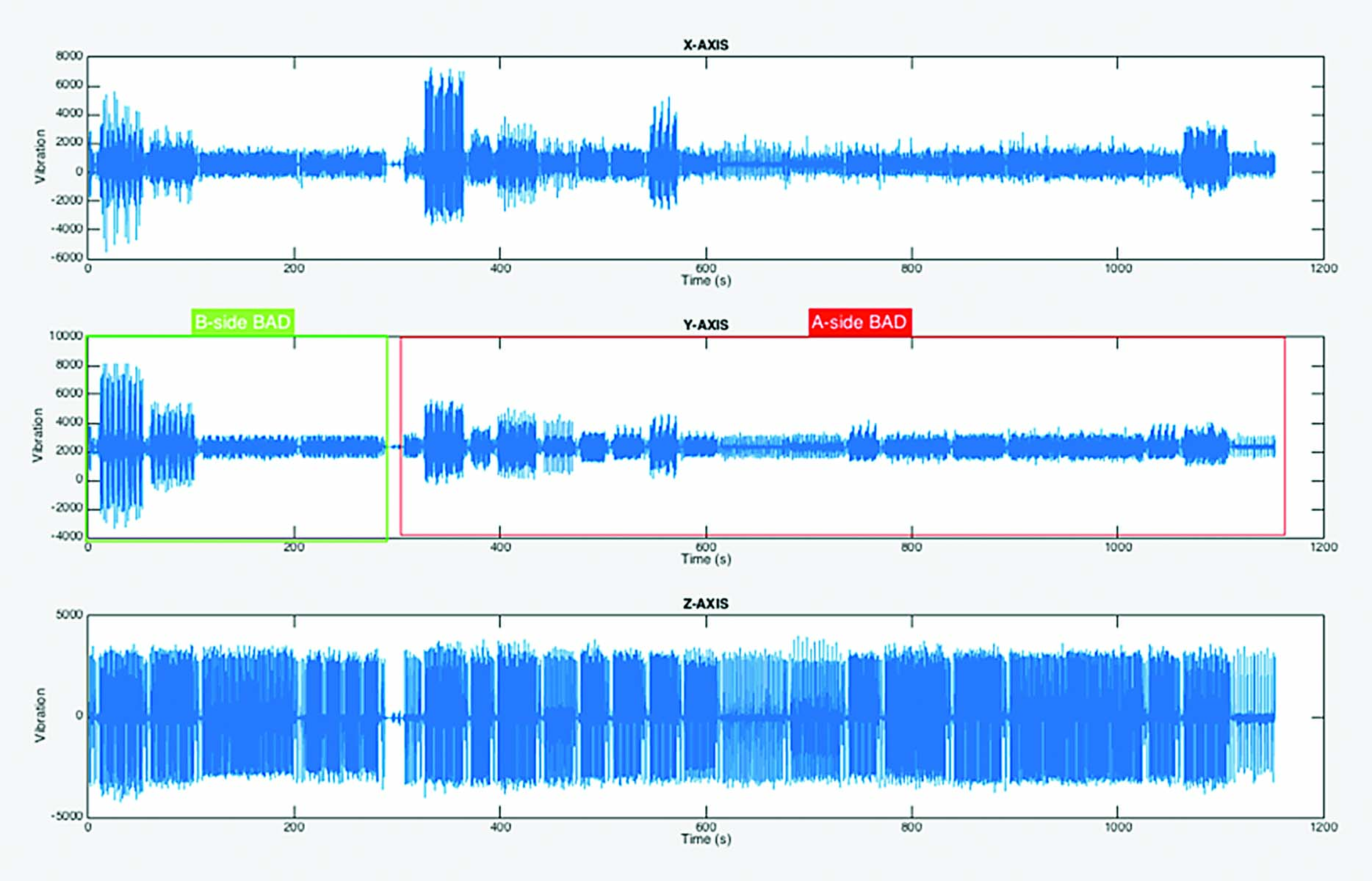
Bosch Rexroth’s analytics system (above) can determinequickly and accurately whether a part is good, eliminating the need for manual inspection. Image courtesy of Bosch Rexroth
In addition to efforts to standardize data to enable sharing information, he sees a good deal of work being done in the area of data gathering for predictive maintenance. This involves collecting information from machines — vibration, temperature, electrical signals, power draw, etc. — and identifying problems as machines fall out of tolerance, as well as informing users of what to do to solve the problems.
“That will allow more autonomous manufacturing so companies can reduce the number of people on-site,” Hale said. “This works well in the COVID environment and will also work well once economies get up and running again. Everyone was pushing in that direction because of labor shortages, and I expect that to come back very strongly on the other side of this crisis.”
Automated Part Checks
Automated data collection and analysis also can be employed to assess the quality of machined parts. At a plant in South Carolina, an artificial intelligence system developed by the North American research and development team of Charlotte, North Carolina-based Bosch Rexroth Corp. is gathering and analyzing data to spot bad automotive components made by 38 CNC machines. The machines drill two different holes in each part. After a machine drills a hole in one side of a part, a tower holding the workpieces rotates and a second hole is drilled in the other side of the component. In the process, chips that are sent flying during cutting operations can end up in the already drilled cavities and produce undesired part vibration.
The goal of the R&D team was to eliminate the need for humans to manually check each part for chips in cavities.
“It’s a tedious and time-consuming operation,” said Lead Innovation Strategist Matteo Dariol of Bosch Rexroth.
The system created by him and his colleagues includes Bosch sensors mounted on a drill to capture vibration data, which is collected by an edge device near the machines and eventually travels to an Amazon Web Services cloud platform for analysis.
To create an AI neural network capable of evaluating the parts, the Bosch Rexroth team had to extract certain information from the vibration signal produced during drilling. The team also needed “labels” created by operators clicking on Amazon Dash buttons to signal whether each drilled part was good. By matching labels and vibration information produced at different times during machining, the team was able to teach the neural network which vibration data indicated a bad part (one with a chip in the cavity) and a good part (one with no chip in the cavity), as well as the type of tool used in the machining operation.
Downloaded to the edge device, the neural network can evaluate parts almost instantaneously as they’re machined, Dariol said. The system has been running for more than two years and has become more accurate over time thanks to continuous data collection.
“Now we produce 1% or less false positives and false negatives,” he said. “So our customers are really trusting the results they are getting from our system.”