

Printing large objects fast: Research & Innovation
The High-Area Rapid printing 3D printer prints objects as large as an adult human in just a couple of hours.
The High-Area Rapid Printing 3D printer is sufficiently big and fast to print objects as large as an adult human in just a couple of hours. The ability to rapidly print parts on demand could make parts warehousing and expensive molds things of the past. Developed by Northwestern University researchers, HARP will be available by next year from Azul 3D Inc., Evanston, Illinois.
“HARP enables machinists to make jigs, tools and molds quickly and efficiently out of durable materials,” said James Hedrick, CEO and co-founder of Azul 3D.
He said large parts can be made in a single piece from industrial-grade materials.
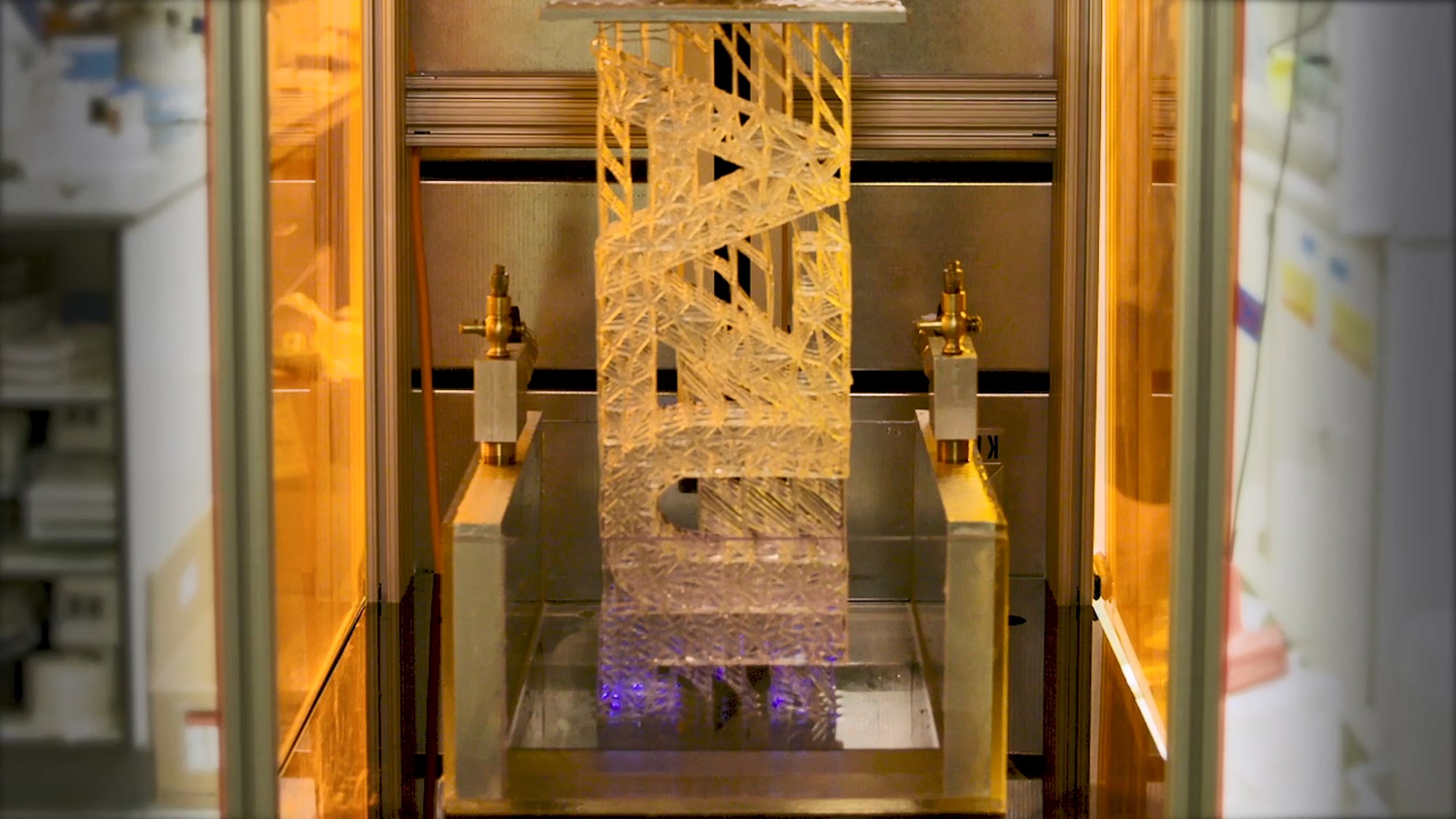
The HARP 3D printer is suitable for producing both large and small parts. Image courtesy of Azul 3D
While Hedrick completed his doctorate at Northwestern under the supervision of professor Chad Mirkin, he worked in a laboratory with postdoctoral student David Walker. The three men started to develop a nano-3D printer.
They realized early that the printer could print both large and tiny structures.
“We recognized immediately that with HARP, we had the ability to transform manufacturing,” Hedrick said. “We transitioned our focus from nano to macro, and the three of us founded Azul 3D to transition the technology from the lab to the factory.”
Review the print ads from this magazine to continue
This quick advertiser review unlocks the rest of the article and keeps the full-screen reader focused on the ads instead of the page chrome.
Advertisers included in this article experience
Print placements connected to this article
Nachiamerica
RE-Think Your
Carbide Oil Hole Drills with Nachi’s Aqua REVO Drill Unique patented design for coolant directed at the cutting edge Conventional Aqua REVO Keep your drill cooler while drilling ~ Allowing you to extend tool life. REVO lutionizing Drilling Area with low cooling effect Area with high cooling effect.
RE-Think Your Carbide Oil Hole Drills with Nachi’s Aqua REVO Drill Unique patented design for coolant directed at the cutting edge Conventional Aqua REVO Keep your drill cooler while drilling ~ Allowing you to extend tool life. REVO lutionizing
Visit Nachiamerica View this placement in the issue recordPrint ads from this magazine
Carbide Oil Hole Drills with Nachi’s Aqua REVO Drill Unique patented design for coolant directed at the cutting edge Conventional Aqua REVO Keep your drill cooler while drilling ~ Allowing you to extend tool life. REVO lutionizing Drilling Area with low cooling effect Area with high cooling effect.
RE-Think Your Carbide Oil Hole Drills with Nachi’s Aqua REVO Drill Unique patented design for coolant directed at the cutting edge Conventional Aqua REVO Keep your drill cooler while drilling ~ Allowing you to extend tool life. REVO lutionizing
Continue reading
April 2020
The prototype HARP is 3.96 m (13′) tall with a 0.23-sq.-m (2.5-sq.-ft.) print bed and can print about 0.5 m (1.5′) in an hour. The machine is suitable for printing individual large parts or many different small parts at once.
The company has an ever-expanding library of materials that HARP can use, including ceramics and durable, tough elastomeric rubber. The key advantages of the machine are fast throughput and the ability to produce industrial-grade parts at a cost point that enables manufacturers to move beyond prototyping with 3D printing, Hedrick said.
HARP uses a new, patent pending version of stereolithography — a type of 3D printing that converts liquid plastic into a solid. The machine prints on a vertically moving plate and projects ultraviolet light to cure liquid resins into hardened plastic. HARP is in a class of 3D printers that uses high-resolution light patterning to produce parts that don’t need extensive post-processing.
This method can print pieces that are hard or elastic. These continually printed parts are mechanically robust as opposed to the laminated structures common with other 3D-printing technologies, according to Azul 3D.
Thanks to a nonstick liquid that behaves like liquid Teflon, the technology of the machine bypasses the problem of large amounts of heat being generated during printing. HARP projects light through a window to solidify resin. The liquid flows over the window to remove heat and then circulates it through a cooling unit.
“3D printing and HARP offer tremendous opportunities for manufacturing in tooling and for making end-use parts,” Hedrick said.
For more information about Azul 3D, visit www.azul3d.com.
Related




Subscribers can use MFGAxis notes, saves and discussion tools with their innoNET account.


