

Brushing away burrs: Trade Shows & Events
Burrs on machined metal parts come in a variety of shapes and sizes but have one thing in common: They must be removed.
Burrs on machined metal parts come in a variety of shapes and sizes but have one thing in common: They must be removed.
JR Precision & Welding LLC generates light, medium and heavy burrs when machining 4140 steel muzzle brakes. Removing the burrs is challenging, said James Mawazeb, director of operations and lead engineer at the Houston-based machine shop, which was founded in 2017.
A muzzle brake, or compensator, is a device connected to the barrel of a rifle or pistol to help control recoil and the rising of the barrel that normally occurs after firing. Muzzle brakes utilize slots, vents, holes, baffles or similar features to redirect a portion of propellant gases to counter recoil. Burrs form on the oval-shaped gas ports of parts.
Mawazeb said the shop initially took additional passes with the cutting tools that had been used to machine the parts.
“It never helped us remove any of the burrs,” he said.
JR Precision & Welding next sought whether another company could deburr the parts with aluminum-oxide sandblasting or even glass beads, but the processes proved ineffective, Mawazeb said.
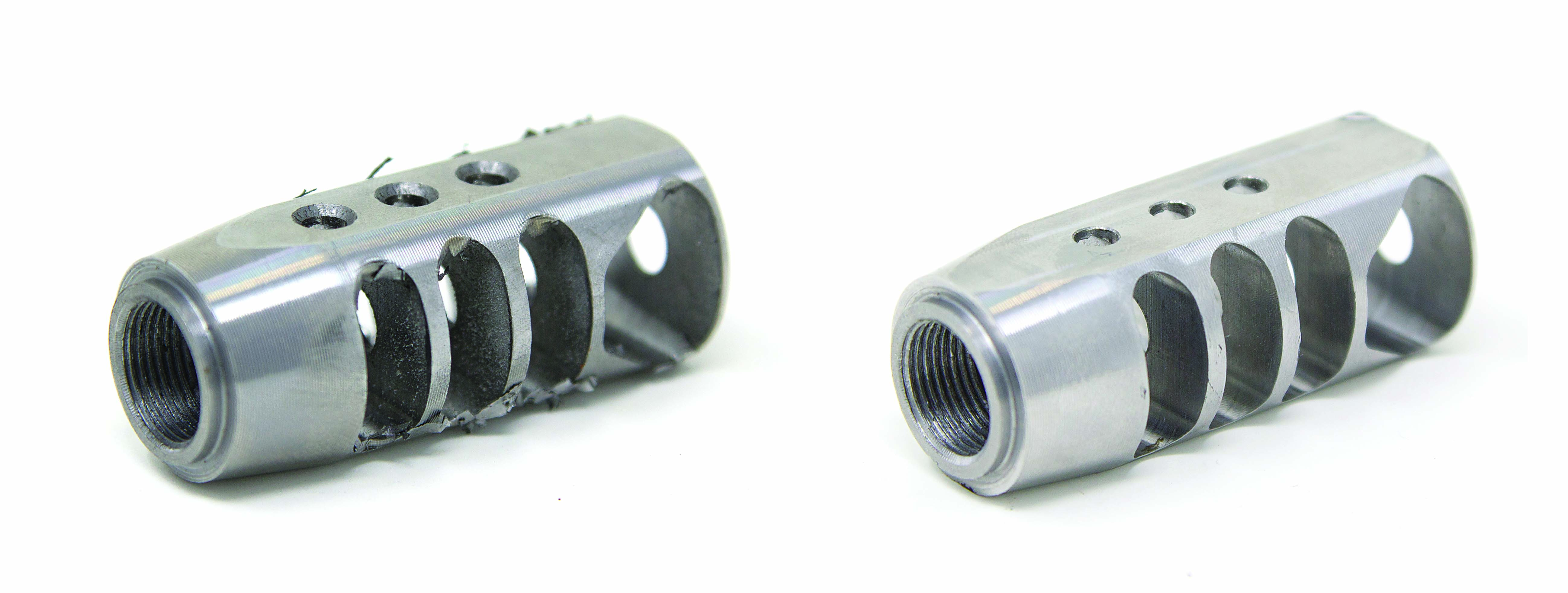
A 4140 steel muzzle brake is shown before and after deburring. image courtesy of JR Precision & Welding
Manually deburring light burrs with a hook-shaped deburring tool and removing large burrs with a Dremel rotary power tool outfitted with a sander were effective but inefficient methods.
“We pumped out 500 parts within about 10 days,” Mawazeb said, “and it took us an extra six days just to deburr all those parts. Even after we got done with deburring them, I still had to make sure every part was right. A lot of people consider me a stickler for that, but if you are going to put your name on a product, you have to make sure it’s right.”
He defined a light burr as one that can be removed with a thumbnail and said large burrs can’t be. The largest burrs the shop sees are about 3.175 mm (0.125″) high.
Adding to the challenge was that the bar stock JR Precision & Welding previously machined was from a supplier that sold only heat-treated 4140 steel bars, Mawazeb said. The shop eventually switched to a supplier of annealed stock, which is easier to machine and deburr.
For a solution, JR Precision & Welding turned to Houston-based tool distributor Bass Tool & Supply Inc., which suggested testing an abrasive brush with filaments angled down. He said results were unimpressive.
Review the print ads from this magazine to continue
This quick advertiser review unlocks the rest of the article and keeps the full-screen reader focused on the ads instead of the page chrome.
Advertisers included in this article experience
Print placements connected to this article
Nskamericacorp
The Possibilities Are Endless
with the Versatile E-Speed ONE-PIECE & MODULAR ELECTRIC MOTOR SPINDLES • Versatile for Lathes, Machining Centers, Custom Machine Applications and Robotic Applications • Maximum Speed 80,000 rpm • Maximum Output 1,200W • Accuracy Less than 1 µm Flange and Straight Motors/Spindles Available in: ø20mm | ø22.8mm | ø25mm | ø30mm | ø40mm.
The Possibilities Are Endless with the Versatile E-Speed ONE-PIECE & MODULAR ELECTRIC MOTOR SPINDLES • Versatile for Lathes, Machining Centers, Custom Machine Applications and Robotic Applications • Maximum Speed 80,000 rpm • Maximum Output 1,200W • Accuracy Less than 1 µm Flange and Straight Motors/Spindles Available in: ø20mm | ø22.8mm | ø25mm | ø30mm | ø40mm
Visit Nskamericacorp View this placement in the issue recordOmgamerica
FH RELY ON O.M.G. HEADS
We prove our skills by continually innovating our range and by engineering cutting-edge products. BAH With a highly professional approach we look for the right balance between operative efficiency and quality service for maximum customer satisfaction. TA.CP TA MO HT VH TSI/TSX T MT-TC-TC3 TA-TAV-TAF-TAO SERIES ANGLE HEADS.
FH RELY ON O.M.G. HEADS We prove our skills by continually innovating our range and by engineering cutting-edge products. BAH With a highly professional approach we look for the right balance between operative efficiency and quality service for maximum customer satisfaction. TA.CP TA MO HT VH TSI/TSX
Visit Omgamerica View this placement in the issue recordPrint ads from this magazine
with the Versatile E-Speed ONE-PIECE & MODULAR ELECTRIC MOTOR SPINDLES • Versatile for Lathes, Machining Centers, Custom Machine Applications and Robotic Applications • Maximum Speed 80,000 rpm • Maximum Output 1,200W • Accuracy Less than 1 µm Flange and Straight Motors/Spindles Available in: ø20mm | ø22.8mm | ø25mm | ø30mm | ø40mm.
The Possibilities Are Endless with the Versatile E-Speed ONE-PIECE & MODULAR ELECTRIC MOTOR SPINDLES • Versatile for Lathes, Machining Centers, Custom Machine Applications and Robotic Applications • Maximum Speed 80,000 rpm • Maximum Output 1,200W • Accuracy Less than 1 µm Flange and Straight Motors/Spindles Available in: ø20mm | ø22.8mm | ø25mm | ø30mm | ø40mm
Continue reading
April 2020
“When it would go over the part,” Mawazeb said, “it would be like it was a toothbrush just rubbing over the metal. So it didn’t actually remove anything. It actually scuffed up the part more and left a horrible finish.”
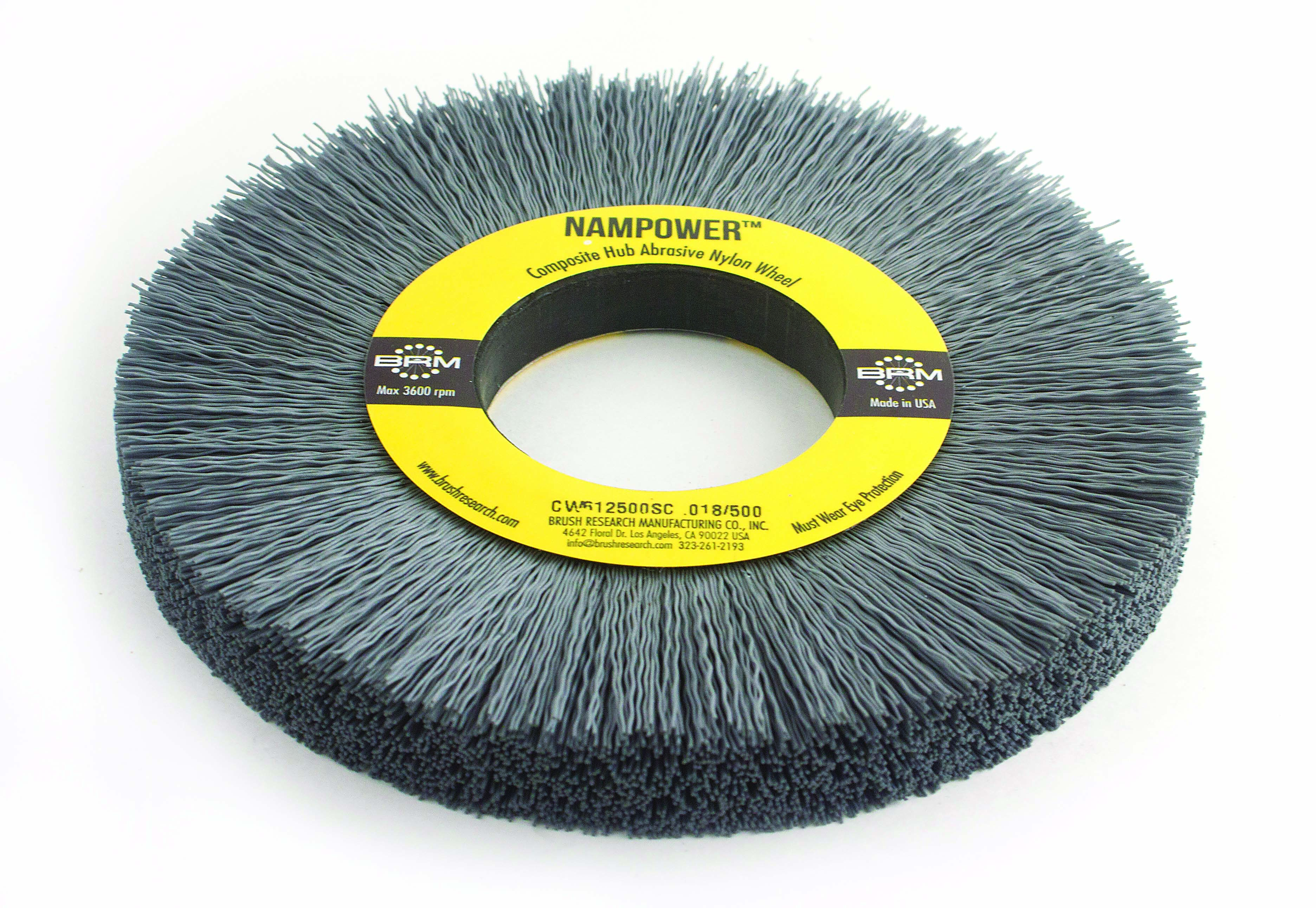
A composite hub abrasive nylon wheel brush handles challenging deburring applications. Image courtesy of Brush Research Manufacturing
By switching from a four-flute endmill to a five-flute endmill, JR Precision & Welding reduced average burr size but still needed an efficient solution. Bass Tool & Supply recommended an abrasive brush from another toolmaker that the distributor carries: Los Angeles-based Brush Research Manufacturing Co. Inc. He wasn’t convinced that a different brush would do the job but sent parts to test at Brush Research Manufacturing’s surface finishing laboratory. After a test in which an abrasive disc brush didn’t sufficiently remove burrs, Brush Research Manufacturing deburred a part with a 152.4 mm-dia. (6″-dia.) abrasive nylon wheel brush that has filaments made of silicon carbide.”It was able to easily get into the slots, push the burrs out and remove them,” said Elysha Cole, product support specialist at Brush Research Manufacturing.
The filaments self-sharpen. As a brush contacts a work surface, filament grit wears off and exposes new cutting particles. This action enables a brush to remain sharp even after repeated use.
After the concept was proven in a lab, JR Precision & Welding purchased an 80-grit 76.2 mm-dia. (3″-dia.) brush. The shorter trim fill has less give and delivers a more aggressive deburring force than the larger version. In addition to removing midsize and large burrs without altering the surface finish, the brush provides a soft edge break to the four gas ports so they are not razor sharp. Mawazeb said deburring a part with the brush takes about a minute. The shop purchased the brush in August and had yet to replace the brush after months of use.
To remove light burrs, it’s more efficient to run a secondary operation using a 4.7625 mm-dia. (0.1875″-dia.) two-flute chamfering tool, which would break when removing heavier burrs, he said.
“We eyeball to determine burr size,” Mawazeb said.
End User
JR Precision & Welding LLC, 972-322-2718
Solution Providers
Bass Tool & Supply Inc., 800-442-0042, www.basstool.com
Brush Research Manufacturing Co. Inc., 323-261-2193, www.brushresearch.com
Challenge
Remove burrs from 4140 steel muzzle brakes for firearms.
Solution
An abrasive nylon wheel brush.
Glossary terms in this article
Related




Subscribers can use MFGAxis notes, saves and discussion tools with their innoNET account.


