

CNC takes machine shops to new levels
I had the privilege of learning the machining craft at my family's machine shop. It was a true mom and pop shop where we made anything that would pay the bills. As orders grew larger and parts became more complex, it was clear that our future would depend on successfully integrating CNC equipment into our shop.
I had the privilege of learning the machining craft at my family’s machine shop. It was a true mom and pop shop where we made anything that would pay the bills. As orders grew larger and parts became more complex, it was clear that our future would depend on successfully integrating CNC equipment into our shop. In 1995, we purchased our first machining center: a small one without any options.
Buying it launched our shop to the next level. Five weeks after receiving the machine, we ordered another just like it. I programmed them with a pencil, paper and a calculator, typed codes into the controls and stored all programs in the machine tool controls. We used edge finders and indicators to set parts and measured tool lengths by touching parts with each tool. Compared with today’s technology, our methods were crude.
Machining centers and techniques have advanced at a fast pace since I started programming and operating CNC machines. A few significant improvements have transformed the machines into what we use today, enhancing shop and machinist efficiency.
Need for Speed
Our first CNC machine was capable of only a 7,500-rpm spindle speed. Although machines were available with higher-speed spindles, those machines were expensive and rarely found at small shops.
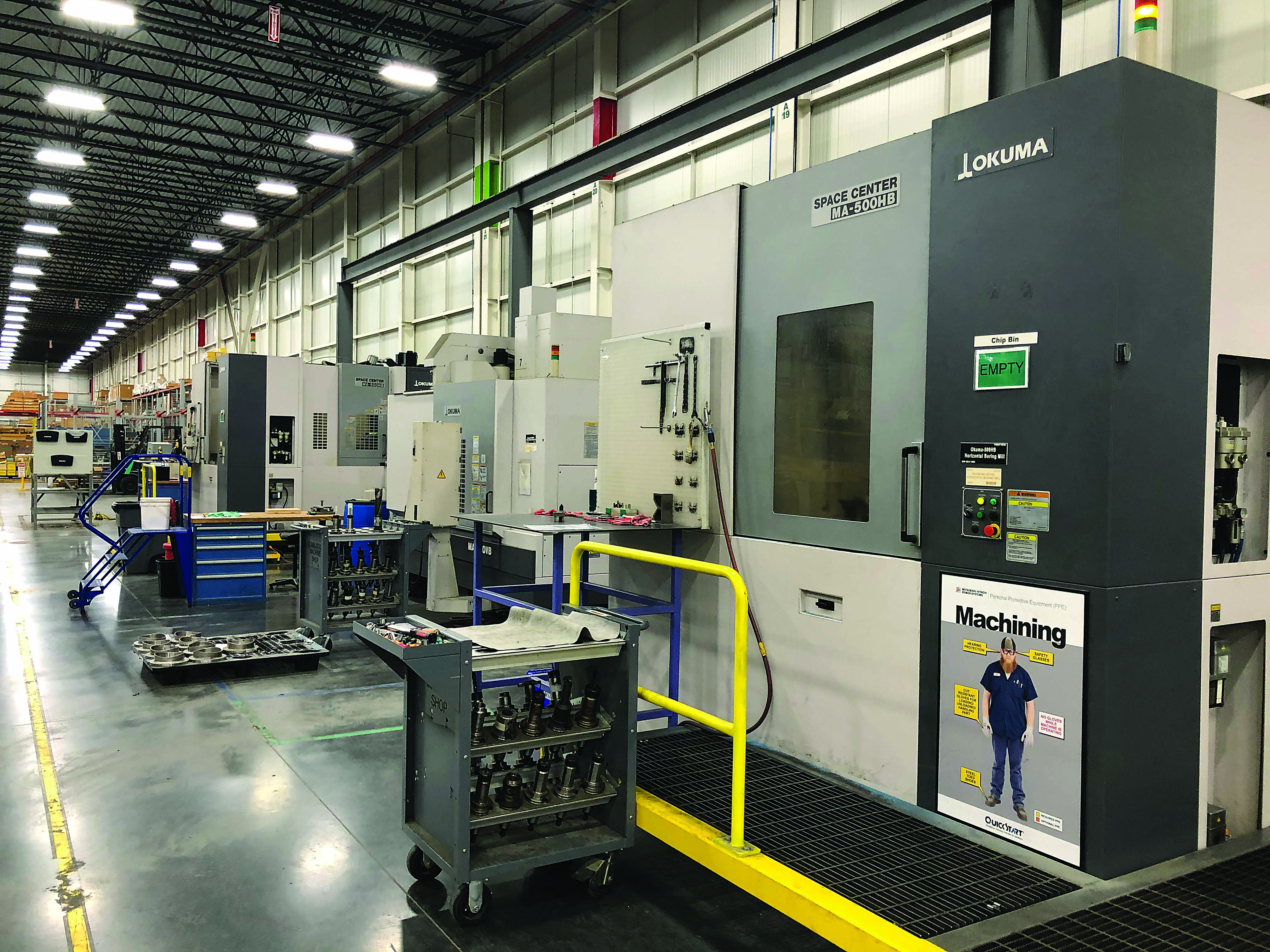
Mitsubishi Hitachi Power Systems Americas has several machining centers (right) with features like high-torque
spindles and through-spindle coolant. Image courtesy of C. Tate
When we bought our original machines, we would have needed to use some type of ancillary device, such as an air spindle or a geared spindle speeder, to achieve higher spindle speeds. In addition to being costly, spindle speeders were often unreliable and underpowered. Today, it is common for machining centers to have 20,000-rpm spindles.
Spindle speed may sound insignificant, but it has a direct impact on the programmed feed rate of a machine tool. High feed rates usually mean high removal rates and reduced cycle times, making a shop more efficient.
Every programmer should know that rpm multiplied by feed per tooth equals inches per minute. So as spindle speeds increased, more dynamic machine tools were needed.
Review the print ads from this magazine to continue
This quick advertiser review unlocks the rest of the article and keeps the full-screen reader focused on the ads instead of the page chrome.
Advertisers included in this article experience
Print placements connected to this article
Nskamericacorp
The Possibilities Are Endless
with the Versatile E-Speed ONE-PIECE & MODULAR ELECTRIC MOTOR SPINDLES • Versatile for Lathes, Machining Centers, Custom Machine Applications and Robotic Applications • Maximum Speed 80,000 rpm • Maximum Output 1,200W • Accuracy Less than 1 µm Flange and Straight Motors/Spindles Available in: ø20mm | ø22.8mm | ø25mm | ø30mm | ø40mm.
The Possibilities Are Endless with the Versatile E-Speed ONE-PIECE & MODULAR ELECTRIC MOTOR SPINDLES • Versatile for Lathes, Machining Centers, Custom Machine Applications and Robotic Applications • Maximum Speed 80,000 rpm • Maximum Output 1,200W • Accuracy Less than 1 µm Flange and Straight Motors/Spindles Available in: ø20mm | ø22.8mm | ø25mm | ø30mm | ø40mm
Visit Nskamericacorp View this placement in the issue recordPrint ads from this magazine
with the Versatile E-Speed ONE-PIECE & MODULAR ELECTRIC MOTOR SPINDLES • Versatile for Lathes, Machining Centers, Custom Machine Applications and Robotic Applications • Maximum Speed 80,000 rpm • Maximum Output 1,200W • Accuracy Less than 1 µm Flange and Straight Motors/Spindles Available in: ø20mm | ø22.8mm | ø25mm | ø30mm | ø40mm.
The Possibilities Are Endless with the Versatile E-Speed ONE-PIECE & MODULAR ELECTRIC MOTOR SPINDLES • Versatile for Lathes, Machining Centers, Custom Machine Applications and Robotic Applications • Maximum Speed 80,000 rpm • Maximum Output 1,200W • Accuracy Less than 1 µm Flange and Straight Motors/Spindles Available in: ø20mm | ø22.8mm | ø25mm | ø30mm | ø40mm
Continue reading
April 2020
Our initial CNC machine was not high end but had comparable specifications to many other machining centers on the market. In rapid traverse mode, the machine would travel 10.16 m/min. (400 ipm). In a feed move, the machine could go 6.35 m/min. (250 ipm). Machines today are capable of rapid traverse and cutting feed rates in excess of 60.96 m/min. (2,400 ipm) — six times faster than our machine.
As machining centers have become more dynamic, the use of advanced milling techniques, commonly called high-speed machining, has gained popularity. HSM offers many benefits like reduced cutting forces, extended tool life and large depth-to-diameter ratios, all of which increase milling efficiency. HSM toolpaths are based on maintaining uniform chip thickness across a profile, which requires substantial computing power. Therefore, creating HSM paths without software would be impossible.
Growth of CAM
Few shops 25 years ago used CAM software as we do today. Small shops relied on conversational controls or — like we did at my shop — used brute force by writing G code on paper and then typing that into a control. Even large companies at the time depended on unwieldy systems, such as Automatically Programmed Tool, a cumbersome Fortran-based language that required thousands of hours to master.
CAM software with a graphical user interface transformed programming into an activity like a video game. Programming is so easy that almost anyone can create a simple toolpath after a few minutes of training. Without modern CAM software, HSM toolpaths would not be possible. And we would not have been able to fully capitalize on increased speeds without HSM.
Loading programs and other data into a CNC requires a communication system. At my family’s shop, I typically typed programs directly into a control, which was painfully inefficient. We tried to connect a machine to a computer to improve efficiency, but it never worked properly. We abandoned the project after determining that it was too complex for our skill set.
Machine tool controls now come designed to communicate, and connectivity is simple. Most have Cat5 connections and USB ports, and some have wireless connectivity. At least one builder already allows connection and data transfer with a smartphone. Connectivity, data collection and remote interaction with machines will dominate future control development.
Looking ahead, we will continue to see significant advances in communication, connectivity and data transfer. More importantly, I expect more machining and additive manufacturing processes to be combined into a hybrid platform in which a near net shape component is produced with an additive process and fine-tuned with a machining process. Making a part soon may be as simple as saying, “Hey, Siri, make a widget.”
Glossary terms in this article
Related



Subscribers can use MFGAxis notes, saves and discussion tools with their innoNET account.


