Parts cleaning can be complicated
Almost all machined parts coming out of a machine tool are covered in some type of metalworking fluid residue. Depending on the next step in a part's life, a certain amount of cleaning is in order. A major factor in determining the type of necessary cleaning is the degree of cleanliness specified by a customer.
Almost all machined parts coming out of a machine tool are covered in some type of metalworking fluid residue. Depending on the next step in a part’s life, a certain amount of cleaning is in order. A major factor in determining the type of necessary cleaning is the degree of cleanliness specified by a customer. Other considerations include the workpiece material, the type of debris to be removed and the level of complexity for part features.
“It really depends on which stage of the manufacturing process you’re on,” said Sandro Siminovich, director of sales for Ecoclean Inc., Southfield, Michigan.
Cleaning parts generally involves a combination of cleaning time, a solution and the solution temperature. The two main drivers of solution chemistry are the debris, or soils, that must be removed and the workpiece material. Some materials, such as aluminum, brass and bronze, can be harmed when cleaned with an incorrect solvent. And some cleaning agents can affect post-machining processes, such as plating, said Bernie Santerre, manager of
outside sales and business development for Graymills Corp., Broadview, Illinois.
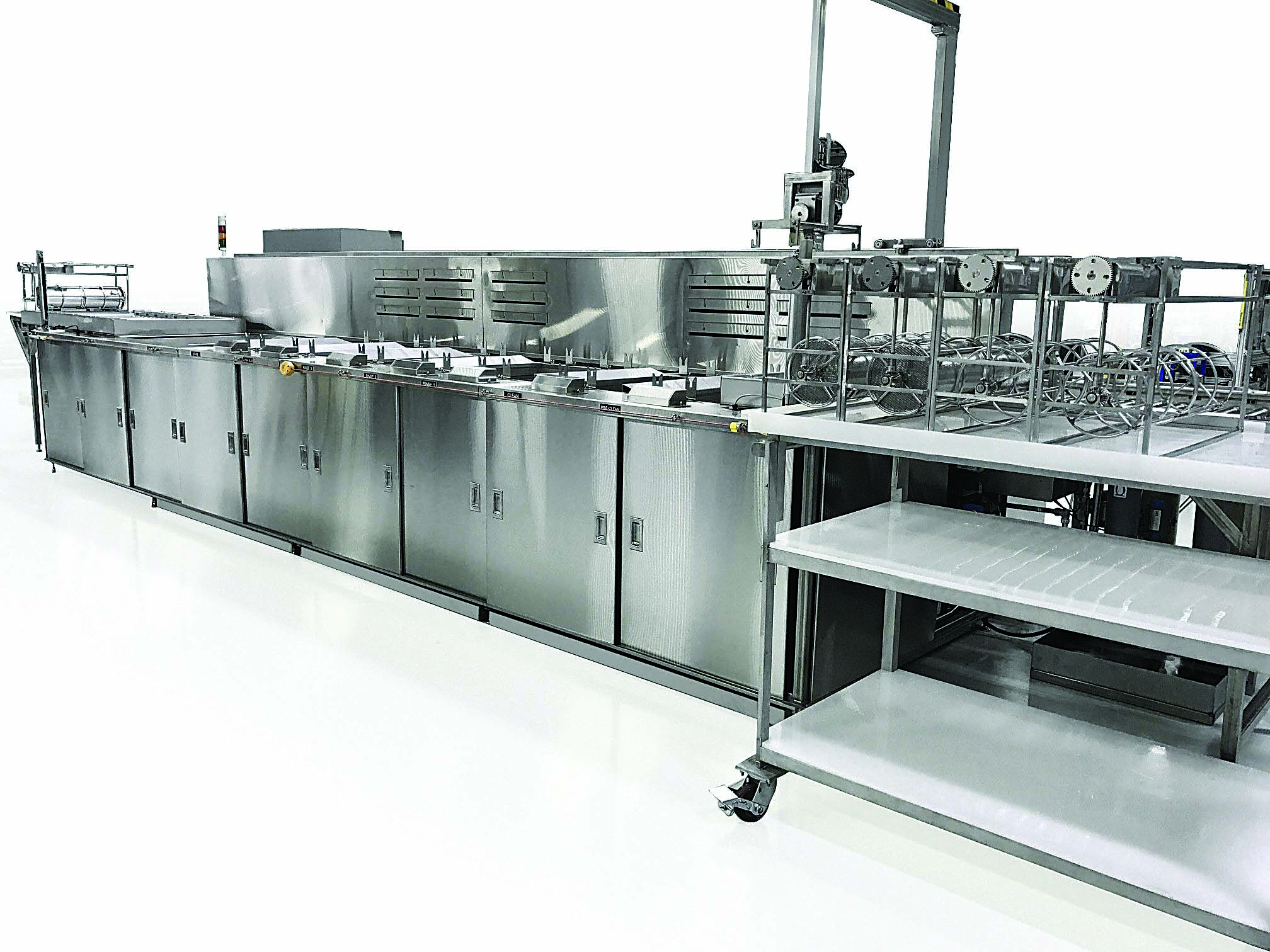
The rotation silo is a parts cleaner that features indexing rotation and ultrasonics to enhance batch cleaning of parts with complex geometries that might be prone to nesting. Image courtesy of Miraclean Ultrasonics
“The right machine also needs to factor in load size and throughput goals,” said Cheryl Larkin, Northeast regional sales manager for Miraclean Ultrasonics, Ashville, New York.
Finding the right parts cleaner ultimately can be just as complicated as the cleaning process itself.
The Cleaning Process
To select an appropriate cleaning agent, the maxim “like dissolves like” applies. If a shop uses a nonpolar cutting fluid, such as mineral oil or grease, a solvent might be the correct choice. When ultrasonic cleaning, for example, chips and particles, which are polar contaminations, no longer adhere to a part after the oil or grease is removed and are carried away by the cleaning action.
The ultrasonic process uses ultrasound, usually 20 to 40 kHz, to agitate a fluid. Ultrasonics introduces microscopic bubbles into a cleaning solution. They implode and take the soil with them. The bubbles travel wherever a solution goes, making ultrasonics suitable to clean parts with complex geometries and apertures.
Water-based detergents also effectively break the soil bond when properly matched to substrates and soils based on the pH level, solution concentration and temperature.
The higher the temperature, the better, Siminovich said. Solvent-based machines typically work with a temperature of about 65.6° C (150° F) during the liquid phase. With vapor degreasing, the temperature is about 121.1° C (250° F). For water-based cleaning, the temperature is usually about 37.8° to 48.9° C (100° to 120° F).
Increasing cleanliness requirements and achieving consistent cleaning results are common demands, he said.
Two main criteria measure how clean a part must be: the visible particle size and weight, which are measured in microns and milligrams, and the invisible surface tension, which is measured in millinewtons per meter or by contact angle and indicates how much of a chemical is left on a surface.
“At Miraclean,” Larkin said, “we build for a variety of industries, and each customer’s cleaning requirement is unique.”
She said requirements range from visual inspection and particle counts to water break tests and black light or white glove inspections.
The Cleaning Systems
Finding the right parts cleaning machine or system is “shockingly complicated,” said Tom Kucklick, applications specialist at Graymills.
A batch machine is widely used to simultaneously clean a large number of small parts, which are placed in trays or baskets and go into one or more tanks depending on the number of stages. With a single-chamber machine, parts go inside the chamber, and the entire process takes place inside.
One of the most common forms of parts cleaning is ultrasonic cleaning. It can be used with just water, but adding a cleaning agent appropriate for the part to be cleaned and the type of soiling present enhances cleanliness.
The simplest form of water-based ultrasonic cleaning consists of a standard-size heated tank, such as one measuring 304.8 mm × 304.8 mm (12″×12″). Parts go into a basket, which a user lowers into a tank that contains chemistry. The amount of time needed to clean them is calculated through trial and error. Parts then are rinsed. Some operations use a second tank for rinsing. Others just rinse parts in a sink and blow off excess water by hand with a compressed air hose.
A large facility that deals with heavily soiled items, such as injection molds or remanufactured automotive parts, might need a bigger parts washer that offers more mechanical cleaning action. That may require an ultrasonic tank that heats water and has a platform that agitates up and down. Those parts also must be rinsed and inhibited or dried.
An installation by Graymills involved an aggressive pre-wash, an ultrasonic wash, rinsing and drying. However, less than 10% of the company’s cleaning systems have multiple stages.
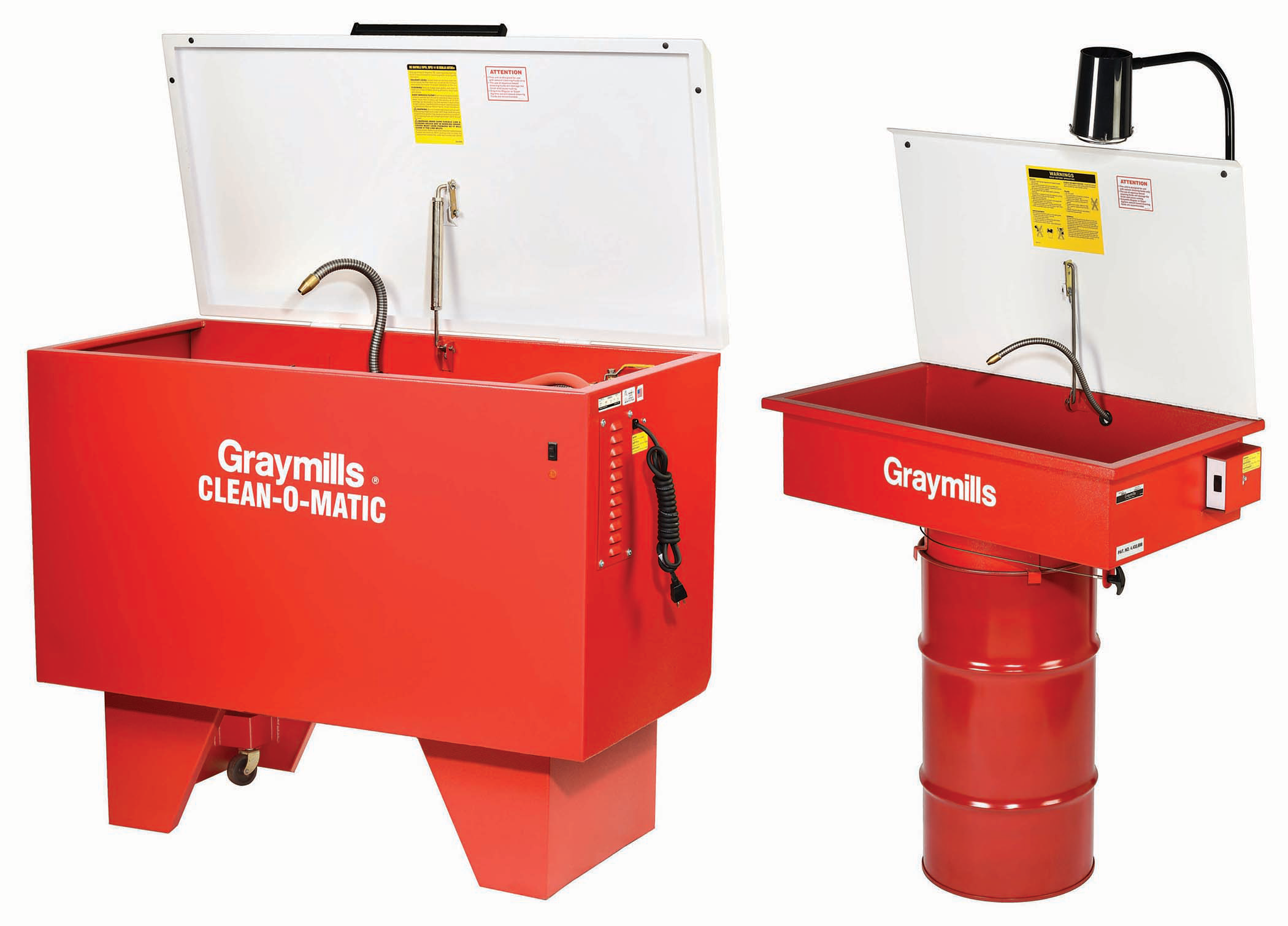
The DMD232 (left) is a small, manual drum-mount washer. The 500 (right) is a small, manual tank washer.
Both have a pump for low-pressure spray washing. Image courtesy of Graymills
Conversely, most of Miraclean Ultrasonics’ systems are automated and have multiple stages for parts that require a high level of cleanliness, such as those for the medical device and aerospace industries.
Kucklick said he also has been seeing more automated parts cleaning, which necessitates proper communication among various pieces of production and cleaning equipment. Most are still manual or semi-automatic, whereby an operator is present at the beginning and end of a cycle but not through the entire period. In addition, there has been a fairly constant shift from solvents to water-based cleaners, especially in locations with strict environmental regulations, such as California, but solvents can be more cost-effective.
All of Ecoclean’s cleaning machines also dry parts.
“Is it always necessary?” Siminovich said. “Nope, but it does make sense to have a drying stage. There’s a blow-off dry process where hot air inside the machine will blow-dry the part. Vacuum dry is more effective because it will remove all of the contamination from the parts. With blow-off drying, that process can reintroduce contamination onto the parts because when you’re blowing air around the part, there’s a risk of sending the particles back onto the parts.”
Depending on the process, cleaning time can vary widely. An equipment supplier typically helps a customer determine which process is needed and how to set up a proper cleaning system for it.
Make an Informed Decision
When looking for a parts washer, an end user must have some information ready for a supplier.
“I get calls all the time,” Kucklick said. “People tell me they are milling X number of parts, and they give me the length, width and height. They’ll say there’s a mixture of coolants and chips that need to be removed before the parts go to a plating process or an anodizing process. With a request like that, we first ask what process they currently have in place.”
Review the print ads from this magazine to continue
This quick advertiser review unlocks the rest of the article and keeps the full-screen reader focused on the ads instead of the page chrome.
Advertisers included in this article experience
Print placements connected to this article
Omgamerica
FH RELY ON O.M.G. HEADS
We prove our skills by continually innovating our range and by engineering cutting-edge products. BAH With a highly professional approach we look for the right balance between operative efficiency and quality service for maximum customer satisfaction. TA.CP TA MO HT VH TSI/TSX T MT-TC-TC3 TA-TAV-TAF-TAO SERIES ANGLE HEADS.
FH RELY ON O.M.G. HEADS We prove our skills by continually innovating our range and by engineering cutting-edge products. BAH With a highly professional approach we look for the right balance between operative efficiency and quality service for maximum customer satisfaction. TA.CP TA MO HT VH TSI/TSX
Visit Omgamerica View this placement in the issue recordPrint ads from this magazine
We prove our skills by continually innovating our range and by engineering cutting-edge products. BAH With a highly professional approach we look for the right balance between operative efficiency and quality service for maximum customer satisfaction. TA.CP TA MO HT VH TSI/TSX T MT-TC-TC3 TA-TAV-TAF-TAO SERIES ANGLE HEADS.
FH RELY ON O.M.G. HEADS We prove our skills by continually innovating our range and by engineering cutting-edge products. BAH With a highly professional approach we look for the right balance between operative efficiency and quality service for maximum customer satisfaction. TA.CP TA MO HT VH TSI/TSX
Continue reading
April 2020
He said companies sometimes don’t have formal processes, or perhaps a company simply cleans parts with rags but has a customer with newly stringent cleanliness specifications.
“You have to ask what their goals are,” Kucklick said. “What is the part, and how many are they trying to clean at once?”
The quantity of parts to clean dictates machine size and how fast the cycle time needs to be.
“Let’s use an aluminum bar with holes in it as an example,” Kucklick said. “I would look at the drawing of the part. If it had a lot of small blind holes, I would look at an ultrasonic-type machine because of the ability of an ultrasonic machine to get the grease out of blind holes where debris loves to settle.”
When performing fine cleaning, such as ultrasonic cleaning of medical and aerospace parts, filtration of the wash is critical. As parts are cleaned, debris may float around a tank and be redeposited back onto them and subsequent parts. Debris can be removed by a recirculating filter loop that traps particulates and extends tank life.
Kucklick said changing the cleaning fluid in a machine can be quite an undertaking.
“You can lose anywhere from a half day to a full day of production,” he said, “so you want to extend the life of that fluid as long as possible. Because when that machine is not running, you’re not cleaning parts. And when you’re not cleaning parts, you’re not selling parts.”
Criteria in Check
There are a lot of criteria for selecting the most appropriate machine. What contamination is coming from the upstream process, and what is the required cleanliness for the downstream process? In other words, where is a part coming from before it is cleaned, and where is it going next? Is a part coming from an oil-based grinding process or a water-based machining process? What specifications does a client desire? These initial questions must be answered to determine which cleaning agent to use.
“There are two main things that will help you determine the size of the machine,” Larkin said. “What are the parts in terms of size and geometry, and what’s the throughput?”
She pointed out the need to ascertain if there would be any chemical reactions between a part and the chemical in the cleaning agents being considered.
Larkin said if a parts manufacturer already has a machine or process and wants to see whether the same machine or process could be used for a new customer’s part, Miraclean Ultrasonics will evaluate the situation.
“It’s always a discovery process,” she said.
For its part, Ecoclean has a showroom in Michigan with several machines so current and potential customers can visit or send parts for testing.
Graymills and Miraclean Ultrasonics visit customer facilities to help them set up equipment and to explain the process so operators understand what occurs at each stage.
Pricing
The most uncomfortable question might be, “What’s the budget?” However, sometimes people have no idea what their budget is, Kucklick said.
The least expensive machines don’t always provide the desired results, Siminovich said.
The ultrasonic cleaning method may produce unsurpassed levels of cleanliness but can be expensive.
The cost for water-based machines, which are generally cheaper than solvent-based machines, ranges from a few thousand dollars to more than $1 million. A solvent-based machine costs $400,000 to $500,000, depending on volume and size, and removes all grinding oils.
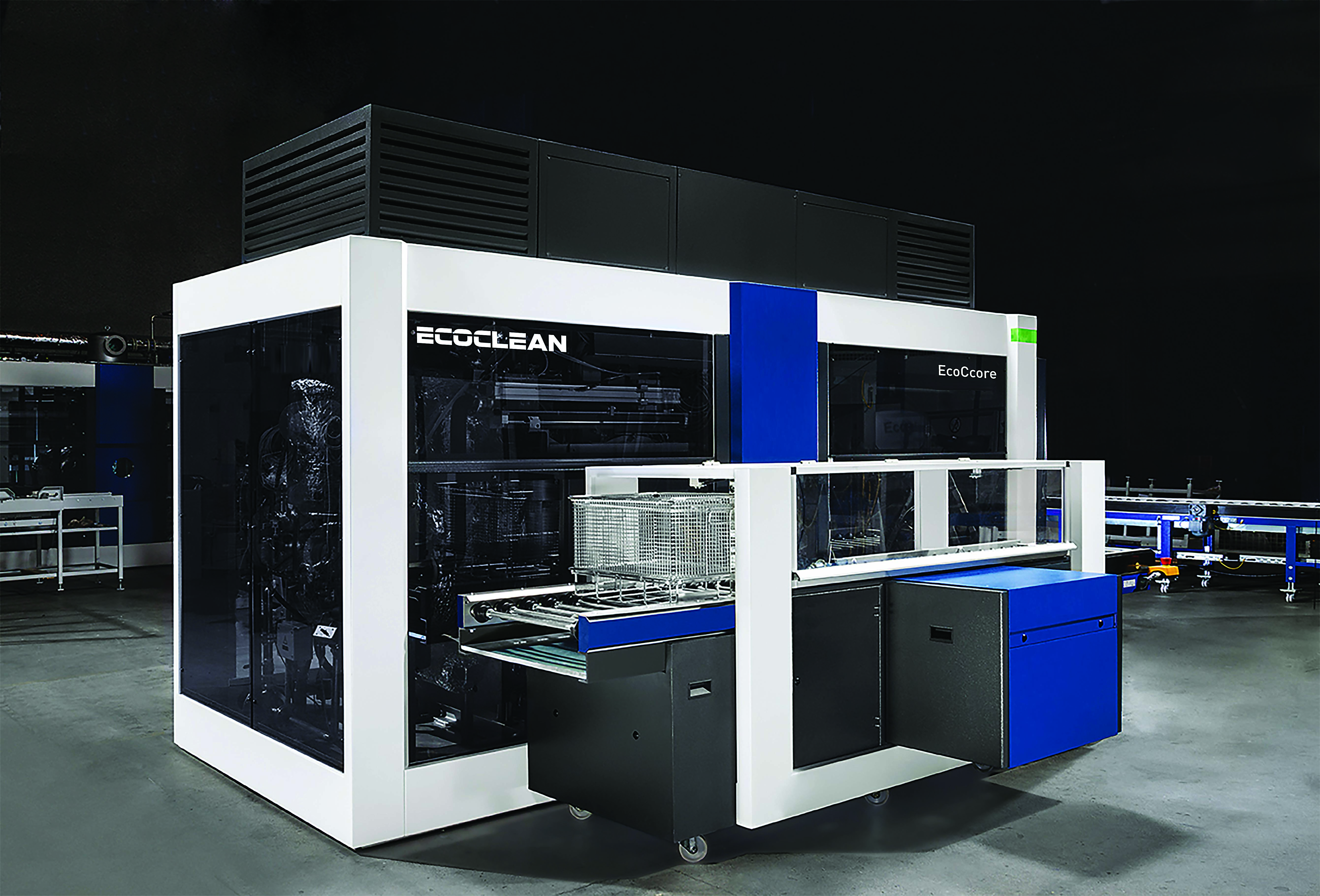
The EcoCcore is one of Ecoclean’s best-selling industrial parts washers. The unit shown is a batch cleaning machine. Image courtesy of Ecoclean
“While the solvent-based machines carry a higher upfront investment point, it has considerably less running costs,” Siminovich said. “So your payback on the equipment will be faster — on average it’s about two years — than that of a water-based machine.”
Others have found that developments in water-based cleaning — since the 1988 Montreal Protocol, which led to reductions of regulated solvents — have produced cleaned parts that rival or surpass solvent cleaning and have a similar payback.
Regarding water-based ultrasonic cleaning, a common misconception is to imagine a tabletop-size tank, but some ultrasonic systems are over 9.1 m (30′) long. All Ecoclean machines incorporate ultrasonic as an option.
“In our experience,” Santerre said, “a lot of cleaners cost less than $10,000, even $1,000, but single units can sell for up to $60,000. But the worst-case scenario is having the machine operator do the cleaning because an expensive worker is being used for a low-skill task.”
A small shop might be able to get by with one machine, but some facilities require dozens of washers.
Washing parts is only one of the critical steps in today’s manufacturing processes, yet it is vitally important to many industries. Armed with the necessary information, any shop can figure out which parts cleaning system would best meet its needs.
“There are times when a cleaning method simply fails for some reason,” Kucklick said. “Our ability to change gears and try up to three other types of cleaning is a tremendous benefit when attempting to solve a cleaning mystery.”
Ultrasonic cleaning process checklist
Particular needs and goals for parts cleaning determine the appropriate ultrasonic cleaning equipment and chemistry for a job. Answering the following questions will help decide the best process for one’s needs.
- What is the largest part that you need to clean?
- What are the part substrates?
- What are the soils?
- Are there blind holes or other complex part features?
- How many parts do you want to clean per batch?
- What is the estimated weight of a batch?
- How many batches need cleaning in an eight-hour shift?
- How many shifts are there per day?
- How clean is clean?
— Miraclean Ultrasonics