Ream a ‘hole’ lot better with replaceable heads
Do you still use that old standby, the HSS chucking reamer, for hole-finishing operations? There are excellent reasons to do so. HSS chucking reamers are inexpensive, dependable, readily available and forgiving of misalignment and misuse. For example, one catalog house lists more than 5,000 HSS reamers on its website, most of them in stock.
Do you still use that old standby, the HSS chucking reamer, for hole-finishing operations? There are excellent reasons to do so. HSS chucking reamers are inexpensive, dependable, readily available and forgiving of misalignment and misuse. For example, one catalog house lists more than 5,000 HSS reamers on its website, most of them in stock. But if you decided a long time ago to ditch HSS hand-ground tool bits for carbide ones, it might be time to question why you haven’t taken the same route for reamers.
For many shops, the move to solid-carbide reamers is a no-brainer. Yes, the price may be several times that of their HSS equivalent, but the higher productivity and hole quality are enough to win over even the most frugal shop owners and purchasing managers — that is, until reaching hole sizes of 12.7 mm (0.5″) and larger, at which point a solid-carbide reamer becomes increasingly hard to justify. What then?
Brazed carbide reamers are one option, but a better alternative dates back a century. On Dec. 27, 1920, inventor Torsten A. Gyllsdorff of Detroit-based Standard Reamer & Tool Co. applied for a patent for a two-piece reamer, one “wherein the cutting end can be replaced at low cost when worn.” His “new and improved reamer” unfortunately used an HSS head, which minimized improvements to productivity, but hats off to his forward thinking regardless.
Old Dog, New Tricks
A number of cutting tool manufacturers have resurrected Gyllsdorff’s idea and made it better. Peter Gennuso, sales engineering manager for OSG USA Inc., Irving, Texas, said the company’s PXM endmill platform can be equipped with a variety of heads, including special form tools, chamfer and radius cutters or exchangeable-head reamers.
“Because only the head of the tool is made of carbide, it’s a much more cost-effective solution for large-diameter reaming applications,” he said.
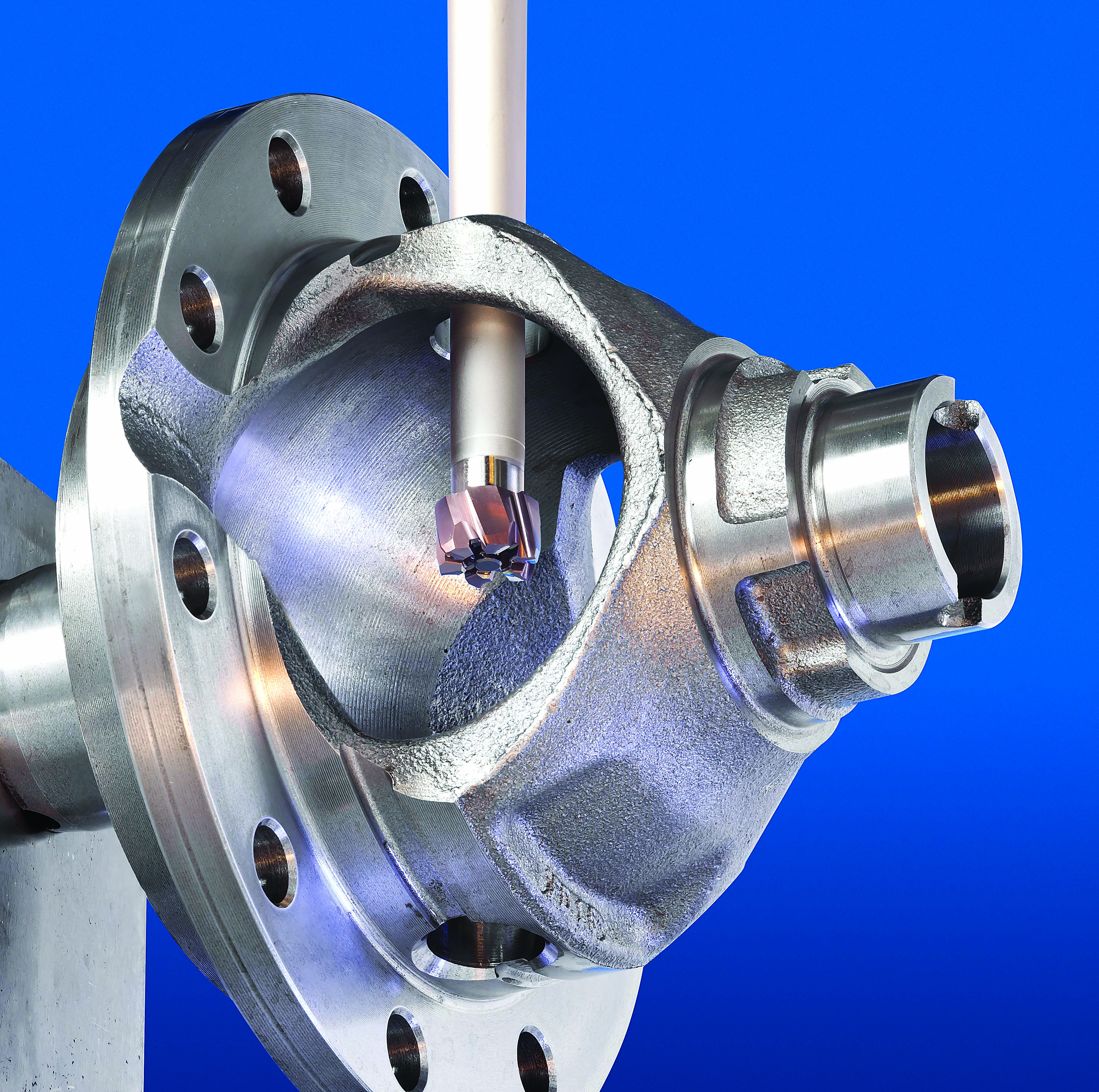
The Bayo T-Ream reamer from Iscar is equipped with a bayonet screw and special wrench for rapid changeovers. Image courtesy of Iscar Metals
What defines large? Depending on the style of head, the PXM system covers diameters from 10 mm to 32 mm (0.39″ to 1.26″), a range that Gennuso said complements OSG USA’s solid-carbide reamer line.
“The vast majority of machined holes are 9⁄16″ (14.29 mm) in diameter or smaller,” he said, “and for most of these, solid reamers are the best choice. For larger diameters, however, the PXM lineup provides the advantages of a solid cutting tool with the flexibility and cost benefit of an indexable platform.”
These reamers are also quite accurate. In OSG USA’s case, the PXM offers 0.015 mm (0.0006″) or less of radial runout and axial repeatability within ±0.03 mm (0.0012″). This is accomplished via a buttress-style, screw-on carbide head whose face and taper mate with a cylindrical steel shank, similar to an HSK spindle or a comparable dual-contact mount.
Gennuso said a general rule is to leave 1% of a hole’s finished diameter for reaming. For a 12.7 mm hole, that would mean drilling to 12.57 mm (0.495″). Check any drill chart, however, and you’ll find that the nearest drill size is 12.3 mm (0.484″), roughly three times his recommendation. So what do you do?
“Reamers are designed to remove a relatively small amount of material,” he said. “But with the larger diameters like those discussed here, your drilling options are more limited. So it might be necessary to drill as close as you can, semifinish with a boring tool and then ream to size. Without that three-step process, it can be tough to guarantee the proper amount of finishing stock and avoid problems with chip evacuation.”
Hello, Alvan
What if you need to go even larger? Talk to Ben Morrett, senior product manager for the Alvan reamer line at Allied Machine & Engineering Corp., Dover, Ohio. Since the early 2000s, the company has partnered with S.C.A.M.I. snc, a family-owned reamer manufacturer in Italy that produces modular reamers up to nearly 203.2 mm (8″) in
diameter.
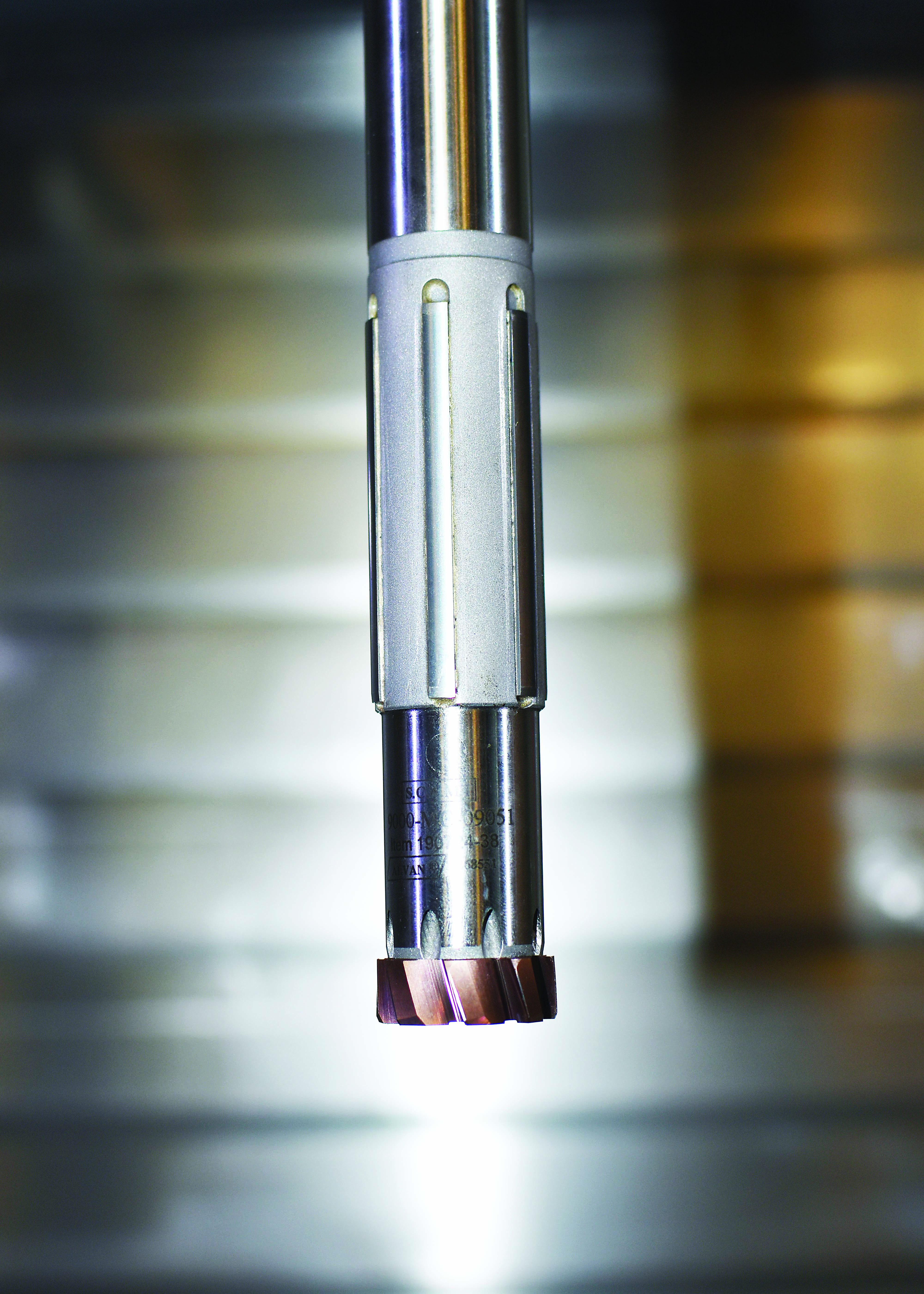
Since the early 2000s, Allied Machine & Engineering has partnered with S.C.A.M.I., a manufacturer of modular reamers. Image courtesy of Allied Machine & Engineering
The reamer line’s monoblock style covers hole diameters from 5.8 mm to 32.1 mm (0.228″ to 1.264″) while the replaceable-head series is slightly larger at 11.8 mm to 60.6 mm (0.465″ to 2.386″). Both kinds are available in fixed or expandable models. There’s also a ring-style reamer that ranges from 17.6 mm to 200.6 mm (0.693″ to 7.898″).
Review the print ads from this magazine to continue
This quick advertiser review unlocks the rest of the article and keeps the full-screen reader focused on the ads instead of the page chrome.
Advertisers included in this article experience
Print placements connected to this article
Cutting Tool Engineering
®
OPTIMIZED A COMPLEX ROUGHING PROCESS MADE SIMPLE.
® OPTIMIZED A COMPLEX ROUGHING PROCESS MADE SIMPLE. Visit ctemag.com to learn more.
Visit Cutting Tool Engineering View this placement in the issue recordPrint ads from this magazine
OPTIMIZED A COMPLEX ROUGHING PROCESS MADE SIMPLE.
® OPTIMIZED A COMPLEX ROUGHING PROCESS MADE SIMPLE. Visit ctemag.com to learn more.
Continue reading
January 2020
“It’s a very versatile product line,” Morrett said. “We have different grades of cermet, carbide, PCD and CBN available, as well as various coatings and geometries, so there’s little we can’t handle materialwise. With that in mind, I would say that most of our customers are using them for production work, such as hydraulic manifolds and firearm components.”
He said his statement about production work is not meant to scare off job shops and other high-mix, low-volume manufacturers that benefit from the product’s broad application range and ability to expand holes up to 1% of a reamer’s diameter. The sticking point is cost: Whereas a five-person shop might balk at spending an additional 30% or more for a modular reamer, high-volume manufacturers easily can justify it based on cost per hole.
“I worked with a shop recently that was getting around 1,000 parts out of a brazed carbide reamer,” Morrett said. “By switching to our Alvan solution, they increased that to 14,000 parts. So, yes, our tool costs roughly one-third more than a conventional reamer, but the delta is insignificant when you consider the productivity improvements.”
Down in the Bayo
Arlington, Texas-based Iscar Metals Inc. is another company targeting high-volume manufacturers.
“If you’re only doing a handful of parts, it’s probably most cost-effective to use a standard HSS or brazed carbide reamer,” said David Vetrecin, holemaking product manager for Iscar Tools Inc., Oakville, Ontario. “Modular reamers are more suitable for production work where cycle time is critical.”
Hole quality is also a critical factor when selecting a reamer, he said. Iscar’s Bayo T-Ream interchangeable-head reamer, which covers diameters from 11.5 mm to 32 mm (0.453″ to 1.26″), guarantees diametral head accuracy of ±2.03 µm (0.00008″) and 3 µm (0.0001″) runout and indexing
repeatability.
“In most applications, we can easily hold hole size within 5 µm (0.0002″) even while feeding 50% faster than a traditional carbide reamer,” Vetrecin said. “This makes our system a favorite in the aerospace, automotive and indeed any industry where hole quality is just as important as throughput.”
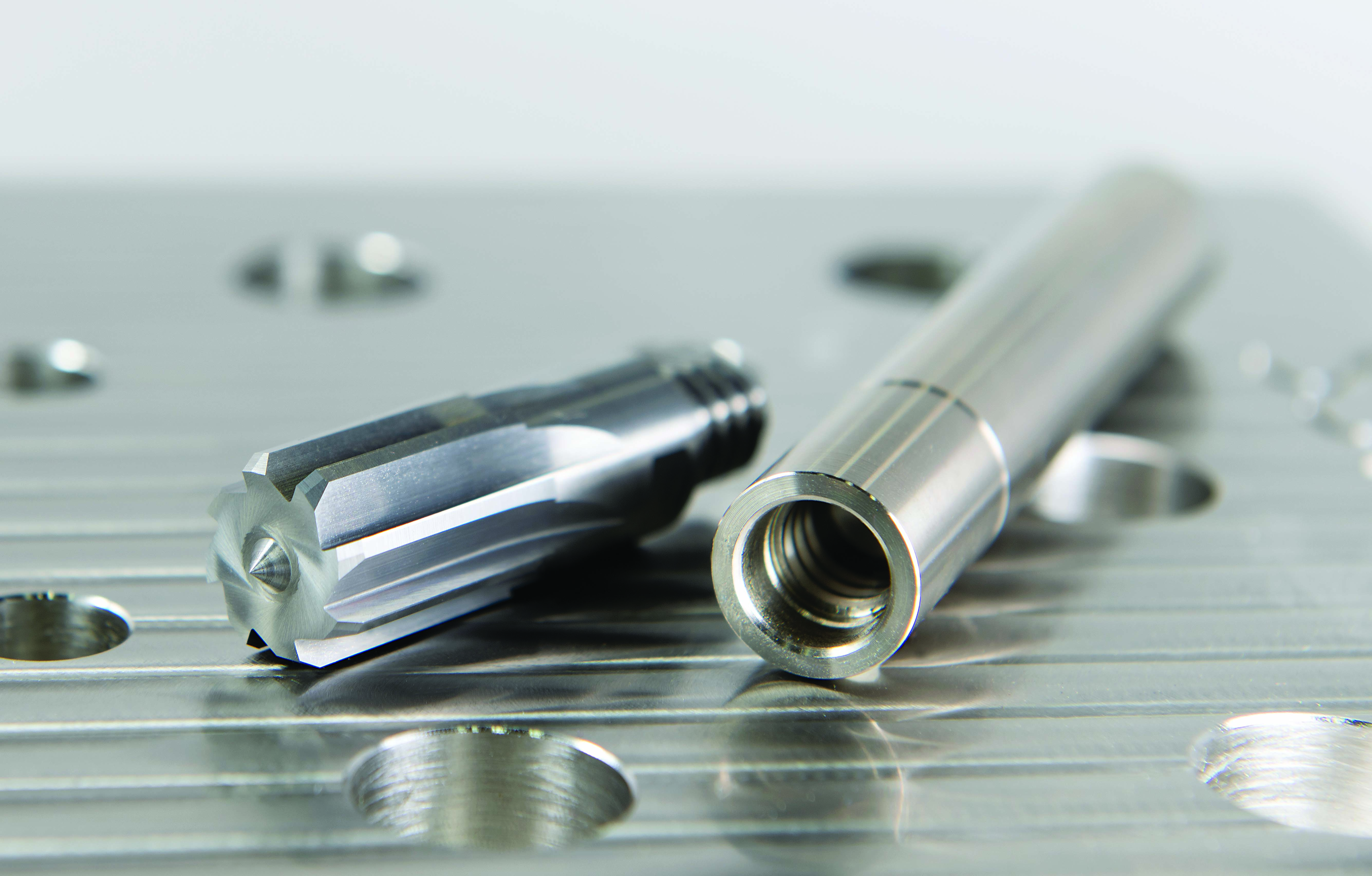
Because only the head of the tool is made of carbide, modular reamers are cost-effective for many reaming applications. Image courtesy of OSG USA
Throughput also depends on setup time, and modular reamers don’t disappoint. The Bayo T-Ream, for example, is equipped with a bayonet screw and special wrench for rapid changeovers. Perhaps more important than speed is simplicity, however. Considering the shortage of qualified workers, modular reamers offer a set-it-once approach, after which anyone can replace heads with a screwdriver.
Rules of the Reaming Road
Vetrecin said the rules are no different when using modular or conventional reamers. For the best chip evacuation on through-holes, always use a tool with left-hand flutes, which push chips forward. Blind-holes should be reamed with a straight-flute tool or right-hand tool, if available. Since most modular reamers offer through-the-tool coolant, by all means use it, preferably with high-pressure coolant.
Monitor tool life, and replace tools sooner rather than later, especially if there’s the possibility of regrinding a tool, he said. Because penetration rates are often much higher with modular reamers — primarily due to the advanced edge geometries and coatings from most cutting tool providers — always follow a manufacturer’s recommendations for feeds and speeds.
Lastly, don’t forget to properly align a reamer. Some toolmakers offer adjustable sleeves or adapters for machines with out-of-whack turrets and spindles. Otherwise, a high-quality hydraulic holder is the best way to grip any reamer while avoiding floating holders whenever possible.
“Whether modular, HSS or solid carbide, hole quality and tool life both depend on minimizing runout when reaming,” Vetrecin said.