Making waterjet precision possible: Testing & Quality Assurance
When considering waterjet controller software, think about how your business and machine tool will evolve.
An abrasive waterjet machine demonstrates its fullest advantages when it cuts complex geometries in a variety of materials. The software package that drives the machine makes the biggest contribution to waterjet utility and overall cost control. Waterjet machines initially used G code, but they exhibit special physics and geometric considerations that traditional cutting methods can’t handle. To program the advancements in tapers, corner passing and a plethora of cutting models, some waterjet builders have moved to more integrated controllers.
A waterjet has three major components: the pump, nozzles and controller. Because a waterjet behaves differently from traditional CNC machine tools, the controller takes on paramount importance. Advanced cutting models enable the software to control the machine’s motion faster and more precisely to generate exactly the result that the programmer intended. With the right controller software, the waterjet OEM focuses on programming as a foundation of the machine tool rather than as an afterthought.
The best waterjet manufacturers develop their controller software in conjunction with their AWJ hardware. Using empirical data on how the jet stream acts in each configuration of nozzle, abrasive and material, software developers can account accurately for what happens at every point along a toolpath. From the data, programmers can produce cutting models to input the precise calculations that are critical to AWJ functionality. The
outcome is a combination of hardware and software that saves money with cutting time, cutting pressure, abrasive consumption, water use and the workpiece material all optimized in the controller’s cutting models.
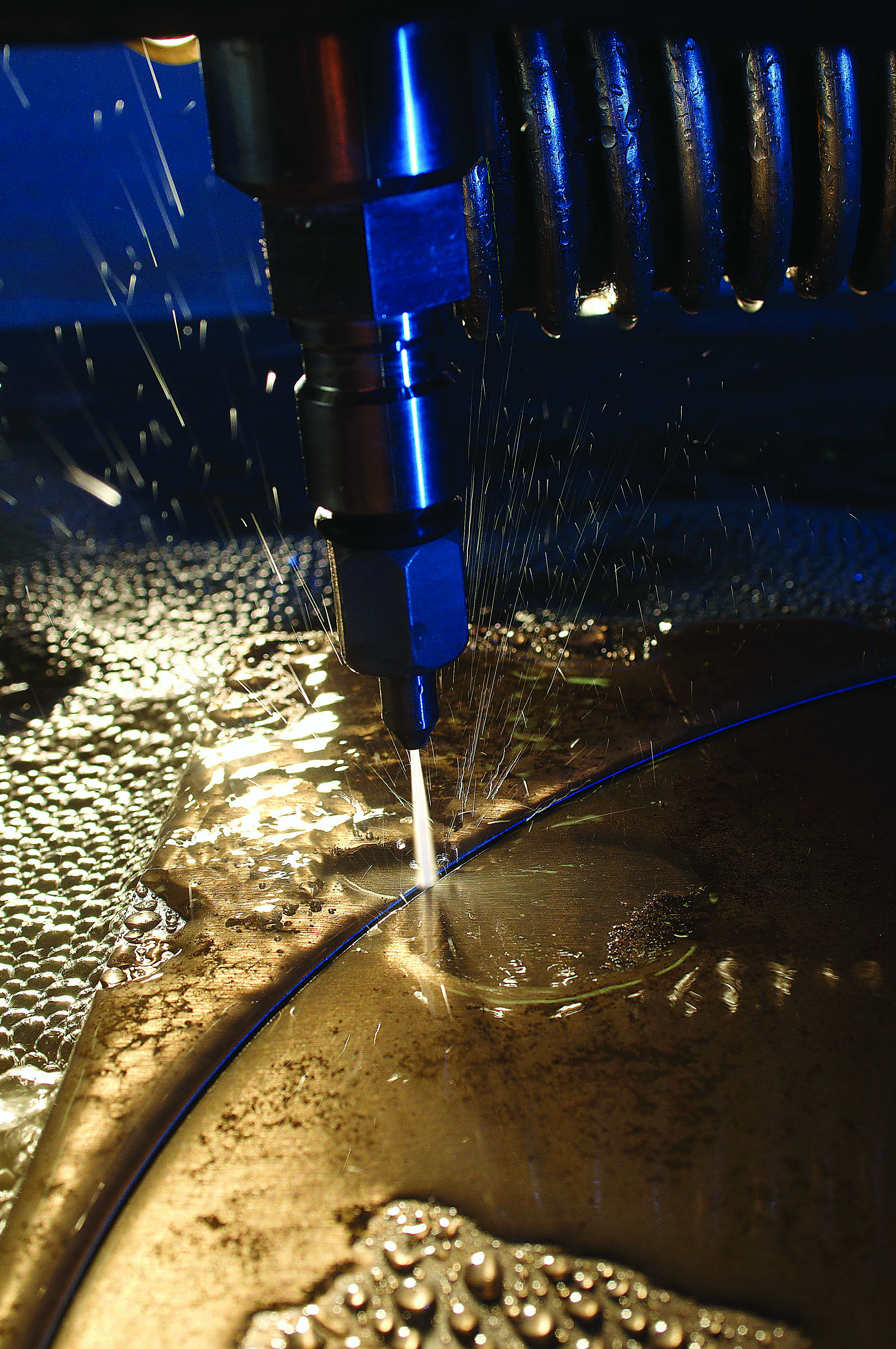
The Tilt-A-Jet allows automatic elimination of tapers. Image courtesy of Joyce Photography Inc.
Omax Corp.’s programmers have worked to hone AWJ cutting through several iterations of IntelliMax software. In the early 1990s, the first-generation software was built on the geometry of how an AWJ behaved. By the third generation, improved processing power and better code capabilities allowed a stronger understanding of corner production and motion control for enhanced cut quality and speed.
The current fourth generation of IntelliMax has benefited from further study of cutting models. Omax has conducted thousands of empirical tests on thousands of material samples to comprehend how an AWJ functions in each case. With the second generation of IntelliMax, an Omax machine could process a gear with eight teeth and a 26″ toolpath in 30 minutes. The fourth generation can cut 20 teeth and a 63″ toolpath in the same amount of time.
Review the print ads from this magazine to continue
This quick advertiser review unlocks the rest of the article and keeps the full-screen reader focused on the ads instead of the page chrome.
Advertisers included in this article experience
Print placements connected to this article
Toolflo
The Threading Specialist!
FLO-LOCK ON-EDGE CHASERS API Threading chasers! Full line of standard threading inserts • Buttress, WW, NPT, Rounds... and toolholders with chip control! LAYDOWN Wide array of standard thread geometries in both inch and metric sizes! Extensive offering also includes chipbreaker items, multitooth configurations, and pressed.
The Threading Specialist! FLO-LOCK ON-EDGE CHASERS API Threading chasers! Full line of standard threading inserts • Buttress, WW, NPT, Rounds... and toolholders with chip control! LAYDOWN Wide array of standard thread geometries in both inch and metric sizes!
Visit Toolflo View this placement in the issue recordNachiamerica
NACHI IS YOUR...
DRILLING... Flat Bottom Drills Coolant Thru and Non-Coolant Thru Aqua Micro Drills & MILLING SOLUTION... 5 Flute End Mills Square End and Ball Nose FOR THE MEDICAL INDUSTRY.
NACHI IS YOUR... DRILLING... Flat Bottom Drills Coolant Thru and Non-Coolant Thru Aqua Micro Drills & MILLING SOLUTION... 5 Flute End Mills Square End and Ball Nose FOR THE MEDICAL INDUSTRY
Visit Nachiamerica View this placement in the issue recordPrint ads from this magazine
FLO-LOCK ON-EDGE CHASERS API Threading chasers! Full line of standard threading inserts • Buttress, WW, NPT, Rounds... and toolholders with chip control! LAYDOWN Wide array of standard thread geometries in both inch and metric sizes! Extensive offering also includes chipbreaker items, multitooth configurations, and pressed.
The Threading Specialist! FLO-LOCK ON-EDGE CHASERS API Threading chasers! Full line of standard threading inserts • Buttress, WW, NPT, Rounds... and toolholders with chip control! LAYDOWN Wide array of standard thread geometries in both inch and metric sizes!
Continue reading
October 2019
Evolved software can make a huge difference in efficiency. For example, a 94-ksi intensifier pump with second-rate software cut a 40″ toolpath of a Geneva wheel in 50 seconds and consumed 1 lb. of abrasive. A 60-ksi direct-drive pump paired with better software cut the same part in 41 seconds with only 0.68 lb. of abrasive. The time and abrasive savings are obvious, with the improved software complementing the efficient direct-drive pump.
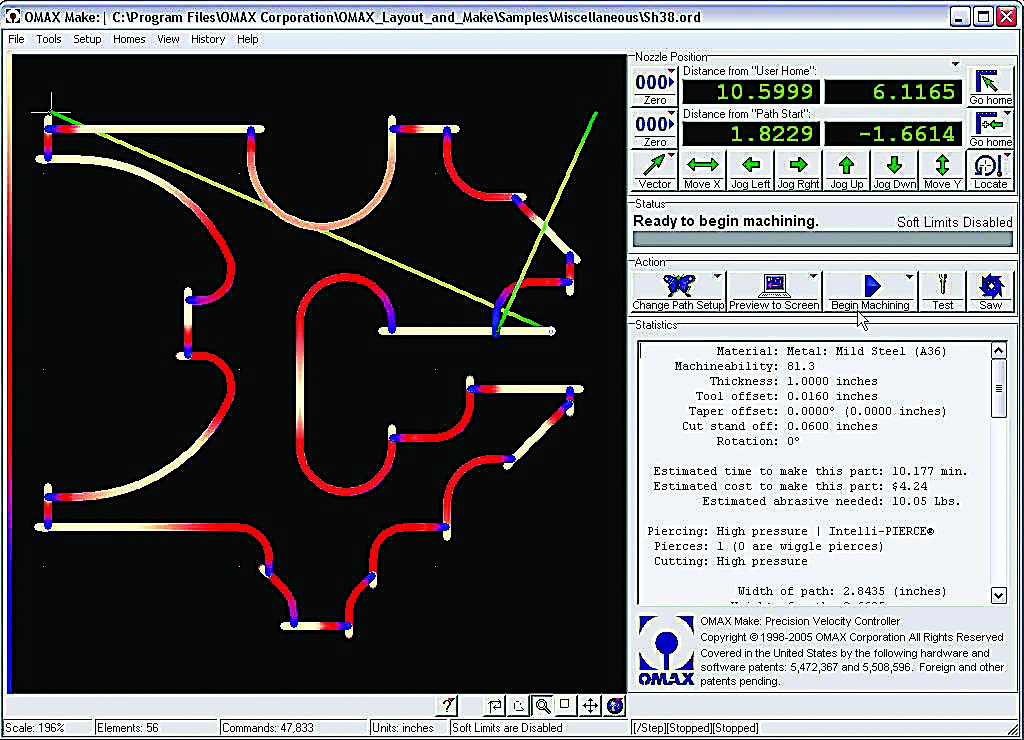
A test part shows corner passing and speed in the fourth generation of IntelliMax software. Image courtesy of Omax
Software progress moves beyond standard AWJ operations. Taper compensation software and hardware, which are options for some waterjets, can position the nozzle at an angle calculated by the software to exactly offset the taper. The taper doesn’t disappear—it simply moves to a scrap area of the material, leaving the part with precisely square edges. With a tilting head, the controller can quicken even straight sections of the toolpath just a little bit by tilting into the cut to improve surface finish with less need to reduce cutting speed. For operators, a click of an interface button enables taper compensation.
When considering waterjet controller software, think about how your business and machine tool will evolve with you. Some OEMs provide free software upgrades so a waterjet always works to the best of its ability.
If you had bought an AWJ with progressive software 20 years ago and made no improvements to the machine other than regularly updating its software, you would have noticed your manufacturing time accelerating tremendously with each software upgrade. These increases in speed would have saved money with electricity, water and other consumables. In addition, the growth in software capabilities would have made it possible for you to take on more waterjet cutting work.
In another 20 years, how will your software have improved your waterjetting?