Additive approach to machining Ti6Al4V
To demonstrate that additively manufactured steel cutting tools can machine Ti6Al4V equal to or better than their conventionally manufactured HSS counterparts, Jimmy Toton, a mechanical and manufacturing engineering Ph.D. candidate at the Royal Melbourne Institute of Technology in Australia, conducted research.
To demonstrate that additively manufactured steel cutting tools can machine Ti6Al4V equal to or better than their conventionally manufactured HSS counterparts, Jimmy Toton, a mechanical and manufacturing engineering Ph.D. candidate at the Royal Melbourne Institute of Technology in Australia, conducted research. Using laser metal deposition equipment at RMIT University’s Advanced Manufacturing Precinct, the director of which is Toton’s supervisor, professor Milan Brandt, Toton 3D-printed tool blanks with the chemical composition Fe25Co15Mo. Sutton Tools Pty. Ltd., Thomastown, Australia, then ground the blanks on a CNC tool and cutter grinder to produce endmills. Toton has worked at Sutton Tools as an intern.
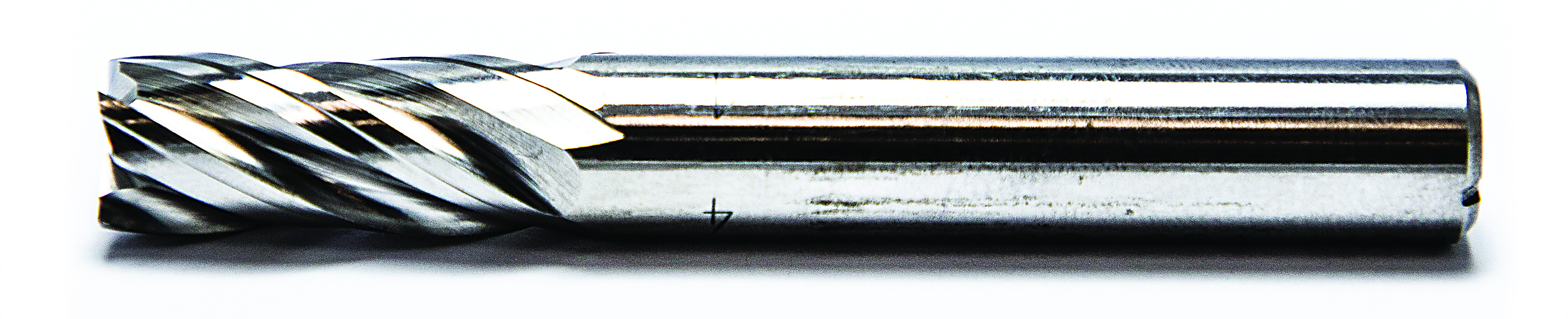
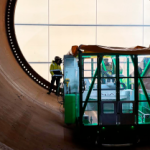
Once the tool blank is 3D-printed via laser metal deposition, it is centerless-ground, and then the tool’s features are produced on a CNC grinder. Image courtesy of RMIT University
According to the definition from the American National Standards Institute, the material is not technically HSS but closer to the definition for maraging steel. “It is carbon-free and strengthened by the precipitation of nanosized intermetallics through artificial aging,” Toton stated in an email.
Steve Dowey, technology manager at Sutton Tools and a senior lecturer and industry fellow at RMIT University, said Toton targeted a substrate material that provides an intermediate high hot hardness between HSS and carbide.
“The substrate has thermomechanical properties that make it a suitable material for titanium machining, such as a higher hot hardness and resistance to thermal softening than all high-speed steel grades,” Toton added.
Printing with the material, however, wasn’t easy. “Creating a straight, long, thin cylinder without any defects was quite an interesting challenge, and Jimmy took that on and spent a long time optimizing the deposition conditions,” Dowey said.
To overcome the issues he faced in getting the deposited metal layers to print properly and bond strongly, Toton noted he employed high-temperature substrate heating to manipulate solid-state transformations with a microstructure during printing and prevent crack formation.
“All of optimization of printing doesn’t come in the manual,” Dowey said, adding that manufacturers of additive equipment are becoming better at providing more information. “It is a bit of a dark art.”
Review the print ads from this magazine to continue
This quick advertiser review unlocks the rest of the article and keeps the full-screen reader focused on the ads instead of the page chrome.
Advertisers included in this article experience
Print placements connected to this article
Tungaloy America | [email protected] | 888.554.8394
ACCELERATED TURNING
Vibration Free Deep Hole Boring Ultimate solution for tool overhang challenges up to L/D = 10 Wide range of shank diameters from 16 mm to 60 mm Exchangeable boring head compatible with positive and negative insert options.
ACCELERATED TURNING Vibration Free Deep Hole Boring Ultimate solution for tool overhang challenges up to L/D = 10 Wide range of shank diameters from 16 mm to 60 mm Exchangeable boring head compatible with positive and negative insert options Tungaloy America | [email protected] | 888.554.8394 www.tungaloy.com/us
Visit Tungaloy America | [email protected] | 888.554.8394 View this placement in the issue recordPrint ads from this magazine
Vibration Free Deep Hole Boring Ultimate solution for tool overhang challenges up to L/D = 10 Wide range of shank diameters from 16 mm to 60 mm Exchangeable boring head compatible with positive and negative insert options.
ACCELERATED TURNING Vibration Free Deep Hole Boring Ultimate solution for tool overhang challenges up to L/D = 10 Wide range of shank diameters from 16 mm to 60 mm Exchangeable boring head compatible with positive and negative insert options Tungaloy America | [email protected] | 888.554.8394 www.tungaloy.com/us
Continue reading
July 2019
While a conventional sintered blank might be 98% dense, Dowey said the 3D-printed blanks are fully dense. But that difference didn’t create any issues when Sutton produced the tools. “It was pretty straightforward to make a cutting tool from it,” he said, noting that about five tools were made. “We followed conventional grinding practices.”
Dowey added that the selected tool geometry isn’t one that’s optimized for machining titanium but one that’s effective for cutting a variety of materials to demonstrate an improvement over HSS in this application. The 3D-printed tools did show an improvement in tool life, he said, but he emphasized that a part manufacturer would realize significant cost savings only by boosting productivity and would not be extending tool life. “Saving CNC machining time is the crucial thing.”
Because laser metal deposition doesn’t provide sufficiently high resolution to print complex through-coolant holes, Dowey said the next project will focus on 3D printing through-coolant tool blanks via powder bed fusion. “The LMD process was more to prove the material. The powder bed process is more realistic in terms of volume and could potentially provide a tool that we could economically sell. Right now, LMD is not economical.”
Toton explained that economic considerations played a major role in deciding to initially print blanks by LMD. With powder bed fusion, the machines at RMIT University require enough powder to fill the entire build volume, or at least 30 kg. In contrast, LMD can be performed with a few hundred grams of powder.
“As my material is experimental, a single batch is incredibly expensive,” he stated. “My aim was to develop a process methodology to manufacture cylindrical bars with the right microstructure, mechanical properties and wear resistance when machining titanium alloy Ti6Al4V, a proof of concept. From this position, you are more likely to attract the research dollars needed to develop the IP for PBF.”
His LMD research, however, has already attracted dollars. RMIT University reported that Toton received the 2019 Young Defence Innovator Award, which comes with a 15,000 Australian dollar ($10,678) prize. “I am currently planning a much deserved trip to Europe,” Toton noted about the prize money.