Surface roughness measurement can be challenging
L.S. Starrett's precision tool education manager offers the latest trends and developments in surface roughness measurement.
In an interview with CTE Editor Alan Richter, Ira E. Friedman, precision tool education manager for The L.S. Starrett Co., Athol, Massachusetts, discussed surface roughness measurement, including the latest equipment developments, common challenges, noncontact measurement applications and profile parameters.

Ira E. Friedman is precision tool education manager for The L.S. Starrett Co. Image courtesy of L.S. Starrett
Cutting Tool Engineering: What are the latest trends and developments in surface roughness measurement equipment?
Ira E. Friedman: Users of metrology instruments, especially hand-held metrology devices, expect those instruments to have fundamental features, including the ability to communicate with smart devices. Full-color screens and graphical displays, which were rare only a few years ago, are now expected as standard features. Users also prefer USB charging, USB data storage and Bluetooth connectivity. Engineers and quality managers also now have surface measurement tools to examine numerous part parameters. With this development comes a host of quality improvements. While Ra may appear on the print, now they can examine a host of parameters, archive the data and explore ways to improve the process.
CTE: What common challenges do metrology equipment manufacturers and end users face?
Friedman: Surface roughness measurement devices are being used more and more in challenging environments, such as directly on the shop floor. This is forcing metrology manufacturers to design more robust systems while still offering the sensitivity to measure the finest details at high levels of accuracy. Surface roughness measurement equipment is evolving with new interfaces and smart technology. With the influence of smartphones and other intuitive devices, surface roughness measurement is easier, faster and less demanding to perform with a high degree of accuracy and reliability. However, the setup for measuring very small parts with a minimum radius can be difficult to achieve. This challenge is typically overcome by using a smaller cutoff value, resulting in a shorter trace. And in some cases, operators will benefit from training to interpret data.
Review the print ads from this magazine to continue
This quick advertiser review unlocks the rest of the article and keeps the full-screen reader focused on the ads instead of the page chrome.
Advertisers included in this article experience
Print placements connected to this article
Kyoceraprecisiontools
MFH-RAPT R
DRV HIGH FEED MILLING AT ITS ABSOLUTE BEST INDEXABLE MAGIC DRILL Ø0.375"~Ø0.625" | Ø8mm~Ø16mm Ø0.625"~Ø2.000" | Ø16mm~Ø50mm Ø1.000"~Ø6.000" | Ø25mm~Ø160mm Experience the Power of the MFH High Feed Milling Cutter Family Boost productivity and reduce machining costs with the MFH-RAPTOR’s economical double-sided inserts. Covering such a.
MFH-RAPT R DRV HIGH FEED MILLING AT ITS ABSOLUTE BEST INDEXABLE MAGIC DRILL Ø0.375"~Ø0.625" | Ø8mm~Ø16mm Ø0.625"~Ø2.000" | Ø16mm~Ø50mm Ø1.000"~Ø6.000" | Ø25mm~Ø160mm Experience the Power of the MFH High Feed Milling Cutter Family Boost productivity and reduce machining costs with the MFH-RAPTOR’s economical double-sided inserts. Covering such a broad spectrum of machining operations, the MFH is an essential part to any machine shop’s cutting tool arsenal. Face Milling & Slotting Ramping Helical Milling Pocketing Contouring Shouldering
Visit Kyoceraprecisiontools View this placement in the issue recordPrint ads from this magazine
DRV HIGH FEED MILLING AT ITS ABSOLUTE BEST INDEXABLE MAGIC DRILL Ø0.375"~Ø0.625" | Ø8mm~Ø16mm Ø0.625"~Ø2.000" | Ø16mm~Ø50mm Ø1.000"~Ø6.000" | Ø25mm~Ø160mm Experience the Power of the MFH High Feed Milling Cutter Family Boost productivity and reduce machining costs with the MFH-RAPTOR’s economical double-sided inserts. Covering such a.
MFH-RAPT R DRV HIGH FEED MILLING AT ITS ABSOLUTE BEST INDEXABLE MAGIC DRILL Ø0.375"~Ø0.625" | Ø8mm~Ø16mm Ø0.625"~Ø2.000" | Ø16mm~Ø50mm Ø1.000"~Ø6.000" | Ø25mm~Ø160mm Experience the Power of the MFH High Feed Milling Cutter Family Boost productivity and reduce machining costs with the MFH-RAPTOR’s economical double-sided inserts. Covering such a broad spectrum of machining operations, the MFH is an essential part to any machine shop’s cutting tool arsenal. Face Milling & Slotting Ramping Helical Milling Pocketing Contouring Shouldering
Continue reading
March 2019
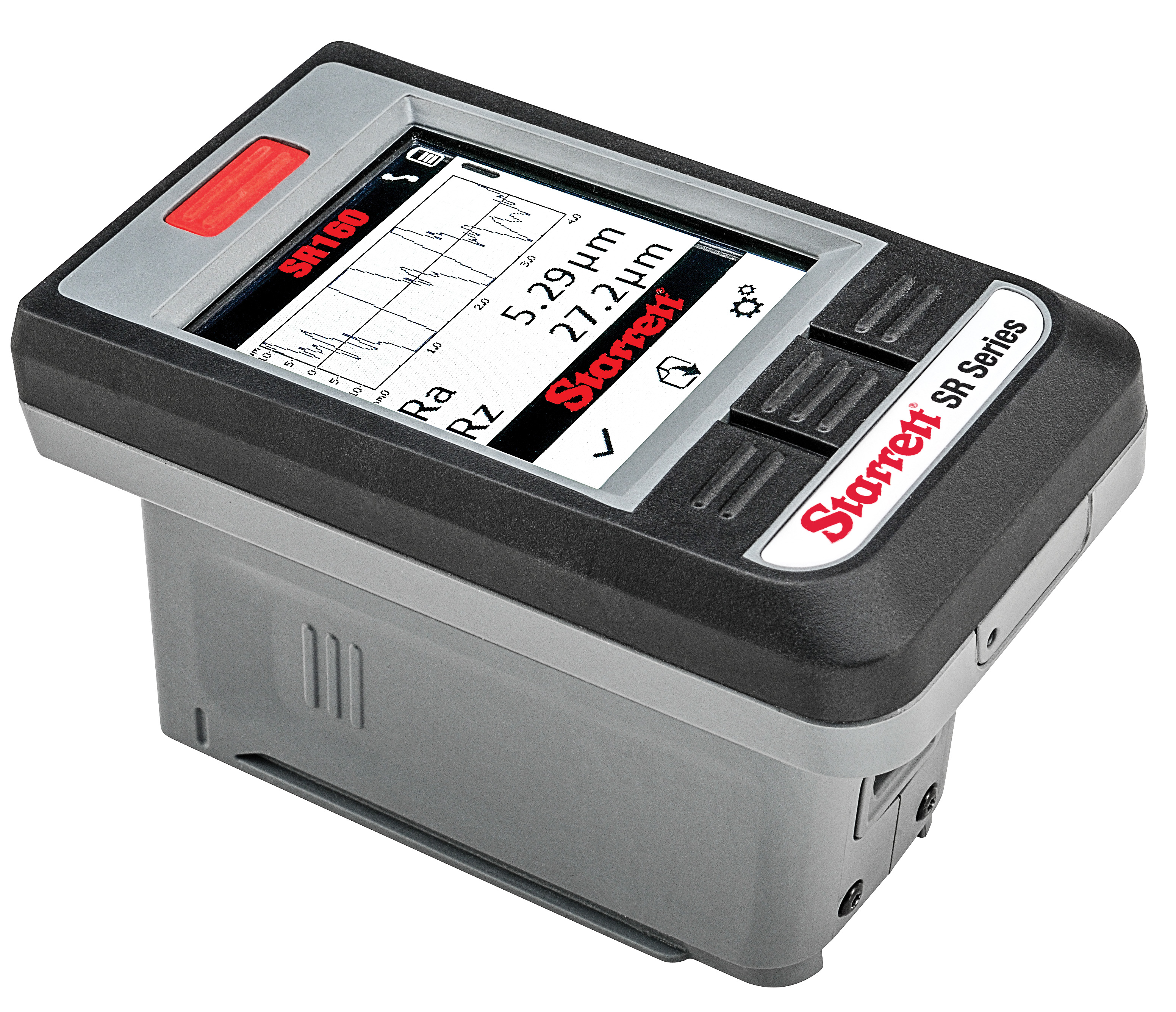
The Starrett SR160 surface roughness tester performs a wide variety of parameters, from common Ra to more complex Rz1Max and Rsk parameters. Image courtesy of L.S. Starrett
CTE: What are the pros and cons of noncontact and contact surface measurement?
Friedman: Noncontact measurement has several key advantages over contact measurement, especially for measuring optical and fragile parts and when speed is critical. However, this typically comes with the disadvantage of significantly higher instrument cost. Contact measurement still tends to be preferred in industries that are more cost-sensitive when making the initial capital tool purchase, where more robust instruments are required and where existing standards are in place based on traditional contact methods. I do not see this changing in the immediate future. While conscious of high throughput demands, it comes at a price. Additionally, exploring new parameters and the need for smaller, user-friendly surface finish measuring devices is on the rise. We try to take the mystery out of surface roughness as the methodologies to collect the data have changed from the old surface finish sample card, where you would compare a sample from a texture card to a rapid reading. Now, highly accurate, smaller, intuitive packages that archive data points and allow a user to parse the data and explore a surface finish are available.
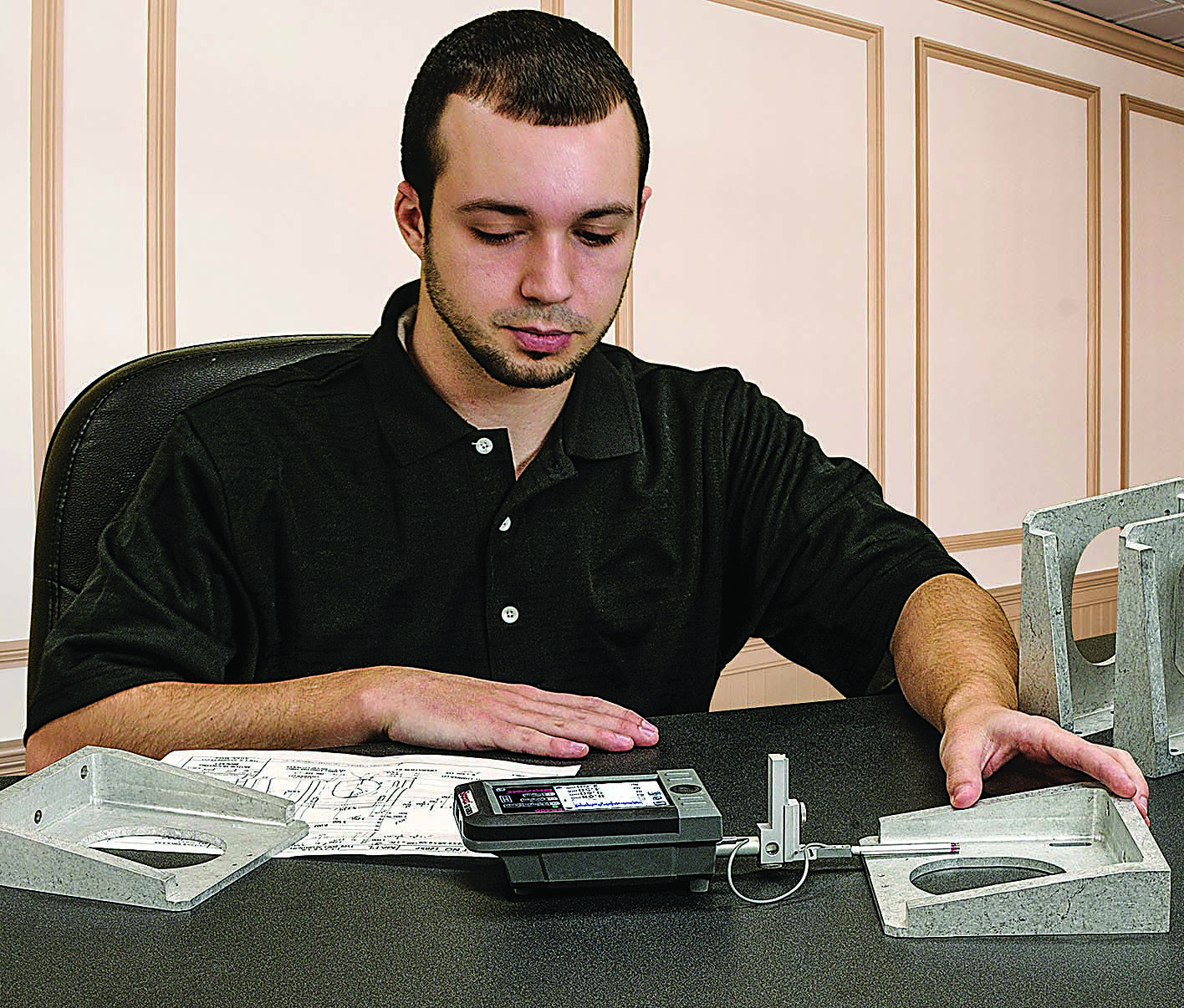
A technician takes a measurement with the Starrett SR400 surface roughness tester. Image courtesy of L.S. Starrett
CTE: What are some of the approaches to parameter selection?
Friedman: Many surface roughness measurement instruments on the market come with a host of parameters built in—not just different parameters but also different filters and parameters based on different standards, such as ISO, JIS and ASME. One approach to parameter selection is to make sure you conform to the best practices in your industry. Many industries have trade associations that help define parameters used for certain parts or manufacturing processes. Another approach is to identify the characteristics of the specific fault being tested for and choose parameters sensitive to these characteristics. Also, many instrument manufacturers are happy to help with parameter selection. Default and/or automatic selection of parameters or filters is rarely a good practice because it will simply select the most common, not the most suitable. The main issue here is what factors about the part being tested are important. If the part is a crankshaft, it will experience different kinds of stresses versus a flat part. The user should strive to understand the application of the correct parameter, along with the correct cutoff value and filter, to eliminate both noise and much of the variability in the process, ultimately achieving a high level of repeatability and process capability.