Toolholder cures runout woes
Variety may be the spice of life but not when it comes to machining tolerances, where tool runout is the enemy of precision, including when processing plastic parts. Just ask Eric Broderson, president of Bennington, Vermont-based K&E Plastics Inc., which began machining plastics in 1966.
Variety may be the spice of life but not when it comes to machining tolerances, where tool runout is the enemy of precision, including when processing plastic parts. Just ask Eric Broderson, president of Bennington, Vermont-based K&E Plastics Inc., which began machining plastics in 1966. For him, runout means increased setup time, compromised part quality, poor tool life and troublesome burrs.
Burrs pose more threats when machining plastics than when machining metal. Most of the techniques typically used to remove burrs from metal materials damage plastic workpieces.
“Deburring plastics can be a nightmare,” Broderson said. “We have a machine out on the shop floor that uses dry ice and compressed air. It freezes the little fibers and then blows them off.” Along with cryogenics, his shop relies on abrasive pads and toolholder-mounted wire brushes.
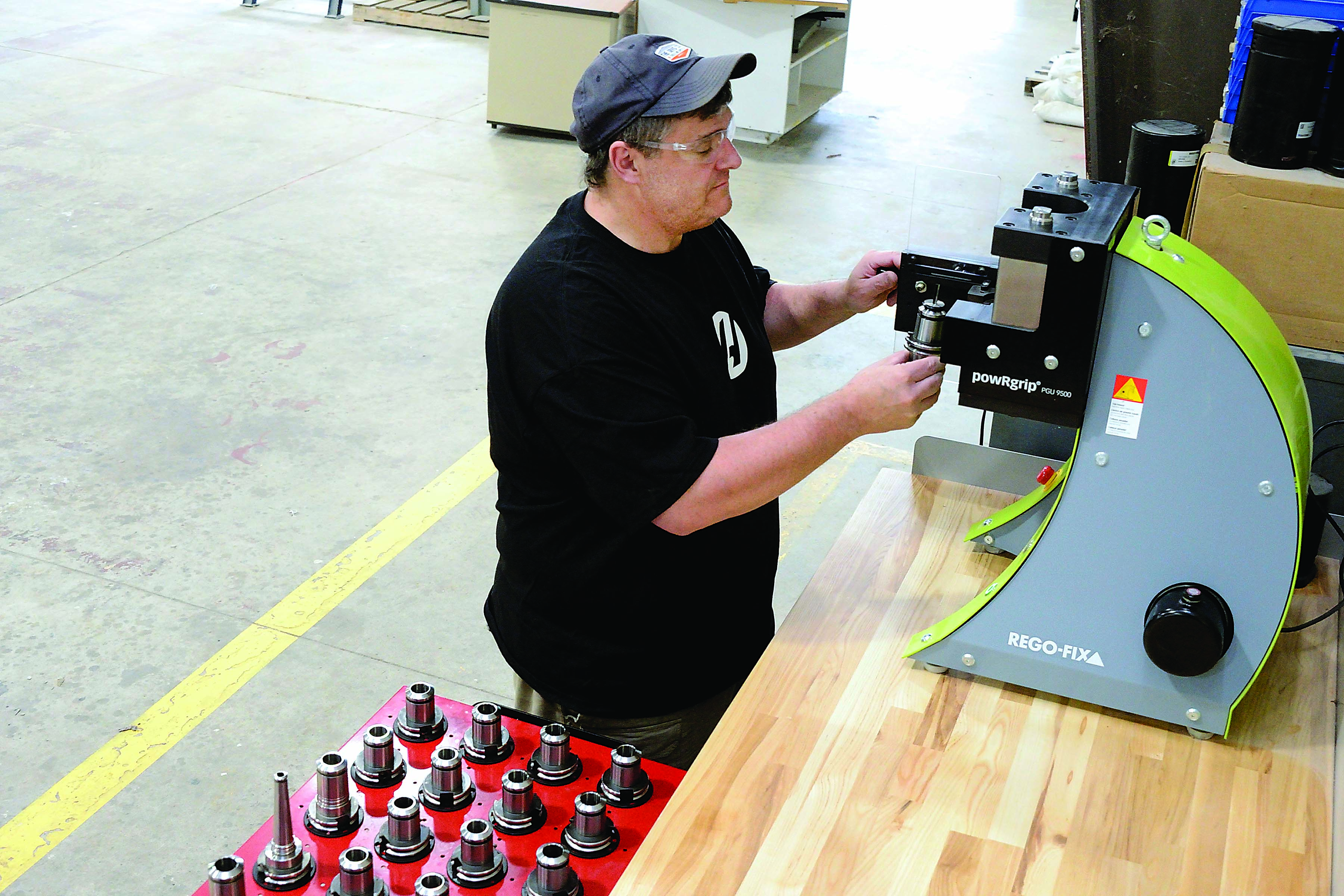
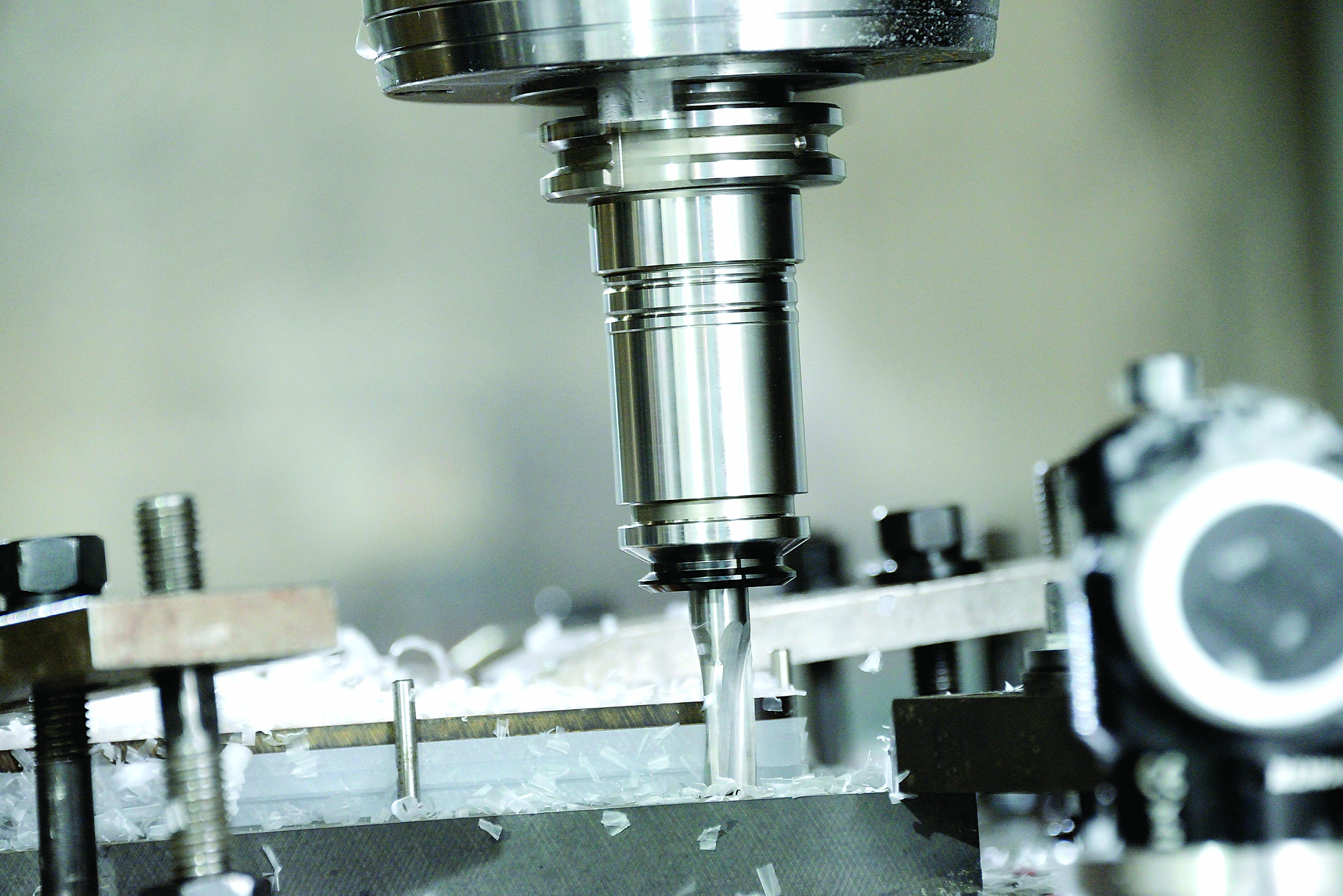
The powRgrip toolholding system enables K&E Plastics to drastically minimize tool runout when machining plastics. Image courtesy of Rego-Fix Tool
K&E Plastics’ traditional tooling, including standard CAT 40 toolholders with TG 100, yielded runout of about 0.002″ to 0.003″, which in turn produced burrs. Tool life also suffered, especially on highly abrasive plastics that contained glass fiber. “I could have a 3-flute endmill, but I might only be cutting with one flute because of the runout from the way the tool ran,” Broderson said.
His quest for runout reduction led him to question how his shop held its cutting tools. When Broderson investigated alternatives, he found that many toolholders weren’t a good fit for his company’s workflow.
Meanwhile, K&E was working on a project with another Bennington company. Broderson learned that it had swapped its former toolholder system for one that virtually eliminated runout. Intrigued, he obtained a few of the tools to test on K&E’s equipment and materials, liked what he saw and scheduled a full
demonstration. Instead of 0.002″ to 0.003″ runout, K&E slashed it to 0.0002″ to 0.0003″ with the powRgrip System from Rego-Fix Tool Corp., Whitestown, Indiana.
Review the print ads from this magazine to continue
This quick advertiser review unlocks the rest of the article and keeps the full-screen reader focused on the ads instead of the page chrome.
Advertisers included in this article experience
Print placements connected to this article
Kyoceraprecisiontools
INDEXABLE MAGIC DRILL
DRV High Speed and High Efficiency Drilling The new DRV Magic Drill combines a CVD outside insert and a PVD inside insert to allow for high speed machining and excellent drilling precision. The Newly developed insert chipbreakers improve chip evacuation and the holder’s thicker center core provides greater rigidity
DRV INDEXABLE MAGIC DRILL High Speed and High Efficiency Drilling The new DRV Magic Drill combines a CVD outside insert and a PVD inside insert to allow for high speed machining and excellent drilling precision. The Newly developed insert chipbreakers improve chip evacuation and the holder’s thicker center core provides greater rigidity. Check it out: kyoceraprecisiontools.com/DRV Drill depths from 2xD ~ 6xD 1-800-823-7284 | [email protected]
Visit Kyoceraprecisiontools View this placement in the issue recordPrint ads from this magazine
DRV High Speed and High Efficiency Drilling The new DRV Magic Drill combines a CVD outside insert and a PVD inside insert to allow for high speed machining and excellent drilling precision. The Newly developed insert chipbreakers improve chip evacuation and the holder’s thicker center core provides greater rigidity
DRV INDEXABLE MAGIC DRILL High Speed and High Efficiency Drilling The new DRV Magic Drill combines a CVD outside insert and a PVD inside insert to allow for high speed machining and excellent drilling precision. The Newly developed insert chipbreakers improve chip evacuation and the holder’s thicker center core provides greater rigidity. Check it out: kyoceraprecisiontools.com/DRV Drill depths from 2xD ~ 6xD 1-800-823-7284 | [email protected]
Continue reading
January 2019
As part of the system, the PGU 9500 automatic clamping unit secures tools in holders in less than 10 seconds without setting parameters or using heat. The system—which also includes powRgrip collet holders, clamping inserts and PG collets—solves K&E’s runout-related problems.
With the press of a button, the powRgrip automatic clamping unit produces a force of up to 9 tons. The pressure fit between collet and toolholder creates a radial force that concentrates on the tool shank through the slotted collet, holding the tool safely and with a high degree of concentricity. This smart system automatically determines clamping pressure based on the clamping insert for a quick, accurate, secure setup that earned Broderson’s immediate commitment.
“The presale demonstration and testing that Rego-Fix’s representative offered allowed us to make the investment much easier,” he said. “Our first purchase order covered probably 30 percent of our milling machine tooling. Eventually, we’ll use Rego-Fix on 100 percent of our milling operations.”
Along with the accuracy that K&E gets, Broderson said the powRgrip System is quick and simple. “It’s very easy to load a holder into the die, put the collet in—done. With Rego-Fix tooling, job changeovers are also much faster.”
With runout significantly minimized, K&E’s machinists can set cutter compensation at zero and use a 0.125″-dia. endmill to create a 0.125″ slot. Multiple passes with a 0.093″-dia. tool are no longer needed, reducing cycle times.
“With Rego-Fix tooling precision,” Broderson said, “we’re actually cutting with all three cutter flutes instead of just one, and there is less vibration. This means fewer burrs, so we get a better finished product coming off the machine.”
Part sizes at K&E range from those measuring 0.060″ in diameter, which are run on K&E’s screw machines, to others that are 15″ in diameter, which are run on the shop’s largest lathe. The range also includes 1″ cubes all the way up to 3′-by-4′ parts machined in the vertical milling department.
With runout off his list of problems, Broderson has more time to focus on growing his firm in a vibrant economy. Among the productivity advantages of Rego-Fix tooling, he sees one that relates directly to current economic conditions: Reducing cycle times helps K&E accommodate ever-shorter lead times and just-in-time manufacturing.
For more information about how K&E Plastics reduces tool runout, view a video presentation here: cteplus.delivr.com/2dyz9