



Benefits of dummy workpieces: General Industry Coverage
The Grinding Doc's a fan of false nips, aka dummy workpieces, but only in certain situations.
Dear Doc: I creep-feed-grind nickel alloys for the aerospace industry. Some of our grinders use a dummy workpiece; some don’t. What’s your take on dummy workpieces?
The Doc Replies: I’m a fan of dummy workpieces—also called false nips—but only in certain situations. Let’s take a look at when they’re useful.
Dummy workpieces are used to help get coolant to the hot spot (see figure) when the wheel is entering the workpiece (when up grinding) and when the wheel is exiting the workpiece (when down grinding). In shallow-cut surface grinding, the main benefit of coolant is lubrication, not heat removal. Here, a dummy workpiece might help a little.
However, when creep-feed grinding, the main benefits of the coolant are lubrication and heat removal. Here, you must have good cooling—and in this case, a dummy workpiece can help a lot.
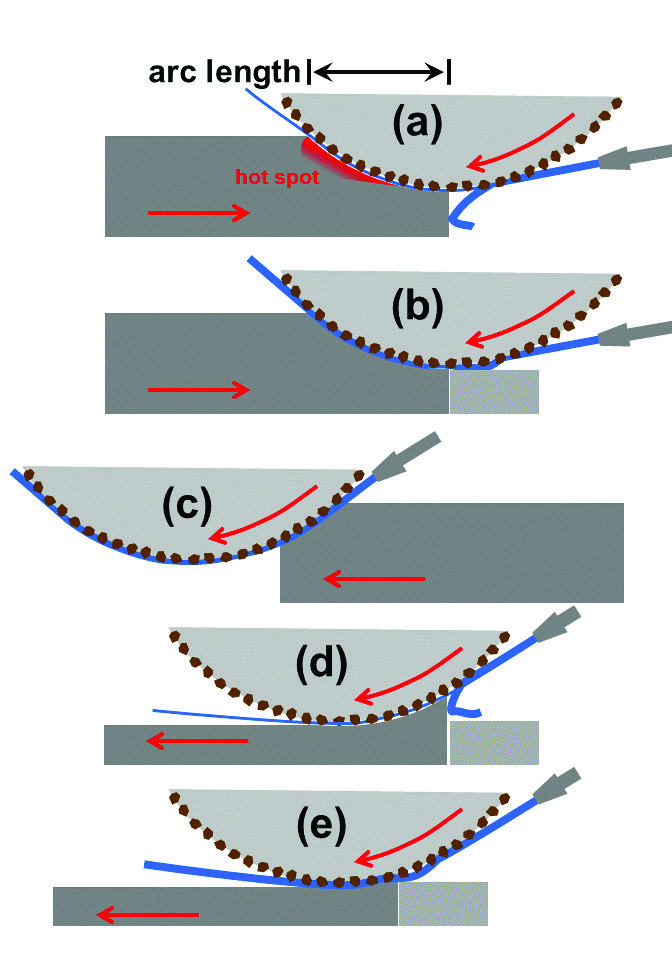
Dummy workpieces are used to help get coolant to the hot spot. Image courtesy of J. Badger
But that depends on where you put the workpiece. When up grinding, if you don’t have a dummy, the coolant will deflect off the wheel (a) at the entry point. A dummy workpiece will help catch the coolant and carry it to the hot spot. Here, you put the dummy at the entrance (b).
When down grinding, you don’t need a dummy at the entrance (c), but you can put a dummy at the exit (d). However, in this case, the benefit is not as good. That is because the material yet to be removed obstructs the utility of the dummy. It will help, though, when taking a small DOC finishing pass (e).
How long does the dummy need to be? For up grinding, ideally it would be just a little bit longer than the arc length. The equation for arc length is: arc length (in.) = √DOC × wheel diameter. An 8″ wheel taking an 0.080″ DOC would require a dummy slightly longer than 0.8″. For down grinding, a much shorter dummy will work.
Of course, the height of the dummy needs to be the height of the workpiece after the workpiece has been ground. If you’re doing complex forms—for example, a fir tree root form—make the dummy a little bigger and grind through it the first time.
It’s not an exact science. Dummies can be a little shorter or a little longer. Multiple-pass operations will get less benefit from the dummy on the early passes. Compromises will probably need to be made. But even then, dummies can be helpful in getting coolant to the hot spot and reducing loading, grit dulling and white-layer thermal damage.
Cooling is not the only benefit of the dummy. If you are generating big burrs, using a dummy where you get exit burrs (the wheel exit when up grinding and the wheel entrance when down grinding) can work wonders in reducing burrs, provided the dummy is exactly flush with the workpiece. A dummy can also reduce oxidation burn on the unground surface—or make the burn worse depending on the coolant situation, so give this some thought.
Glossary terms in this article
Related



Subscribers can use MFGAxis notes, saves and discussion tools with their innoNET account.


