


Clean, green and lean: Turning Performance
Shops can be both lean and green by using work cell-based approach to parts washing and environmentally friendly cleaning compounds and technologies.
When it comes to parts washing, there’s more than one way to “go green.” One way to perform environmentally friendly parts washing is by replacing technologies that release volatile organic compounds and objectionable solvents with aqueous-based ultrasonic cleaning. High-pressure water cleaning can also be used.
Another approach focuses on eliminating elaborate and outdated centralized wash systems. In addition to being easier on the environment, approaches like these support lean operations that save money and improve operating efficiency.
Centralized wash systems that are capable of cleaning every type of contamination from every department are increasingly outdated, according to John Carson, marketing manager for Guyson Corp. of USA, Saratoga Springs, N.Y., a manufacturer of industrial cleaning and surface finishing machinery. “They would plunk this multistage cleaning system in the middle of a factory and then everybody would haul parts to the central parts washer, wait in line until the parts ran through and then bring them back to the next stage of operation,” he said. That increases the amount of time value isn’t being added to parts, adds to the work-in-process inventory and wastes energy transporting pallets of parts back and forth.
A better approach is to use a simpler, more energy-efficient system sized for a work cell. That cleaner has features and applies cleaning chemistries appropriate for handling what’s required in a specific work cell, such as removing cutting fluid before the parts travel, possibly via conveyor, to the next department or operation.
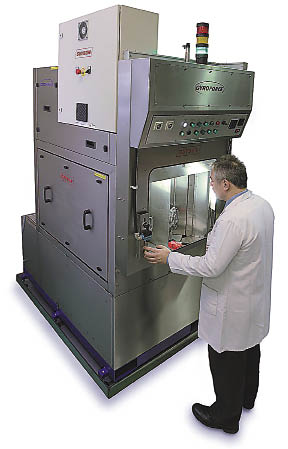
Courtesy of Guyson
The 24-sq.-ft. footprint of an indexing rotary parts washer from Guyson Corp. is sized for a work cell. It incorporates two spray washing stations and two drying stations.
He called the work cell-based system a “lean” approach to parts cleaning where the parts are cleaned only as needed. “With a lean approach, the parts are essentially pretty darn clean all along,” Carson said, “but they’re not necessarily as clean as they’ll be in the final stages.”
In addition, waste is reduced by using only the energy necessary for specific cleaning requirements. “It’s very wasteful to be cleaning beyond what is needed for the next step because it’s going to have to be repeated after that guy dirties the parts again,” Carson said. For almost every manufacturing step, there’s some type of contamination that must be removed before the part can be considered finished, he added.
Although operational savings from a work-cell approach can be substantial, the equipment cost for a centralized or decentralized system may be similar. “The lean guy may still be spending $200,000 on his parts cleaning,” Carson said, “but he might spend $40,000 at a whack in five different locations.”
The savings from reduced labor, work-in-process inventory and parts transportation is not lost on manufacturers seeking to cut costs. “We see fewer and fewer examples of the old-fashioned methods of cleaning and more of the work cell-based, or leaner, approach,” Carson said. “People can’t afford to do it the old way and, frankly, it’s not justifiable.”
Replacing Solvents
Parts washing chemistries are also available for replacing undesirable cleaning solvents, such as synthetic and petroleum-based ones, that a federal agency or the manufacturer itself has deemed unhealthy for the environment, workers or both. “It’s hard to know what solvents are being used, as many are outlawed each year, and every area of the country varies,” said Frank Pedeflous, owner of Omegasonics, Simi Valley, Calif. His company produces ultrasonic parts washers and about 40 different water-based soaps for use in ultrasonic systems, with the application dictating the appropriate soap.
Pedeflous noted that parts manufacturers generally require an alkaline soap with a pH in the high 10s to the middle 11s or an enzyme cleaner that eats oil and digests it off as carbon dioxide. The alkaline soap is not caustic enough to scar aluminum and generate bright spots on part surfaces, and so it is not an aggressive cleaner. For shops machining a lot of aluminum, he recommends the enzyme cleaner, which has a pH in the middle 8s. Although an aggressive cleaner will not damage stainless steel and titanium parts, such a soap is usually not needed because the primary cleaning task is removing cutting oils, which doesn’t require aggressiveness, according to Pedeflous.
When parts, such as medical implants, require passivation, which protects against rusting and corrosion, they receive a citric acid bath to remove free iron particles from their surfaces because the metals typically used to make those parts, including titanium and stainless steel, have a minute amount of iron ore in them. Any residue from cutting tools must also be removed during passivation. Passivation with citric acid, which has a pH from 2.8 to 3.2, generally follows an alkaline soap treatment to remove cutting fluids and one or two water rinses to remove soap residue.
The citric acid also removes surface rust, according to Pedeflous. “That shines metal surfaces,” he said, noting that water-based glycolic acid, which has a pH similar to the citrus solution, also removes surface rust.
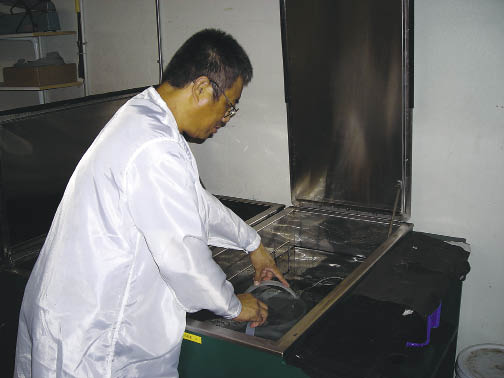
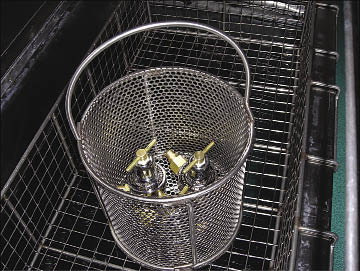
Courtesy of Omegasonics
Instead of scrubbing and washing parts, potentially missing hard-to-reach cracks and crevices, a worker can place the parts in an ultrasonic parts washer, flip a switch and perform other jobs.
Another water-based alkaline cleaner is available from Dylon Industries Inc., Cleveland. Technical data from Dylon states that the company’s recently developed Grade CL-1001 cleaner/degreaser’s chemical constituents are a blend of surfactants and nonpetroleum solvent. “It’s based on natural oils, actually,” said John Kondilas, the company’s director of technology. “There is no chlorine in the material.”
According to the company, the biodegradable, nonflammable cleaning agent is a concentrated formula and must be diluted with water to enable maximum cleaning action. The ratio ranges from 1:100 for scrubbing floors to up to 1:50 for use in pressure sprayers and power washers to 1:20 for cleaning smoke, soot and machine exteriors to 1:5 for removing cutting oil and use in ultrasonic tanks.
The cleaner has a pH use level of 11 to 12 and can be rinsed off with water. “It helps break down oils with its alkaline nature and doesn’t attack steels,” Kondilas said. “And it’s not going to cause corrosive action on dies or the work environment.”
Although the degreaser itself is environmentally friendly, Kondilas noted that it emulsifies and contains the material being cleaned. “If you have nasty oils and greases in there, they are going to be emulsified and you must have those removed in accordance with any environmental laws,” he said. “It doesn’t take nasty materials and make them friendly.”
Petroleum-based solvents have their supporters, but the growth of water-based parts cleaners appears to be rising because they can improve workplace safety while saving manufacturers some green. “Metalworking industry people want to get away from solvents because of the fire hazards and the fumes that go along with solvent-based cleaners,” Kondilas said. He added that “CL-1001 has the capability to lower operational costs, if nothing else because you dilute it with water, so it has to be more cost-effective [than petroleum-based solvents].”
Hi-Fi Cleaning
The equipment used to apply water-based cleaners varies based on numerous factors, including the need to reduce labor and part complexity. “You’re not having laborers scrubbing parts by hand,” Omegasonics’ Pedeflous said of ultrasonic cleaners. “The machine is doing that work so you’re not tying up valuable resources to do cleaning, especially if you’ve got blind-holes that you can’t get to no matter what tools you’re using. That’s where the ultrasound works so well because it can go into those areas and pull from the inside out.”
Cleaning is achieved by the vacuum sound bubbles an ultrasonic machine produces using an ultrasonic generator, or amplifier, and a transducer, or speaker. “It’s a lot like a stereo speaker in water,” Pedeflous said. “We’re just oscillating transducers within a water bath to create sound bubbles.”
In addition to the type of soap used, the output frequency needs to be appropriate for the job at hand. The higher the frequency, the smaller and more numerous the bubbles. Most industrial part cleaning applications are done at 40kHz, or 40,000 cycles per second. This means an ultrasonic tank creates 40,000 microscopic cleaning bubbles per second per transducer. For heavy items or highly contaminated items, a 20kHz to 25kHz output frequency might be appropriate because it creates bigger, stronger bubbles, but fewer of them.
On the other extreme, higher output frequencies, such as 68kHz or even 178kHz or higher, are suitable for cleaning debris smaller than a micron from parts. Those include medical and electronics applications, such as disk drives. “I wouldn’t use, as an example, a high frequency to clean an injection mold because I’m not going to get enough energy to do a good, thorough job,” Pedeflous said. “It may take a lot longer or I may just never get it done.”
Ultrasonic equipment manufacturers can build a tank with more than one frequency, such as 40kHz and 68kHz, but a user couldn’t operate between those at, say, 50kHz. However, Pedeflous said most will provide a sweep frequency, such as one that sweeps back and forth from 39,000 to 41,000 cycles per second, to eliminate standing waves for optimal cleaning performance.
The tank temperature and the time parts remain exposed to ultrasound are additional variables. The appropriate temperature is a function of the cleaning chemistry, because different chemistries break down at different temperatures. “The enzyme cleaner is something we generally don’t like to see go above 130° F because then it’s not as active,” Pedeflous said, noting that most applications are in the 130° to 150° F range.
He added that if parts are washed with soap and then receive two rinses, the temperature, for example, might go from 130° F for the wash to 140° F for the first rinse to 150° F or higher for the final rinse. Rinsing at a hotter temperature removes the soap and other residues and provides an effective flash dry.
For critical applications, it may be appropriate to lower the temperature and leave the parts in the cleaning chemistry longer because time and temperature are inversely proportional.
Clean Machines
Unlike an ultrasonic machine, where parts are processed unfixtured in batches, Sugino Corp., Itasca, Ill., offers CNC high-pressure water washing centers that require hard fixturing to clean one or more parts at a time. “We can pressurize more than one nozzle, so if we have two parts sitting side by side, we can use a dual-nozzle manifold to hit both parts at the same time,” said Dave Becker, sales manager for Sugino. “When necessary, this is done to improve cycle time.”
Sugino’s three basic cleaning machines are the Ü-Jet with a maximum operating pressure of 1,015 psi, the recently introduced Spa-Clean Jet with pressures up to 5,000 psi and the Jet Clean Center with maximum pressures of 5,000, 7,250 and 10,000 psi, depending on the model.
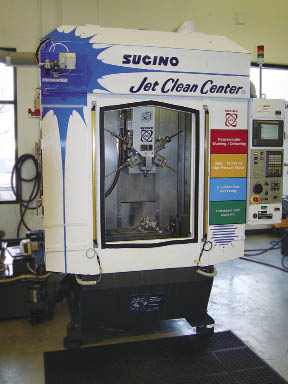
The company developed the Jet Clean Center primarily as a CNC deburring machine but is finding more and more customers are using the machine for mainly intermediate and in some instances for final washing, according to Becker. “Our customers are relying on the pressure and the velocity of the water to clean parts rather than using a cleaning agent at a lower pressure,” he said.
Sugino recommends a 5 to 7 percent solution of synthetic rust preventative combined with deionized or reverse-osmosis water for all its cleaning machines. This solution provides the best composition for meeting cleaning specifications and eliminates the possibility of inputting particulate and chlorine directly into the machine, according to the company.
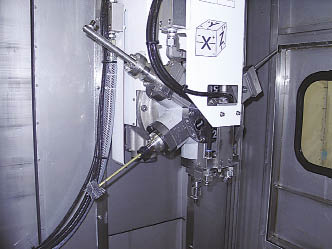
Courtesy of Sugino
The Jet Clean Center from Sugino has a CNC turret for applying various tools for cleaning and deburring parts.
In addition to positioning hard deburring tools, the Jet Clean Center’s turret positions nozzles for cleaning and deburring, with little or no difference between the nozzles used for deburring or cleaning. “The difference may only be larger orifice diameters to produce more flow rate for washing or using a fan nozzle to provide more coverage when washing a part,” Becker said. The nozzles include lance, direct-spray, fan-spray and right-angle nozzles, as well as multiple-nozzle manifolds. Becker indicated the lance nozzles are Sugino’s own designs. They typically have two holes 180° apart but can also be tailored to an application. In contrast to Sugino’s other cleaning machines, the Jet Clean Center’s nozzles can enter the workpiece. “In some applications, we’re going 7 ” or 8 ” into the part,” he said.
Similar to the Jet Clean Center, parts are not submerged in the Spa-Clean Jet. Using a 4-axis, gantry-type robot with two or four nozzles on the robot arm, an end user programs a nozzle to maneuver around the workpiece.
Parts are submerged, however, in the Ü-Jet machines. There, a special horn nozzle creates cavitation by forcing water through openings in the workpiece. The water then flows throughout the passages and cavities in the entire part, searching for contamination and flushing it out. “A vortex pulls the chips and debris out of all the exit holes in a part rather than water just going in one hole and exiting from the very next opening,” Becker said.
All three machines come standard with closed-loop filtration systems to remove particles to 5 microns. “Closed-loop filtration adds to the environmental friendliness,” he said. “You’re not constantly recycling it outside of the machine.”
The cleaning centers won’t alter a part’s surface, but they can be helpful when processing a part with varying surface finishes, such as an artificial knee joint with a fine finish on mating surfaces imparted using a fine buffing compound and a porous surface for the bone to grow into. “There is an issue sometimes with getting buffing compound stuck inside the porous surface,” Becker said. “High-pressure water is very effective for blasting that out.”
Customers have used the high-pressure waterjet cleaners to wash parts from the size of a dime to a 40 “-long, 350-lb. crankshaft. “Typically, the parts we work on are fairly complex, with a lot of cross-holes and blind passages,” Becker said. “The material could be anything, but mainly it is aluminum, cast irons, alloy steels and some stainless.”
The cleaning machines can be integrated with automated loading/unloading, but that doesn’t mean they usually are. “Surprisingly, most of the time they’re manually loaded and unloaded,” Becker said. Although automation can significantly increase the efficiency of a work cell, he noted that the machines are processing multiple part numbers in many instances, so manual loading and unloading simplifies part changeover.
What’s not surprising is that parts manufacturers are increasingly turning to parts washing equipment and cleaning chemistries that reduce their environmental impact to comply with regulations, provide a healthier workplace and gain a competitive edge through waste minimization. CTE
About the Author: Alan Richter is editor of Cutting Tool Engineering, having joined the publication in 2000. Contact him at (847) 714-0175 or alanr@jwr.com.
Courtesy of Dürr Ecoclean
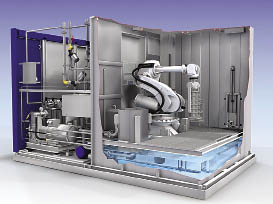
The robotic handling system on the EcoCFlex parts cleaning machine from Dürr Ecoclean allows for quick adjustment to various components and changing requirements within the cleaning process.
Combining cleaning and automation
The technology of the EcoCFlex cleaning machine from Dürr Ecoclean GmbH combines parts cleaning with the flexibility of a 6-axis robot that’s integrated into a treatment module. The machine’s design permits fast process optimization or adjustment, involving quick workpiece changes or integration with new workpiece types with minimal effort, according to the company.
The robot picks up individual or palletized workpieces at a defined point outside the machine and transfers them into the multifunction chamber for cleaning. Once a part is loaded, cleaning, air drying and optional vacuum drying take place in the same location. The robot movements can be precisely adapted for specialized cleaning requirements via a workpiece-specific program.
Based in Filderstadt, Germany, the company has U.S. offices in Wixom, Mich., and Bowling Green, Ohio. Dürr Ecoclean will be exhibiting at the parts2clean trade show, scheduled for Oct. 20 to 22 in Stuttgart, Germany. Visit www.parts2clean.com for additional information about the show, which focuses on production and maintenance cleaning systems.
Contributors
Dürr Ecoclean Inc.
(248) 960-4630
www.durrautomation.com
Dylon Industries Inc.
(800) 237-8246
www.dylon.com
Guyson Corp. of USA
(800) 633-6677
www.guyson.net
Omegasonics
(800) 669-8227
www.omegasonics.com
Sugino Corp.
(888) SUGINO-1
www.sugino.com
Glossary terms in this article
Related


Subscribers can use MFGAxis notes, saves and discussion tools with their innoNET account.