



Back to Basics: Drilling Performance
Gundrilling is a type of deep-hole drilling that was initially developed for manufacturing firearms. Gundrilling creates holes with length-to-diameter ratios that far exceed the capabilities of conventional drills.
Gundrilling is a type of deep-hole drilling that was initially developed for manufacturing firearms. Gundrilling creates holes with length-to-diameter ratios that far exceed the capabilities of conventional drills.
Where conventional drills are used to produce holes up to 5 diameters deep, the gundrill can produce holes more than 100 diameters deep, with far greater precision. The depth of the hole is limited only by the torsional stiffness of the drill’s tubular steel flute.
There are two keys to successful gundrilling. Suitable speeds and feeds for proper chip management, and adequate coolant pressure for lubrication of the brazed carbide tip and chip evacuation along the drill’s single flute. High-pressure oil or water-soluble coolant flows through an internal coolant passage of the gundrill to the cutting area.
Chips formed by the cutting action are forced up the flute and out of the hole. Because of the off-center position of the drillpoint, the drilling action places considerable pressure on the wear pad surface(s) that help guide the drill and create a burnishing effect as the hole is drilled. Typical surface finish of a gundrilled hole is from 32 to 64 µin—even better in some materials.
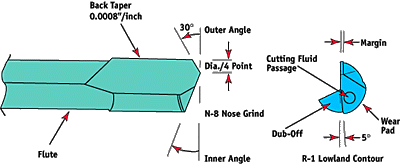
A gundrill with a general-purpose nose grind.
The illustration shows a conventional, single-flute gundrill with the common R-1 “lowland” contour (relief) ground on the drill’s diameter and the N-8 30°x20° nose grind. This combination is generally standard for U.S.-made gundrills and suitable for most applications where drilling is at right angles from the solid.
There are other nose-grind and contour combinations better suited for tough materials, very deep holes and/or an angled entry and exit. Tip coatings, such as TiN, TiAlN and TiCN, often increase tool life and improve hole finish, even after the tip has been resharpened.
GUNDRILL NOMENCLATURE
Back Taper: Developed along the length of the carbide tip to control heat buildup and prevent seizing of the tip in the hole.
Cutting Fluid Passage: The hollow center through the drill that delivers fluid to the tip, cooling the cutting zone and lubricating the carbide tip.
Dub-Off: Ground to provide chip clearance and help direct coolant flow.
Flute: As with a standard drill, it’s used for chip evacuation. On a gundrill, it also evacuates the chips with a flushing action from the cutting fluid.
Inner Angle: Typically from 10° to 20°, this angle cuts to the hole center and works with the outer angle to help break the chip.
Margin: This width is regulated to minimize drag along the flank of the cutting edge with a relieved area behind it that allows coolant to reach the pads.
Outer Angle: Typically from 20° to 40°, ground to one-quarter of the tip diameter from the outside edge. Suitable angles are dependent upon drilling conditions and sometimes the shape requirement of the hole bottom.
R-1 Lowland Contour: A tool with this radial relief, which is standard on most U.S. stock gundrills, is most suitable for drilling at right angles from the solid. Other contours are better suited for very deep holes, an angled entry and exit, cross holes or reaming applications.
Wear Pads: Used to guide the drill and burnish the hole during the drilling process.
About the Author
Doug Holley is president of Drill Masters of Vermont, a manufacturer of deep-hole drills located in North Bennington, Vt.
Glossary terms in this article
Related


Subscribers can use MFGAxis notes, saves and discussion tools with their innoNET account.


