


Grade Wise: Inspection Efficiency
Most people know that using the right grade of insert can improve nproductivity dramatically. Few know that the proper grade is also important nwhen utilizing round tools.
When it comes to production jobs that require solid round tools, it’s important to use the proper grade of carbide.
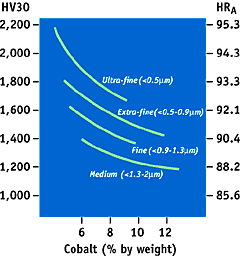
Grain size, cobalt content and hardness relationship for four carbide grades available from Sandvik Hard Materials.
People in the metalcutting industry are accustomed to using different grades of inserts to maximize operations that involve indexable tooling. But they usually don’t think about grade selection when it comes to solid-carbide round tools.
They should, especially if they do production work. Significant savings can be realized by choosing the proper grade of round tool for long runs.
Granted, it’s often more cost-effective to utilize indexable tooling for production jobs. But sometimes only a round tool will work. Examples of this are when a hole diameter is too small for an indexable tool or when the part requires a stepped form that would be easier to produce with a round tool.
In these cases, it makes sense to match the round-tool grade to the material being cut and reap the same benefits as when the optimum grade of insert is used.
Grade Smart
Tool life is a major concern when considering a production job, because, obviously, the quality of the tool will affect the overall cost of the project. When selecting a carbide round tool, consider the following: grain size, transverse rupture strength, binder and grind quality. Let’s look at each of these.
Grain size. Not all carbides are the same. For example, there are carbide tools on the market that have grain sizes ranging from 1 to 10 microns in diameter, yet they are all lumped under the heading “micrograin carbide.” There are also submicrograin carbides available. These pArticles can be as small as 0.4 microns, but they are commonly between 0.6 and 0.8 microns.
Grain size will, in many cases, dictate the wear life of the tool and the applications in which it will be successful. Round tools manufactured with larger grains are more likely to chip than those with smaller pArticles.
A grade should be classified according to the largest particle within the carbide. Some companies sell micrograin-carbide tools having an average grain size of 1 micron, even though there are 6-micron grains within the mixture. Consistency of grain size is important.
When selecting carbide round tools, buyers should ask their vendors to supply a grain chart. It will allow them to see the consistency of the tool’s substrate.
Transverse rupture strength. Probably the most important thing to know about a carbide round tool is its transverse rupture strength. A tool’s TRS rating, given in pounds per square inch, indicates its true strength and endurance potential.
TRS can vary significantly from tool to tool. The method the carbide fabricator uses to manufacture the blank determines the TRS value.
All carbide tools are sintered, a process that changes them into a form that the blank purchaser can grind to size. However, not every tool undergoes the sintering process known as Hot Isostatic Process. Sinter-HIPing, which is done before grinding, involves applying high heat and pressure to a blank. The process “squeezes” air out of the blank, significantly reducing porosity.
| Standard Grades | |||||||||||||
| US Industry Code |
ISO Code |
Grade | Composition | Specific Gravity g/cm3 ± 0.25 |
Hardness HRA ± 0.7 |
Transverse Rupture Strength min Kpsi |
Grain Size |
Recommended Applications | |||||
| WC | Co | TiC | TaC | Others | Microns | Class | |||||||
| C-1 | K30 K40 |
CT-1 | 90 | 10 | 14.55 | 91.1 | 250 | 1-2 | Fine | Roughing cuts-Cast iron & nonferrous materials | |||
| C-2 | K20 | CT-6 | 94 | 6 | 14.95 | 91.9 | 235 | 1-2 | Fine | General purpose-Cast iron & nonferrous materials | |||
| C-3 | K10 | CT-3 | 95.5 | 4.5 | 15.15 | 92.4 | 210 | 1-2 | Fine | Light finishing-Cast iron & nonferrous materials | |||
| C-4 | K01 K05 |
CT-4 | 97 | 3 | 15.20 | 92.9 | 195 | 1-2 | Fine | Precision boring-Cast iron & nonferrous materials | |||
| C-9 | CT-9 | 92 | 8 | 14.75 | 91.2 | 265 | 2-3 | Medium | Heavy wear part-No shock | ||||
| C-10 | CT-10 | 90 | 10 | 14.55 | 89.7 | 295 | 2-3 | Medium | Medium wear part-Light shock | ||||
| C-11 | CT-11 | 83 | 17 | 13.85 | 87.2 | 335 | 2-3 | Medium | Light wear part-Heavy shock | ||||
| C-12 | CT-12 | 87 | 13 | 14.25 | 88.6 | 315 | 3-4 | Coarse | Light impact dies | ||||
| C-13 | CT-13 | 83 | 17 | 13.85 | 87.2 | 335 | 3-4 | Coarse | Medium impact dies | ||||
| C-14 | CT-14 | 75 | 25 | 13.15 | 84.5 | 350 | 3-4 | Coarse | Heavy impact dies | ||||
| Micrograin and Submicron Grades | |||||||||||||
| US Industry Code |
ISO Code |
Grade | Composition | Specific Gravity g/cm3 ± 0.25 |
Hardness HRA ± 0.7 |
Transverse Rupture Strength min Kpsi |
Grain Size |
Recommended Applications | |||||
| WC | Co | TiC | TaC | Others | Microns | Class | |||||||
| C-2C-3 | K20 | CT-61 | 94 | 6 | * | 14.95 | 92.4 | 250 | 1.0 | Micrograin | |||
| C-1C-2 | K30K40 | CT-100 | 90 | 10 | * | 14.55 | 91.4 | 270 | 1.0 | Micrograin | |||
| C-1 | K40 | CT-106 | 84.5 | 15.5 | * | 13.90 | 89 | 350 | 1.0 | Micrograin | |||
| C-4 | K01K05 | CT-60 | 94 | 6 | * | 14.95 | 92.9 | 300 | 0.8 | Submicron | |||
| C-3 | K10 | CT-80 | 91.5 | 8.5 | * | 14.80 | 92.4 | 350 | 0.8 | Submicron | |||
| C-2 | K20 | CT-110 | 90 | 10 | * | 14.52 | 91.9 | 400 | 0.8 | Submicron | |||
| C-1 | K30K40 | CT-116 | 84 | 16 | * | 13.90 | 89.6 | 450 | 0.8 | Submicron | |||
| CT-206 | 94 | 6 | * | 14.90 | 93.6 | 350 | 0.5 | Submicron | |||||
| CT-210 | 90 | 10 | * | 14.50 | 92.7 | 400 | 0.5 | Submicron | |||||
| CT-212 | 88 | 12 | * | 0.5 | Submicron | ||||||||
Sinter-HIPing can increase a tool’s TRS by 25 to 75 percent. Many of the major carbide producers sinter-HIP blanks upon request. Some offer this service for an additional cost, while others incorporate it into their standard carbide-blank-production process.
Sinter-HIPing raises the price of a blank approximately 25 percent. However, some tool manufacturers utilize Chinese carbide. Generally, these blanks cost half as much as those produced from carbide produced outside of China.
TRS is also affected by the amount of cobalt that the blank contains. The industry-standard TRS for a nonsinter-HIPed blank containing 10 percent cobalt is approximately 200,000 to 250,000 psi. For a sinter-HIPed blank, it can be as high as 550,000 psi.
Sinter-HIPed materials are starting to grow in popularity because of their excellent performance characteristics. The higher TRS ratings provided by these materials suggest that tools made from them will resist wear better and, therefore, chip less than nonsinter-HIPed blanks.
Typically, the amount that a tool chips is what differentiates a premium grade from a standard grade.
Binder. Every tungsten-carbide tool requires a binder. Cobalt and nickel are the most prevalent binders, with cobalt being the most common by far.
Nickel-bonded carbide grades are recommended for fairly specialized applications. If corrosion resistance is a concern, for instance, it’s best to select a blank with a nickel binder. Nickel is also the binder of choice when a nonmagnetic tool is required.
Most carbide tools contain 8 percent cobalt. Tools with this binder percentage can be used for a wide range of applications. However, there can be performance differences among 8-percent-cobalt tools.
For example, a sinter-HIPed 8-percenter with a high TRS rating will have much more success in a high-impact application than a tool with the same cobalt content that hasn’t been sinter-HIPed.
For a tool to run optimally, it is crucial that the percentage of binder in the blank match the application. The binder and percentage of binder determine if the carbide will have wear or shock capabilities, or a combination of the two. The higher the cobalt percentage, the more resistant the tool will be to shock. Conversely, the lower the cobalt content, the better the tool will resist wear.
Grind Quality. A manufacturing project’s success depends on every element of the production process. If a machine is outdated and can only hold a nominal tolerance, it won’t meet the demands of a tight-tolerance production job.
It’s a similar situation with carbide round tools. If a tool is made of the finest-quality carbide but is poorly ground, it won’t perform to the highest standards. And, naturally, a superbly ground tool must be made of premium-grade carbide in order to perform optimally.
Sticker Shock. Obviously, a carbide round tool that’s made from a premium blank ground to exacting standards will carry a higher price tag than a lesser-quality tool. Usually, though, the higher initial outlay will be recouped because the tool will last longer, which will positively impact the run time of a production job. Using the proper tool for a production job helps ensure that the cost of the end product will be controlled.
It’s important to keep in mind the potential savings when calculating the cost of a tool. If a properly configured tool costs 20 percent more than an improperly configured one but is capable of producing 50 percent more pieces, it’s worth the investment. The number of parts a tool produces should be used to determine its “true” cost.
It is important to realize the costs associated with changing tools. Each time that production stops to replace tooling, the profit margin suffers.
To demonstrate how tool-change time affects costs, consider a fictitious shop that has an hourly machining rate of $60. Swapping out a round tool on one of the shop’s CNC machines usually takes 15 minutes—a machine cost of $15. In addition, time is spent checking to make sure that good parts are still being produced after the tool change. A full inspection for complex parts averages 45 minutes, or $45 of lost machining time.
Between swapping out the tool and reinspecting parts, the shop loses $60. If switching to a premium-grade round tool eliminated just two tool changes a week, the shop would save $6,240 annually.
Following are some actual savings realized by three companies after they switched to premium-grade round tools:
- An automotive manufacturer had been using a C-2 endmill on an aluminum casting. It switched to a C-11 tool, which cost about 40 percent more, and increased tool life by 200 percent.
- An aerospace manufacturer had been using a C-2 micrograin-carbide drill in titanium. Changing to a C-2 submicrograin-carbide tool increased tool life by 185 percent. The new tool cost 10 percent more than the old one.
- A manufacturer that machined extruded aluminum switched to round tools made from sinter-HIPed carbide blanks and experienced a 350 percent increase in tool life. Both the old and new tools were manufactured from C-10. The new tools cost approximately 60 percent more.
Every company should examine its tool costs, especially the costs of tools used for long part runs. Often, a carbide round tool with a bigger price tag will more than pay for itself by reducing machine downtime.
About the Author
Peter Fretty has 15 years of industry experience, including time spent working as a cutting tool applications specialist. He currently is operations manager at White Lake Machine Inc., Montague, Mich.
Glossary terms in this article
Related


Subscribers can use MFGAxis notes, saves and discussion tools with their innoNET account.