



Hard and Fast Rules: Turning Performance
Author describes what he's learned about turning hardened steel. Discussed are the machine tools needed as well as PCBN and ceramic inserts.
Advanced cutting tool materials such as polycrystalline cubic boron nitride and ceramic have made the turning of hardened steel a cost-effective alternative to grinding. Indeed, many machine shops have retired their cylindrical grinders in favor of less expensive and more versatile CNC lathes.
Compared to grinding, hard turning:
- permits faster metal-removal rates, which means shorter cycle times;
- eliminates the need for coolant;
- shortens setup times; and
- allows multiple operations to be performed in one chucking.
Today’s sophisticated CNC lathes offer accuracy and surface finishes comparable to what grinders provide. Many metalcutting experts, particularly those who sell machine tools, assert that an extremely rigid, high-performance lathe is a prerequisite for hard turning. That’s not always the case.
Often, all you need for hard turning is a 2-axis CNC lathe and the correct cutting tools. (See accompanying article, page 45.)
You also need to run tests before hard turning a customer’s parts. You’ll learn a lot, and, if you’re like me, you’ll discover that the testing can be a lot of fun.
Running Tests
A number of years ago, I worked as an applications engineer for a machine tool distributor. One of our customers, a shop that manufactured tooling, was seeking a quicker way to push custom punch and die sets out the door.
The shop was already finish turning hardened tool steel on a regular basis. The process entailed three steps: rough turning soft tool-steel blanks, heat-treating them and finish turning them. The shop wanted to take hard turning to the next level: roughing hardened steel. This would save it from having to rough-turn tooling blanks before heat treatment and permit it to always have hardened blanks on hand. The company estimated that it would save one to two days on every order it processed.
Hard roughing also meant that the shop would need to remove up to 2″ of material per side from hardened blanks, then finish-turn them to the required dimensions. That, obviously, would prove to be a daunting task.
The shop asked me for help. Until then, my experience with hard turning had been limited. And removing such massive quantities of hardened tool steel was, frankly, beyond my imagination.
So I sought the advice of Kennametal Inc.’s local representative, Gary Morsch. He agreed to help conduct cutting trials.
I set up a Hitachi Seiki 20SII 2-axis CNC lathe with an 8″-dia. chuck and a 20-hp spindle. Its 8-station turret was equipped with quick-change tooling, which allowed us to quickly and easily swap out inserts. The tooling shop furnished a crate of D-2 and A-8 punch and die blanks, which had diameters ranging from 2″ to 6″.
When Gary arrived with a selection of inserts, we set to work. The first grade we tried was Kennametal’s KD200 RNM-32T, a solid-PCBN, 3/8″ round insert. At approximately $200 a pop, it was the most expensive insert tested.
Following Gary’s recommendations, I programmed the machine to cut the D-2 tool steel at a speed of 300 sfm, a feed of 0.003 ipr and a 0.100″ DOC. I thought those cutting parameters were a little optimistic for a material with a hardness of RC 60. I fully expected the insert to explode, sending the workpiece and shrapnel flying everywhere.
It didn’t. After pushing the cycle-start button, I heard a slight thump then a whisper as the cutting tool engaged the workpiece.
| Solid-PCBN inserts, like the KD200 RNM-32T shown, were tested on hardened D-2 tool steel. Cutting parameters ranged from 175 to 350 sfm, 0.002 to 0.005 ipr and 0.040″ to 0.125″ DOCs. |
I marveled at the glowing orange chips as they cascaded off the workpiece.
My awe was short-lived, though. The KD200 required indexing after only a few minutes of cutting, due to notching at the DOC line. Edge notching commonly occurs while turning high-strength alloys, and hardened tool steel is no exception. Notching was the primary cause of failure for every roughing insert we tested.
And test we did. We experimented with many different speeds (175 to 350 sfm), feeds (0.002 to 0.005 ipr) and DOCs (0.040″ to 0.125″). But we had limited success. Whatever parameters we tried, the KD200 inserts failed after only a few passes. Their round shape, though, allowed us to index them many times. Each insert yielded an average time-in-cut of 43 minutes.
Next, we equipped the lathe with a hot-pressed ceramic insert, an RNG-45T K090. This 1/2″ round insert is 5/16″ thick and costs about $12.50. I programmed the lathe to run the K090 at a speed of 300 sfm, a feed rate of 0.005 ipr and an average DOC of 0.050″.
The K090 was able to handle everything we threw at it. The only limitation was its size. Because of its large inscribed circle, there was a lot of unwanted contact between the insert and workpiece. Consequently, tool pressure tended to cause the tool to chatter at higher DOCs. Despite this, one insert endured many hours of cutting during the three-day test period.
While observing the cutting passes, Gary and I realized that the majority of insert wear seemed to occur at two points: where the tool first entered the cut and where it hit the part’s shoulder. The insert tended to spark, which indicated to us that it was disintegrating slightly.
I was able to greatly improve tool life by altering the program so that the insert never hit the shoulder perpendicularly. I simply changed the cutting path so that an angled shoulder was created and made the tool come around and clean out the shoulder with facing passes (Figure 1). This eliminated the rubbing effect every time the tool faced up the shoulder.
I also reprogrammed the tool to face-cut a large chamfer on the workpiece before any rough turning was done. This seemed to ease the stress on the tool when it first entered the cut.
The best cutting parameters for the K090 were a 280-sfm speed, a 0.005-ipr feed and a 0.050″ DOC.
In addition to roughing, Gary and I also tested inserts for finish turning. We had the best results with a CNGA 433-T KD050 insert, which costs about $110. This PCBN-tipped tool is designed for finishing and is an example of what Kennametal-and other toolmakers-refer to as a “minitip” insert. It’s about one-half the price of a comparably sized solid-PCBN insert.
I programmed the lathe to run the KD050 at 350 sfm and 0.002 ipr, with an average DOC of 0.005″.
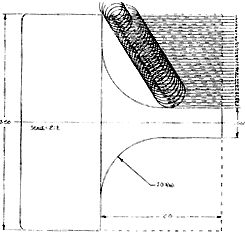 |
| Figure 1: Tool life improved during testing after the cutting path was changed so that an angled shoulder was created. |
Measuring the expected part diameter over dozens of passes showed consistent size, excellent surface finish and very little insert wear. We took this to mean that the cutting parameters were correct.
At the conclusion of our tests, Gary and I had demonstrated the viability of hard turning the punch and die sets.The K090 and the KD050 in particular gave very predictable and satisfactory results, allowing the efficient removal of large amounts of hardened tool steel.
Lessons Learned
I learned many things during the three days I spent turning hardened tool steel. The most surprising one was the impact that programming has on tool life while hard turning.
As mentioned earlier, notching at the DOC line was the primary cause of failure for all of the inserts tested. Multiple repetitive cycles-G71 and G72-kept the DOC consistent throughout the cutting cycle.
|
|
|
Liquid-cooled ballscrews. Thermal axis compensation. Free-flow chip design. All of these options can be added to lathes to optimize hard-turning operations. For many high-precision applications, these big-buck features and capabilities are necessary. And it’s true that hard turning makes big demands on a machine tool. But do you really need to shell out Cadillac money if a Chevrolet will get you where you’re going? You probably already have everything you need to hard-turn: some hardened tool steel; ceramic or PCBN inserts; and a 2-axis lathe, preferably one with a CNC. A lot of today’s CNC lathes can hold tolerances of 0.0005″ or less, which easily falls in the tolerance realm of many grinding machines. And while many factors affect a lathe’s performance, a primary consideration is the quality of its ways. If you want to make heavy roughing cuts, use a machine with box ways. They can handle heavier loads and withstand greater abuse than linear ways, which are capable of higher traverse rates and are generally more accurate than box ways. The biggest consideration when it comes to hard turning, though, is the cutting tools. They will most likely have a greater impact on the success of your hard-turning operation than the machine you use. The choice for most hard-turning operations will probably be ceramic inserts, especially for roughing. They are cheap and readily available. Better yet, many of them fit the same holders as your carbide inserts. PCBN inserts, though expensive, are easily justified under certain circumstances. They are the clear choice for machining ferrous materials, which call for tools with exceptional wear resistance. Most insert manufacturers offer minitip PCBN inserts. These are generally more cost-effective than solid-PCBN inserts. Look for minitips that have two cutting edges per insert. Though they limit the DOC to slightly more than the nose radius of the insert, they are approximately one-fourth the cost, per tip, of a comparably sized, single-edge minitip. If you’re thinking about trying hard turning, there’s one final consideration: Check with your customer first. A hard-turned surface has mechanical properties that are distinctly different from a ground surface. If you perform aerospace or government work, you may need permission from your customer’s engineering department before changing your manufacturing process. -K. Hanson |
This forced the majority of the wear to occur at the same location on the insert.
I found that by using a canned cycle-G90 and varying the DOC slightly, I could reduce notching. Obviously, the shape of the part largely determines the tool path for any workpiece. But with some planning and a little unconventional programming, tool wear can be kept to a minimum during hard turning.
Tool wear isn’t the only obstacle that needs to be overcome. Another is chip control, which can present a problem in any turning operation. The inserts that Gary and I used relied on mechanical chipbreakers to control chips. They offered no control, and sometimes they caught a chip, causing it to wad up and gall the workpiece.
We found that the best way to control chips was to simply aim an air nozzle directly at the cutting zone. This forced the hot chips away from the workpiece and down into the chip pan.
I also have used cold-air guns. They seem to work better than plain compressed air, because they remove heat from the work area and tend to consume less air.
Hard turning works by continuously annealing the material in the immediate shear zone. This softens the material as it is being cut. So instead of steel that has a hardness of RC 58 to 62, the material in the annealed zone is perhaps only half as hard. To achieve this annealing effect while hard turning requires cutting speeds that are perhaps 50 percent less than the recommended cutting speeds used for the same material in its soft condition.
You will probably have to hard-turn dry. Cutting fluid can cause an insert exiting the cut to experience thermal shock.
Lastly, as anyone who has witnessed a hard-turning demonstration can attest, the glowing chips and extreme machining conditions can create a great deal of heat and smoke. Proper ventilation and the safe handling of hot chips should always be considered before hard turning.
During the time since Gary and I conducted the tests, I have had many opportunities to perform further testing. I have demonstrated and experimented with hard turning on a variety of machines and workpiece materials. I have tried various brands of inserts, with equally impressive results. With few exceptions, I have found tool life to be very predictable and reasonable.
For shops that need to quickly turn around parts that are through-hardened, like punches and dies, hard turning can offer significant benefits. It offers greater flexibility and simplifies the manufacturing process. Having an inventory of hardened blanks, for example, would allow a company to provide same-day delivery of custom tooling. This ability can mean the difference between getting an order and losing it.
About the Author
Kip Hanson is a regular contributor to CTE and general manager of Allen Co., Edina, Minn.
Glossary terms in this article
Related



Subscribers can use MFGAxis notes, saves and discussion tools with their innoNET account.


