



Top-Form Geometry: Turning Performance
This article makes the argument that an insert is really a system made up of a combination of factors. The focus of the article is on one of these factors: the top-form geometry, which has evolved from the chipbreaker designs used primarily on turning inserts.
The last few years have seen a genuine revolution in the forces and factors at work in the metalcutting industry. As a result, today’s inserts can be characterized as an integrated system that includes: an engineered substrate; one or more coatings; a top-form geometry or chipbreaker; a specific edge preparation; an appropriate size, style, and nose radius; a toolholder; and a cutting fluid.
Each of these elements makes a distinct contribution to overall system performance on its own, but also works in combination with all the others to achieve the desired result. A cursory glance through any insert catalog will reveal millions of potential combinations of these seven system elements.
Making sense out of such a broad range of choices can be a daunting challenge, but the reward is often a level of productivity that was impossible just a few years ago.
Why Top-Form Geometries?
The term “chipbreaker” does not adequately describe the contribution this element makes to the insert system’s performance. “Top-form geometry” is a more precise description of the very complex shape seen on the cutting surface of a modern insert.
Today’s top-form geometries are the latest generation to flow out of advanced development projects initiated in the early 1990s. Many products are the result of powerful new computer technologies that became available at that time. By combining finite element analysis and advanced 3-D animation technologies, development engineers are able to actually “watch” chips flow across an insert and instantly see the results of small geometry changes.
Thousands of hours of simulation are required to develop a top-form geometry that provides an optimum tradeoff of chip control and cutting-force reduction for a particular range of applications. Advanced, computer-based moldmaking and manufacturing technologies are used to move the final designs quickly into production.
In the cut, a top-form geometry does much more than merely break chips. When properly designed, it also controls cutting forces to allow other elements of the insert system to perform more efficiently. A force-reduction geometry, for example, can also reduce heat, deformation, and friction to enhance tool life and improve size control and finish. This fact largely explains the growing use of top-form geometries on milling inserts, a metalcutting operation that does not usually require chip control. Combined with advances in cutter design, these low-force insert systems help facilitate high-speed milling operations on low-horsepower machines.
One Size Doesn’t Fit All
The first generation of modern top-form geometries was designed to enhance the performance of new substrate and coating technologies that also were coming onstream in the early 1990s. At that point, the industry’s main objective was to “simplify” the insert-selection process by developing products with very broad application ranges-a sort of one-size-fits-all approach to application development.
Those original high-performance top-form geometries aided in this effort by extending the application range of the available substrate/coating combinations, primarily through force and heat reduction. These new inserts worked well, often much better than the designs they replaced. It quickly became apparent, however, that a system that did reasonably well in a broad range of applications did not usually provide truly outstanding performance in any of them.
Ongoing research into substrate materials, coating systems, and top-form geometries soon demonstrated that the “insert-as-a-system” concept was a more productive approach to enhanced metalcutting performance than one-size-fits-all. By shifting some of the functions previously performed by the substrate and coating to the top-form geometry, it became possible to engineer insert systems for very specific applications. The result was another advance in metalcutting productivity that continues to re-shape the industry.
Strength vs. Efficiency
Insert design has always been a tradeoff between strength and efficiency. Negative-rake inserts are the strongest, but positive rake inserts are the most efficient in most applications. Until it became possible to actually “see” what happened at the insert/workpiece interface as the chip was formed, the two approaches had always been considered to be mutually exclusive.
In fact, that proved to be a misconception. Much of the “magic” of today’s top-form geometries is concentrated at the cutting land (i.e., the very small area at the edge where the rubber meets the road as the insert shears its way through the workpiece). Most of these lands are strongly positive, as much as 16° on some light finishing “Top-Forms” and rarely less than 0° even on heavy-duty roughing designs.
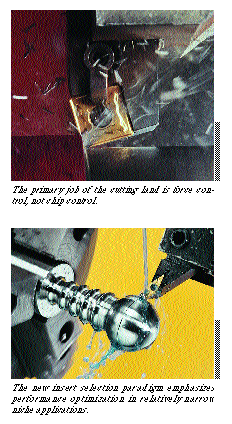
It’s important to remember that the primary job of the cutting land is force control, not chip control. The great bulk of chip management is accomplished by the steps, scallops, and bumps that are so characteristic of today’s inserts. Separating the two functions is one of the keys to optimal performance of advanced insert systems.
Turning an Insert Into a System
With top-form geometries reducing cutting forces, and as a result, lowering the temperature of the insert/workpiece interface, it became possible to take full advantage of developments in both substrate and coating technologies to improve insert-system performance. The result of these synergies has produced a whole new paradigm for insert selection and application.
For example, selectively enriching the cobalt content of the cobalt/carbide matrix near the surface of a substrate produces a very tough, impact-resistant, but temperature-sensitive layer immediately under the coating. Using advanced multilayer coating technologies to deposit extremely smooth layers of very hard, chemically inert materials like titanium carbide or titanium nitride yields an insert that, theoretically, should perform very well in general-purpose turning applications. In practice, however, the combination tends to fail prematurely because the heat generated in the cut softens the cobalt-enriched layer and causes the relatively brittle coating to spall off. Add a low-force top-form geometry and effective chip management to the system, though, and the result is a much cooler running insert optimized for the general-purpose machining role.
Applied to a finishing insert, the “system” approach extends coating life to provide consistent size control and surface finish. In a roughing application, the cutting land is engineered to provide high strength, while the supporting geometric elements handle chip management-even on round inserts.
Matching the System to the Job
As noted above, recent developments in insert systems have moved the industry away from the “simplification” efforts that characterized the 1980s, and into a new selection paradigm that emphasizes performance optimization in relatively narrow niche applications. While this process is necessarily more complex than selecting a one-size-fits-all solution, it should not be a cause for concern or an excuse to avoid using the new generation of insert systems.
Insert selection begins with the workpiece material. You will find the ubiquitous ISO red, yellow, and blue color system used to identify cast iron, stainless-steel, and alloy-steel workpieces in nearly every supplier’s catalog. In most cases, nonferrous materials are included in the red category along with the cast irons.
Next, identify your operation. At a minimum, you will be offered a choice of roughing, general purpose, and finishing, but many suppliers subdivide these into additional categories. From there you will be led to a grade selection and finally to a top-form geometry.
Once you have made an initial selection, the next step is to run the recommended insert system at the speed, feed, and depth of cut indicated to evaluate its performance, and most important, its failure mode. With that established, you can use the additional reference materials supplied to alter the insert system configuration to optimize its performance in your specific application.
Use the Footprint That Fits Best
This procedure will lead you to an optimal insert system, but it may take several attempts to achieve the result you are looking for. Most insert suppliers provide the information you need to circumvent one or more of the steps in the cut-and-try method just described and arrive at a near-optimal solution on the first or, at most, second attempt.
Many manufacturers provide application data and other technical specifications in their catalogs and sales literature. Those technical data sections usually contain a detailed description of both the geometry of each top form and a chart that shows the “footprint” of its application range. For instance, the Valenite catalog has charts that detail feed rate on the horizontal axis and depth of cut on the vertical axis.
Since you will already have established your cutting parameters earlier in the selection process, choosing the optimal top-form geometry is a relatively simple process. Start with the top form in the general recommendation, and then compare the other available forms with footprints that fall within your application parameters. Select the one that best matches your requirements and test it. Then use the footprints to optimize your operations as necessary.
Optimize, Optimize, Optimize
Modern top-form geometries represent a technology in fastrack. Virtually every major insert supplier has an ongoing research and development program dedicated to improving the performance of this key element of the system.
As a result, you can expect to see a steady stream of new top-form geometries in the next few years, each providing a substantial improvement in insert-system performance. The only way to make sure you gain the competitive advantage this technology offers is to work continually at optimizing each application in your shop. Thinking of every insert as a system is a good place to start, and thinking of every insert system, no matter how new, as being on the verge of obsolescence is the only reasonable attitude to have. The revolution in insert system performance has only just begun.
About the Author
Karl Katbi is product marketing manager at Valenite Inc., Madison Heights, MI.
Glossary terms in this article
Related


Subscribers can use MFGAxis notes, saves and discussion tools with their innoNET account.


