

The Pressure’s on to Improve Drilling
The author explains how high-pressure, high-volume coolant can provide better control of chips and temperature during drilling operations. He also describes the tools, equipment and shop procedures that can ensure top performance from a high-pressure coolant system.
|
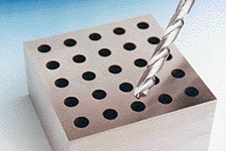
Everybody wants a “silver bullet” to solve problems. For many years, machinists have considered high-pressure coolant to be the silver bullet to solve drilling’s problems. Recent improvements in tooling and equipment have made high-pressure coolant even more practical. As a result, an increasing number of shops are turning to this solution to improve their drilling operations. It is estimated that 40% of all new CNC machines will be equipped with high-pressure coolant by the year 2003. The need for high-pressure, high-volume coolant in drilling became apparent when gundrills were introduced more than 100 years ago. When using these drills, machinists had to keep the coolant pressure somewhere near 1000 psi or the tool would friction-weld to the workpiece. Standard low-pressure coolant systems couldn’t prevent friction-welding, because the process generated so much heat that the coolant boiled away before it reached the chip/tool interface. This boiling produced super-heated steam that formed a barrier that prevented additional coolant from reaching the cutting edge, so little lubrication was provided. The vapor barrier also allowed chips to fall back into the chip/tool interface, causing costly damage. When machinists tried high-pressure coolant on standard drilling operations, they found that the benefits of increasing coolant pressure improved the performance of these operations as well. Properly applied high-pressure, high-volume coolant prevents the formation of a vapor barrier by causing a localized pressure increase. This forces liquid into the cutting zone, removing heat, providing lubrication, and flushing chips away from the cut. Damage from heat and chips is eliminated, and tools can cut until they wear out. High-pressure coolant discourages chip welding, prevents the damaging chemical reactions that may occur at high temperatures, and allows drills to last longer (Figure 1).
With the problems caused by heat and stray chips minimized, machinists can drill faster. Surface speed can be increased by a minimum of 30%. In some operations, the use of high-pressure coolant can result in a 300% improvement. For example, a 0.500″ carbide twist drill penetrating 20 ipm with low-pressure coolant can easily penetrate 60 ipm with high-pressure coolant. Lubricity is increased by blasting lubricating fluid between the chip and the cutting edge at hundreds of miles per hour. With more lubrication and lower temperatures at the cutting edge, surface finishes are often significantly improved. By supplying a constant supply of coolant to the cutting edge, high-pressure coolant also eliminates damaging thermal shock to the tool. With conventional coolant, the temperature of the cutting edge increases as it enters the cut and stays hot until it finishes the cut. When the tool is withdrawn from the cut and the coolant once again can reach the cutting edge, the cutting tool is exposed to an extreme thermal shock. This rapid cycling between high temperatures and quenching can damage a tool more than heat or wear, but the severity of the problem depends on the operation. A turning tool typically will not fail due to thermal shock, because it is subjected to this quenching only three or four times per minute when it is withdrawn from the cut at the end of each pass. A facemilling operation running at 1000 rpm, on the other hand, subjects every insert to 1000 damaging quenches per minute. Drilling falls somewhere in between, with thermal shock occurring every time the drill pulls out of the cut. When using a standard low-pressure coolant system, shops have had to make a difficult choice between subjecting their tools to thermal cycling or the damage that high temperatures cause. Some manufacturers recommend running tools dry on operations that may subject the tool to high rates of thermal cycling, believing that the continued heat and chip damage will take less of a toll on the tool than thermal-shock damage. Current state-of-the-art high-pressure coolant systems make this tradeoff unnecessary. Pressure Where Needed
Appropriate speeds and feeds are also necessary. The application of high-pressure coolant will be unsuccessful if it is used to increase the feed per revolution rather than the speed. Increasing the feed increases the chip size and a chip that is too big can’t be forced through the hole, no matter what the pressure. The gullet of the drill is the limiting factor. Even with through-coolant tools and the proper speed and feed, an increase in coolant pressure will not automatically lead to an improved drilling operation. Coolant volume is an important consideration as well. The coolants used in drilling are considered “contained coolants,” because the machining takes place in a confined area. In these situations, it’s important to pump enough coolant through the tool to completely fill and pressurize the hole. This eliminates the formation of vapor, which leads to high cutting temperatures. The pressure required to prevent vapor is generally in the 1000 psi range, but higher pressures may be needed for particularly difficult applications. The key, however, isn’t the pressure of the coolant going into the tool, but the back pressure generated in the hole that forces the coolant and chips up the drill gullets and out of the hole. Three factors determine the amount of back pressure generated: the coolant-hole size in the drill, the open area of the drill flutes, and the pressure of the coolant entering the back end of the drill. To see how these factors interrelate, consider two 0.375″ drills: an HSS drill and a carbide drill. Because of carbide’s brittleness, carbide drills are manufactured with smaller coolant holes than HSS drills. The extra material adds strength to the carbide drill’s structure. Because the HSS drill has larger holes, more coolant will pass through it. The result will be more flow, more chip removal, and more back pressure in the hole. The difference in back pressure can be large enough to cause a coated HSS drill to work better than a poorly designed solid-carbide drill with smaller coolant holes.
Table 1 compares the coolant flow possible with two different coolant-hole diameters at various coolant pressures. According to this table, a drill with 0.030″ holes will only pass 1.43 gpm at 1000 psi. But when the coolant hole size is increased to 0.060″, the same size drill can pass 5.94 gpm. The large increase is due to the fact that doubling the coolant hole’s diameter quadruples its area. Thus, a coolant hole twice as wide as another can pass four times as much coolant. Many tool users and manufacturers fail to grasp the importance of coolant flow. Believing that high pressure is all that is needed, some manufacturers recommend welding up the large coolant holes of an indexable drill and redrilling them with smaller holes when the tool doesn’t generate enough back pressure. This modification makes it more difficult for the coolant to get through the holes, causing the pressure gage to read the desired pressure, but it won’t solve the problem. A 0.001″-dia. hole will permit almost no coolant to get through. Therefore, there will be virtually no high-pressure effect. Both pressure and volume are needed to generate the back pressure that will eject chips. There is a very easy rule of thumb to determine how much volume will be needed for a given drill. Every inch of drill diameter requires a 10 gpm flow of coolant. For example, a 0.500″-dia. drill will need 5.0 gpm of coolant; a 0.750″ drill will need 7.5 gpm. Using this formula, a machinist can see that a high-pressure coolant system that produces less than 3 gpm might be adequate for a 5/16″-dia. drill, but will fail completely if used with a 2″-dia. drill, which needs 20 gpm of coolant to perform well. In fact, a low-pressure system with a significantly higher volume capacity can outperform a high-pressure system that does not have the capacity required by the drill. Say a high-pressure system with a 5 gpm capacity is used with a 2″ drill. The optimal flow for the drill is 20 gpm, but because of the size of its coolant holes, perhaps a maximum of only 8 gpm can flow through. Because the high-pressure system’s positive-displacement pump can generate no more than 5 gpm, it will not even be able to match the capacity of the drill. A low-pressure system with a 15 gpm capacity will generate greater coolant volume. Although the tool’s limitations will permit a flow of only 8 gpm, this is still better than the 5 gpm generated by the high-pressure system. As a result, the back pressure will be greater and drill performance will be improved. |
||||||||||||||||||||||||||||||||||||||||||||||||
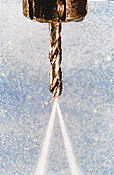
| Back pressure is needed to flush the chips from the hole as the drill penetrates the workpiece. Chips cause unpredictable damage. In general, the longer the chips, the harder they are to control and the more damage they cause. Long, stringy chips wrap around drills, fill the bottoms of holes, catch on chucks, cause mechanical problems with loaders, and in many cases require manual removal. Broken chips that can fall away—or that can be evacuated from the cutting zone and away from the part and drill with coolant force—are almost always more desirable (Figure 3). |  |
| Figure 3: The consistent low temperatures associated with high-pressure coolant improve chip formation. These more consistent chips are easily flushed away from the cutting edge and out of the hole. |
|
When chips are no longer a factor, wear, rather than damage, becomes the drill’s failure mode. Wear is a predictable part of any mechanical process; damage, on the other hand, is random. Without high-pressure coolant, almost all drills fail because of damage caused by chips. Many people who have had 20 years of experience cutting steel have never seen a worn drill. Recut chips break the drill’s cutting edges; uncontrolled heat causes built-up edge and then shock as the buildup breaks off. Computerized Systems Why spend half a million dollars on a horizontal machining center that still needs manual intervention? Computerized systems can automatically monitor coolant level and concentration and refill the reservoir with the appropriate amounts of coolant concentrate and water, keeping the coolant within 0.5% of a pre-programmed target level. The coolant is continuously recycled so no operator intervention is required, except for a maintenance routine every three months. Computer control of the coolant concentration reduces process variability by more than 95% and increases machine uptime. A shop with a coolant system that provides consistent temperature control in the cutting zone can afford to use safer coolants. Most coolants are designed to leave a greasy residue when the high heat of standard machining boils the water away. Manufacturers use potentially carcinogenic additives such as chlorinated paraffins, halogens, and solvents to perform this function. When the temperature range of the process is well-controlled, none of these harmful chemicals are needed. The coolant’s chemistry can be optimized to function more efficiently, using process-control fluids that are friendlier to the operator and to the environment. Keeping Coolant Clean If better surface finish or longer tool life is required, clean coolant is a must. Pumping abrasive fines through a drill to the chip/tool interface damages the tool and the part. Evidence of coolant contamination frequently can be seen when small through-coolant drills are used. Many operators find it difficult to keep chips and swarf from blocking the coolant flow. Before these holes get plugged, however, it’s certain that a great deal of contamination has already passed through the tool. Damage caused by the chips that do get through is part of the reason these tools have such an unpredictable life span. The solution isn’t bigger coolant holes to avoid plugging; the solution is less junk in the coolant. It can take a chip as large as 0.050″ to plug up a small drill’s coolant hole, and yet this is a common occurrence. This is much too large a chip for proper performance using today’s tooling. A chip of this size, for example, is 20 times larger than the maximum size that should come in contact with HSK toolholders. HSK manufacturers recommend coolant filtration down to 5µm for proper performance. Less Interruption, Higher Speed The second example assumes that the shop uses the benefits of high-pressure coolant to increase penetration rates. Because of this, no increase in tool life is assumed. As in the first example, three drills with diameters of 13.0mm, 12.0mm, and 9.5mm are used to drill 1″ holes in 3000 parts. Tooling cost and downtime are the critical factors in cost savings in this example.
Shops only win in the long run with a controlled process. High-pressure coolant is the most effective tool currently available to control the drilling process. However, to achieve its full benefits, it has to be used in conjunction with tools, toolholders, coatings, and carbide grades that have been optimized for its use. The rapid growth in the use of this technology will make it a necessary part of a shop’s ability to maintain prices and profits. About the Author |
||||||||||||||||||||||||||||||||||||||||||||||||||||||||||||||||||||||||||||||||||||||||||||||||||||||||||||||||||||||||||||||||||||||||||||||||||||||||||||||||||||||||||||||||||||||||||||||||||||||||||||||||||||||||||||||||||||||||||||||||||
Glossary terms in this article
Related



Subscribers can use MFGAxis notes, saves and discussion tools with their innoNET account.


