

The need for ta-C: Drilling Performance
In the early 1970s, the first report about diamond-like carbon (DLC) coatings was published. Industrial use of these films started with automotive components, such as high-pressure diesel injection systems and powertrain components. Today, a family of DLC coatings exists with specific advantages in certain applications.
In the early 1970s, the first report about diamond-like carbon (DLC) coatings was published. Industrial use of these films started with automotive components, such as high-pressure diesel injection systems and powertrain components. Today, a family of DLC coatings exists with specific advantages in certain applications.
The coatings are usually classified by the ratio of sp3 to sp2 bonds and the hydrogen content. When carbon is sp3-bonded, it will form diamond; sp2 bonds will lead to graphite. With an increase in the ratio of sp3 to sp2 bonds, the hardness of the coating will typically increase.
DLC coatings can be doped with metals like tungsten (W-C:H), where C is carbon and H is hydrogen, and other elements like silicon (Si-DLC) to change the coefficient of friction or temperature resistance of the layers. A known application for cutting tools is the combination of a hard nitride coating, such as TiAlN, with a softer, lubricating top coating, such as W-C:H. This combination shows excellent results in tapping and drilling applications because it enhances chip evacuation. The focus of this article will be on a specific DLC coating called tetrahedral amorphous carbon (ta-C).
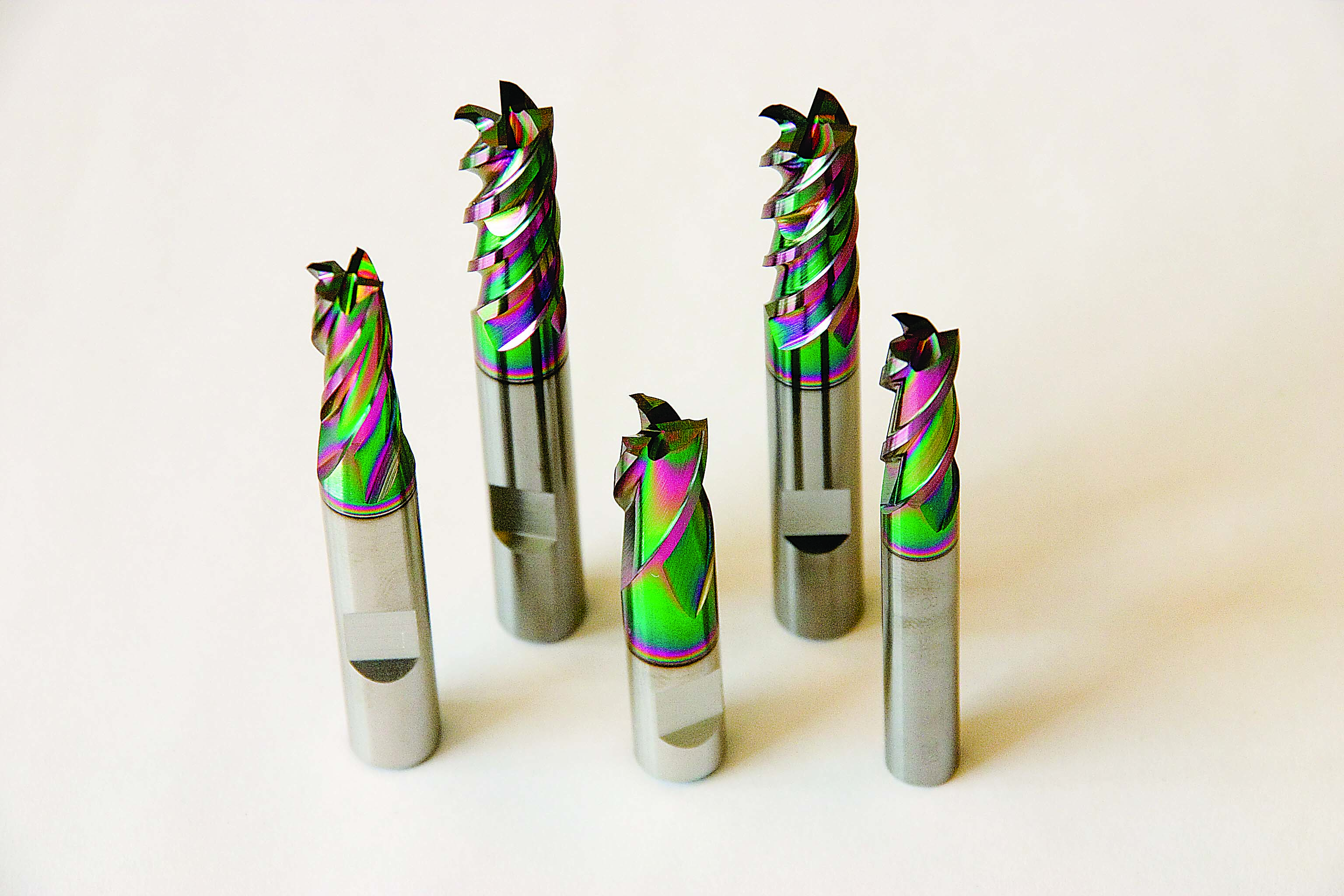
Endmills coated with a ta-C coating via circular arc CARC+ technology display the coating’s typical rainbow color pattern. All images courtesy of IHI Hauzer Techno Coating
Ta-C is a hydrogen-free carbon coating with a high sp3/sp2 ratio. Compared to other DLC coatings, ta-C films show higher hardness and temperature resistance and significantly lower coefficients of friction. The first application of the coating was in the automotive industry: It was deposited on tappets (valve lifters), where it is still used today.
One of the purposes of the coating in tribological, automotive applications such as tappets is to reduce friction, which leads to improved engine efficiency, less fuel consumption and lower CO2 emission. The push for better fuel economy and less pollution has actually resulted in the use of ta-C coatings on cutting and forming tools. One way to improve the mileage of a car is to reduce its weight. Besides the introduction of ultrahigh-strength steels, the use of aluminum in car bodies and engines has risen over the past several decades. The use of plastics, including carbon fiber-reinforced plastics (CFRP), is also increasing in the automotive and aerospace industries.
When cutting these materials, the tool wear mechanisms are different compared with cutting steel. One of the main challenges is to keep the cutting edge sharp and reduce built-up edge. Because the edge radius of cutting tools for this application is quite small, it helps to keep the coating thickness as thin as possible. These factors contribute to the advantage of depositing ta-C coatings on cutting tools specifically for machining nonferrous metals and plastics.

The HiPIMS process on a carbon target for deposition of a ta-C coating.
Ta-C coatings show little adhesion of aluminum to the cutting edge. Given the high hardness of the coating, a coating thickness well below 1μm is typically sufficient on cutting tools such as drills and endmills. The first tests in the aerospace industry—drilling a titanium and CFRP sandwich material—showed that ta-C extended tool life and significantly improved hole quality. As ta-C has a maximum operating temperature of around 500° C, coolant applications are required in these cases.
DLC coatings, such as ta-C, have a certain degree of transparency. When the coating thickness is less than 1μm, tools will have rainbow colors due to an interference effect. As thickness increases, the color becomes gray-black.
Deposition Technologies
Various technologies are used for the deposition of DLC coatings. Historically, plasma-assisted chemical vapor deposition (PACVD) has been the most common technology.
Review the print ads from this magazine to continue
This quick advertiser review unlocks the rest of the article and keeps the full-screen reader focused on the ads instead of the page chrome.
Advertisers included in this article experience
Print placements connected to this article
Vektek
17 NEW
WORKHOLDING PRODUCTS From... See the lastest technology in workholding: • In The Port Sequence Valves • High Capacity Work Supports • Low Pressure Pallet Decoupler • Swing Clamps • and our NEW Advanced Workholding Pumps SEE YOU AT IMTS West Building Booth 431922 Machine Parts Better, Faster, and Learn more - Call:.
17 NEW WORKHOLDING PRODUCTS From... See the lastest technology in workholding: • In The Port Sequence Valves • High Capacity Work Supports • Low Pressure Pallet Decoupler • Swing Clamps • and our NEW Advanced
Visit Vektek View this placement in the issue recordPrint ads from this magazine
WORKHOLDING PRODUCTS From... See the lastest technology in workholding: • In The Port Sequence Valves • High Capacity Work Supports • Low Pressure Pallet Decoupler • Swing Clamps • and our NEW Advanced Workholding Pumps SEE YOU AT IMTS West Building Booth 431922 Machine Parts Better, Faster, and Learn more - Call:.
17 NEW WORKHOLDING PRODUCTS From... See the lastest technology in workholding: • In The Port Sequence Valves • High Capacity Work Supports • Low Pressure Pallet Decoupler • Swing Clamps • and our NEW Advanced
Continue reading
August 2018
Prior to the deposition of the coatings, the tool substrate material must be etched and cleaned via chemical plasma cleaning in the coating equipment’s vacuum chamber. Etching occurs when positively charged argon ions, which are created in a plasma, bombard the negatively charged products. When treating temperature-sensitive products, it is important to control the amount and energy of the ions. When using a plasma (hot filament) source, both the plasma source current and, thereby, the amount of ions can be set. The energy of the ions can be independently controlled by applying a specific negative-bias voltage on the components.
When using PACVD, a hydrocarbon gas, such as acetylene (C2H2), will be introduced in the vacuum chamber. A plasma is ignited by using midfrequency or radio-frequency pulsing or microwave sources. When the plasma ignites, the acetylene will crack into ions and radicals. These will condense on the tools to form the DLC coating. Because of the presence of hydrogen in the gas, this process will always lead to hydrogenated DLC films. To improve adhesion, the coating stack will typically consist of a metallic interface, such as chromium or titanium, followed by a metal-containing carbon coating, such as W-C:H, and, finally, the PACVD DLC layer. Therefore, many DLC deposition systems combine unbalanced magnetron sputtering and PACVD technology.
An alternative method to produce DLC coatings is magnetron sputtering from a graphite target. When this method is applied without the presence of a hydrocarbon gas, hydrogen-free DLC films are produced. To increase coating density and hardness, the film must be bombarded by energetic particles as it grows. Because the sputtered carbon atoms have low energy, the bombardment will be limited. Therefore, DLC coatings that are created by sputtering from a graphite target have a lower hardness. When introducing a hydrocarbon gas during the sputter deposition, both deposition speed and hardness can be increased.
Hard Times
The deposition of hard ta-C coatings has traditionally been performed with cathodic arc evaporation technology. An arc discharge is generated on circular arc cathodes equipped with graphite targets. Due to the extremely high temperature in the arc spot and the electron current emitted from this spot, the evaporated carbon atoms are positively ionized. By applying a negative voltage on the products, the carbon ions bombard them. This process results in a ta-C coating with a hardness greater than 5,000 HV.
A negative effect of arc evaporation is the generation of macroparticles, or droplets, and, therefore, a rough coating. For most milling and drilling applications, a rough surface does not hurt cutting performance. In some applications, however, a smooth surface finish improves cutting performance. For instance, a German tool manufacturer reported that a HiPIMS ta-C coating was tested when tapping two kinds of aluminum, one with a low silicon content and one with a high silicon content. Hauzer’s coating outperformed the benchmark and had lower torque.
Post-treatment by special polishing technologies cannot always be performed. Microtools, such as PCB drills, are one example.
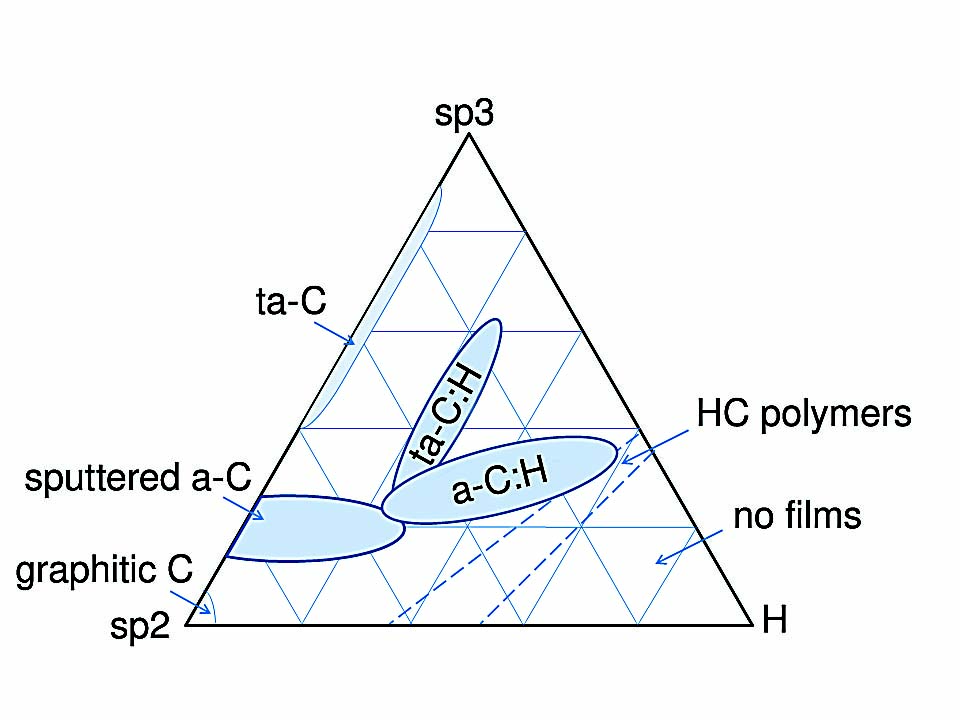
Classification of the family of DLC coatings based on the amount of sp3 (diamond bonds) and hydrogen content.
For many years, the solution for these applications has been filtered arc evaporation. A magnetic filter is used to steer the carbon ions toward the tools, whereas the neutral carbon macroparticles are not steered and bombard the magnetic duct. The cathode is placed less than 90° from the chamber. The particles will move straight ahead and bombard the curved duct. A magnetic field is applied to steer the ions through the curve and reach the chamber. The disadvantages of this solution are a relatively slow deposition speed and small deposition area, as well as high equipment cost for a single purpose. Moreover, some macroparticles will deflect in the duct and still reach the substrates.
Approximately 10 years ago, a new deposition technology was introduced: high-power impulse magnetron sputtering. With HiPIMS, the benefit of the production of ions and the smoothness of sputter coatings can be combined. Until recently, this technology was not suitable for target materials such as graphite.
With the introduction of the latest generation of power supplies and the possibility of programming pulse trains with pulse width modulation, the deposition of hard, hydrogen-free carbon coatings via HiPIMS is possible. With a “classical” HiPIMS, the power supply generates one pulse at a certain frequency and power. With the latest generation, a user can program a train of pulses, which together form a pulse by itself. In addition, the period and width of the pulses within the train and the power can be programmed.
With the changes in the automotive industry and the use of hybrid electric cars, further vehicle lightweighting efforts will occur. This will lead to a greater need for ta-C coatings for both cutting and forming tools.
Related

 MFGAxis Discussion
Be part of the shop-floor conversation
Like, save, or comment on this CTE story.
MFGAxis Discussion
Be part of the shop-floor conversation
Like, save, or comment on this CTE story.


MFGAxis Discussion