

Good machines can come in small packages
There are relatively small, budget-friendly machines on the market that might meet your needs.
If you were asked to imagine a machine tool, chances are you’d conjure up a hefty beast with a hefty price tag. You may be surprised to discover, therefore, that there are relatively small, budget-friendly machines on the market that can meet the requirements of certain industrial cutting applications.
Take the ProtoMAX, an abrasive waterjet machine built by OMAX Corp., Kent, Wash. With a footprint of about 41½”×39½”, the machine weighs approximately 750 lbs. with water in the tank.
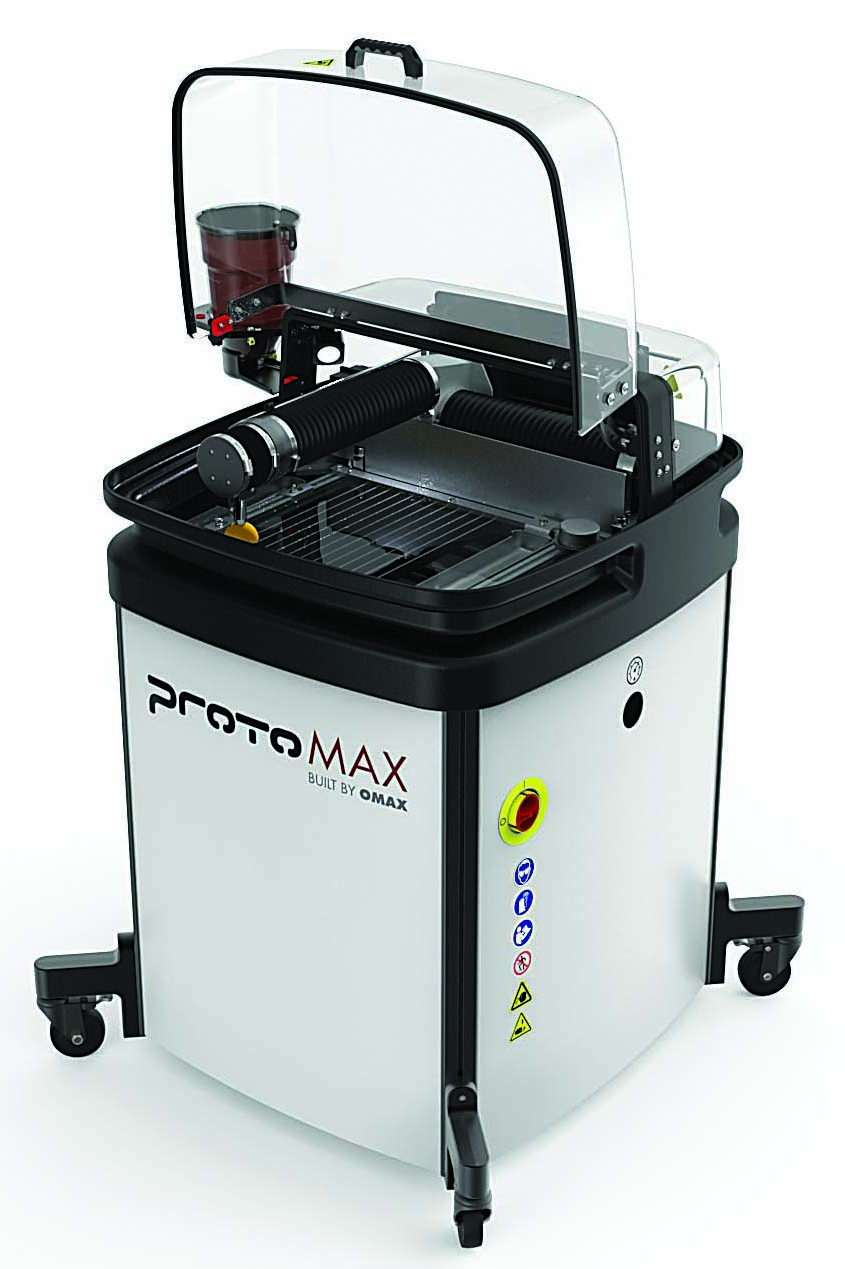
The ProtoMAX waterjet machine may be small, but it can cut virtually any material. Image courtesy of OMAX
Compare that with OMAX’s next smallest waterjet cutter, which has a footprint of about 5’3″×12′, not including the pump, which covers another 4’×5′, according to Stephen Bruner, the company’s vice president of marketing.
Besides consuming less space, the ProtoMAX is built on casters, which allow the compact unit to be rolled from one location to another.
This mobility is helpful during both installation and reconfiguration of a machine shop. “Instead of requiring a forklift and a bunch of people, installation of the ProtoMAX can be a one-man operation,” Bruner said.
In addition to being easy on shop personnel, the ProtoMAX is easy on shop budgets. Whereas standard smaller waterjets typically start in the $70,000 to $75,000 range, Bruner noted, the ProtoMAX is priced at $19,950, including shipping, in the U.S.
According to Bruner, the ProtoMAX can cut any material up to about 1″ thick. As its name suggests, prototyping is one of the machine’s main applications. But it’s also used by some businesses in a production capacity, he added.
In production environments, however, the ProtoMAX has significant limitations. The cutting area measures just 12″ square, and the machine allows only a little over an inch of adjustment in the Z-axis direction. By contrast, Bruner said, an industrial-size waterjet may have a Z stroke of as much as 12″.
Review the print ads from this magazine to continue
This quick advertiser review unlocks the rest of the article and keeps the full-screen reader focused on the ads instead of the page chrome.
Advertisers included in this article experience
Print placements connected to this article
Nachiamerica
AQUA DRILL EX SERIES
Providing Process Improvements for Every Application Current Process End Mill Pilot Drill Deep Hole Drill Process AQUA Drill EX Flat Pilot Drill AQUA Drill EX Oil Hole MQL Deep Hole Drill.
AQUA DRILL EX SERIES Providing Process Improvements for Every Application Current Process End Mill Pilot Drill Deep Hole Drill Process AQUA Drill EX Flat Pilot Drill AQUA Drill EX Oil Hole MQL Deep Hole Drill
Visit Nachiamerica View this placement in the issue recordPrint ads from this magazine
Providing Process Improvements for Every Application Current Process End Mill Pilot Drill Deep Hole Drill Process AQUA Drill EX Flat Pilot Drill AQUA Drill EX Oil Hole MQL Deep Hole Drill.
AQUA DRILL EX SERIES Providing Process Improvements for Every Application Current Process End Mill Pilot Drill Deep Hole Drill Process AQUA Drill EX Flat Pilot Drill AQUA Drill EX Oil Hole MQL Deep Hole Drill
Continue reading
July 2018
In addition, the waterjet uses a 5-hp pump. The good news is that the unit requires only a single-phase 240v power supply rather than the three-phase power required by typical waterjet pumps, which are at least 20 hp. The downside, however, is that the ProtoMAX pump can generate only 30,000 psi of water pressure. This means the pump can’t deliver the cutting speeds of industrial pumps capable of producing water pressures up to 100,000 psi.
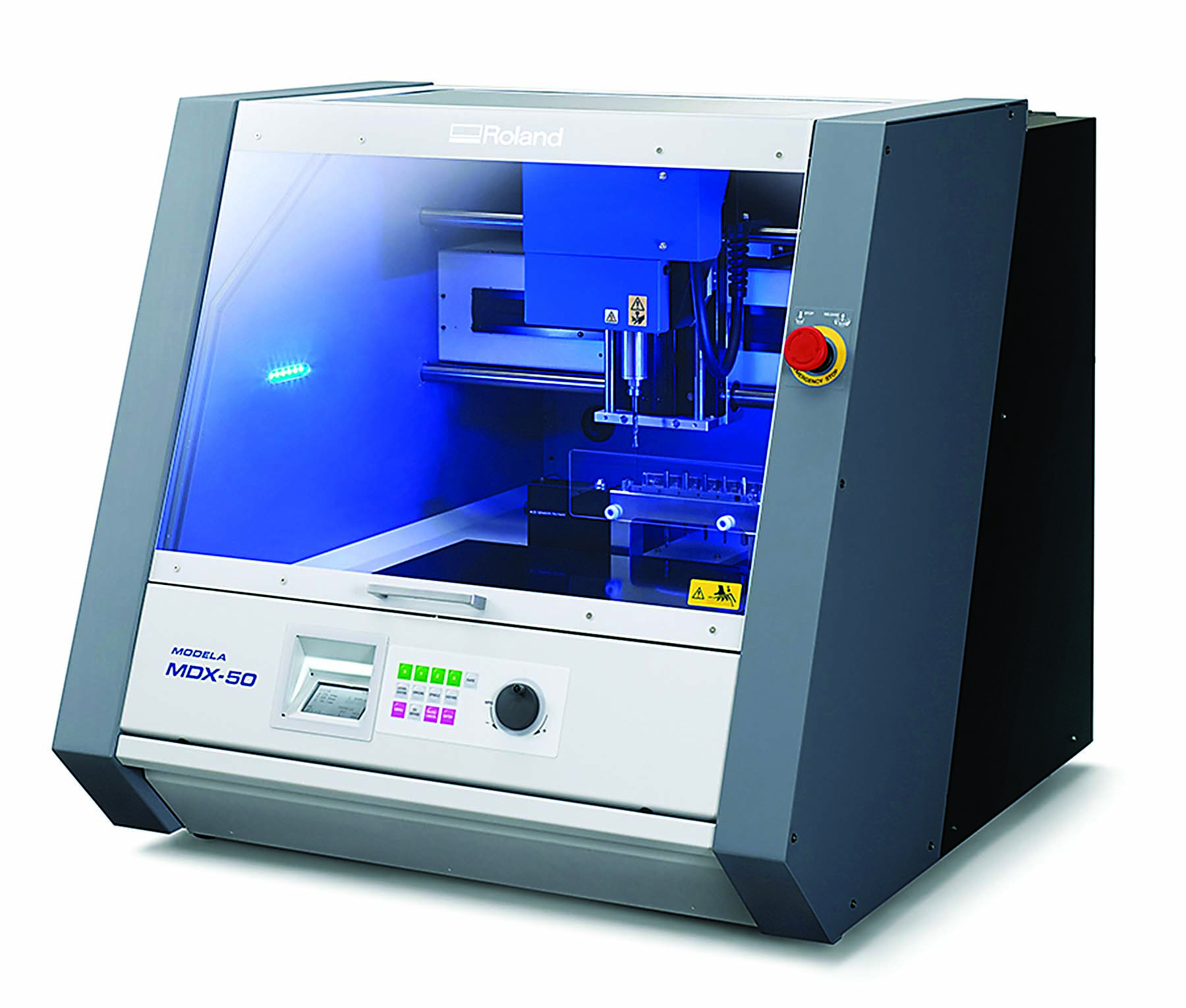
A benchtop CNC milling machine, the MDX-50 can handle
light-duty prototyping and production. Image courtesy of Roland DGA
Besides being large and expensive, conventional CNC machine tools require a skilled machinist or CNC programmer to operate them. But the DGShape line of benchtop CNC mills from Roland DGA Corp., Irvine, Calif., includes a CAM software package that addresses this challenge. The package is designed to allow a novice engineer, student or educator who has no CNC training to operate the machines within a few minutes of learning how to use the software, according to Adam Sebran, Roland DGA’s business development manager for 3D and education products.
Like the ProtoMAX, DGShape benchtop mills don’t require three-phase power. Instead, they operate on household 110v electricity. The idea, Sebran said, is “to provide an easy-to-use solution that is office environment-friendly for engineering departments and educational institutions.”
DGShape mills can also function in industrial settings, handling light-duty prototyping and production, as well as secondary machining operations. But running at 12,000 to 15,000 rpm, Sebran said, these small, low-torque machines “aren’t going to take ½” industrial bites out of a block of steel or aluminum.”
Unveiled last year, the 3-axis MDX-50 is the newest addition to the DGShape lineup. Weighing in at 269 lbs., the mill measures 30″×35″×29″, including the built-in safety enclosure. The machine can mill wood, plastics, nonferrous metals, wax and foam in its 15½”×12″×4″ process area.
Though not as capable as conventional machine tools, the MDX-50 takes a much smaller bite out of a company’s financial resources. The unit’s list price is $10,995; an optional rotary fourth axis costs an additional $3,995.
“So for about $15,000, you get a fully loaded CNC machine,” Sebran said.
Related




Subscribers can use MFGAxis notes, saves and discussion tools with their innoNET account.


