Machine monitoring lets manufacturers improve future processes
Fastenal is an American industrial supply company based in Winona, Minn. It provides companies with the fasteners, tools and supplies they need to manufacture products, build structures, protect personnel and maintain facilities and equipment. It has more than 2,600 branches throughout the U.S., Canada, Mexico and Europe, along with 13 distribution centers.
Fastenal is an American industrial supply company based in Winona, Minn. It provides companies with the fasteners, tools and supplies they need to manufacture products, build structures, protect personnel and maintain facilities and equipment. It has more than 2,600 branches throughout the U.S., Canada, Mexico and Europe, along with 13 distribution centers. More than 400 of its 19,624 employees work at the company’s eight manufacturing locations.
In 2016, company management realized that it lacked adequate information about its manufacturing activities. The company needed to better understand its downtime, machine utilization and quality issues for the sake of improving processes.
Among the issues faced were assessing operations and choosing courses of action when managers weren’t around, according to Joe Garteski, operations manager of precision machining for Fastenal. “We wanted to know what happened from first shift to second shift to the weekend. What happened between those shifts? Was there any variation in productivity? If so, why? Why was that machine sitting idle? Was the machine down that day? Were there more setups that day?”
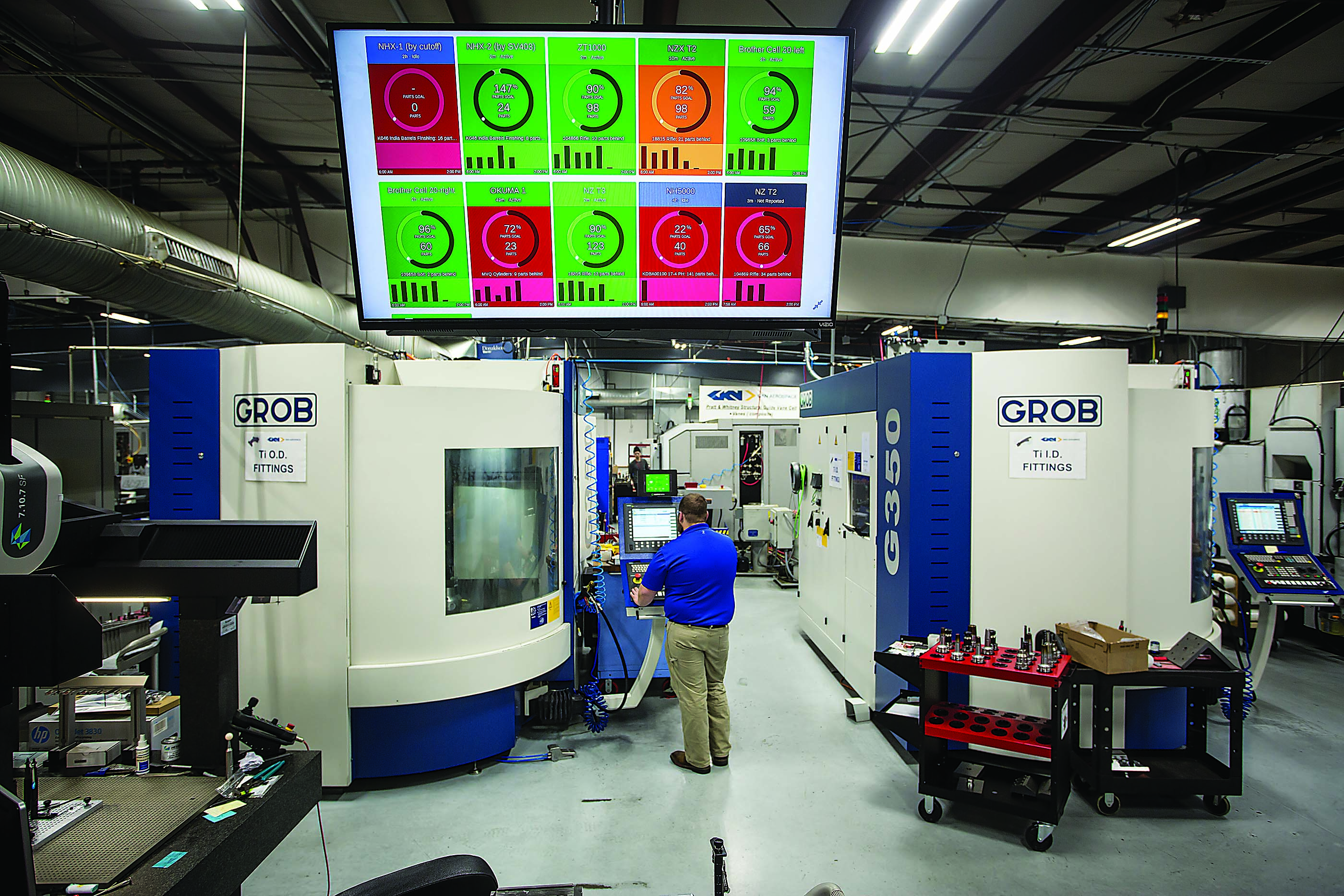
Image courtesy of MachineMetrics.
Another challenge was the lack of real-time information, Garteski noted. “Having to wait for an individual to come back on shift to gather specifics on various issues was very frustrating. Sometimes we would have to wait 16 hours before an operator came back on shift to speak with him to understand why a machine was down or why a specific fault occurred. Was there an issue with tooling? These are the things that we wanted to determine but didn’t have a solution for.”
Hidden Data
The information Fastenal needed can be gathered by sensors, shared by way of Ethernet or other communication technologies, and made visible and useful with analytics and reporting programs. Such data can be created more easily and at less cost than before.
Tom Kelly, executive director and CEO of Automation Alley, Troy, Mich., said, “Even small job shops can get a lot of functionality out of very inexpensive sensors, which they can practically toss around the plant and onto machines to start collecting data. You can get a ton of data out of your old machines, at low cost, in certain instances.”
Kelly suggested that rather than start with a new industrial-internet-of-things-ready CNC machine, smaller job shops may want to “start with, say, getting some sensors onto your old machine that can kick data to your mobile phone on weekends or on the second shift. Learn which of this data is useful to you.”
Kelly said the majority of companies Automation Alley works with are in the small-to-medium range, with small meaning fewer than 100 employees and medium meaning 101 to 500 workers. For such businesses, investing in capital equipment isn’t an easy decision, he noted. “We don’t want to suggest that the answer is always, ‘Go buy the big machine.’ “
Also, in some cases the necessary sensors are not only in place but are already generating the needed data. Professor Jun Ni, director of the S.M. Wu Manufacturing Research Center at the University of Michigan, said: “Companies always ask, ‘Do I need to put a sensor on my machine, on my robot arm?’ You don’t necessarily need to put on a lot of sensors. In many cases, the sensor is already there. In your PLC—your control—you have a lot of hidden information, data that’s not being utilized.
“I think of that data as being like crude oil,” he continued. “It’s underground, and it’s very valuable. But if you don’t put it through a refinery, you can’t use it. Same thing for the data. You need advanced analytics to make it useful.”
Many manufacturers, including small, downstream suppliers, already use programs designed to better understand and utilize processes.
Software Connect, Milwaukee, a vendor-neutral service that enables businesses to source suitable technology for their needs, released a report in November based on a survey of 154 manufacturers. The report analyzed the businesses’ current and planned use of Industry 4.0 components, such as material requirements planning (MRP) software, manufacturing execution system (MES) software and other industry-specific technology tools.
The survey found that 61 percent of small-to-medium manufacturers already use MRP software or plan to buy it within the next year. Almost half of them use it, and 27 percent plan to buy or upgrade it in the next 12 months. Also, 34 percent use MES software or plan to implement it within the next 3 years.
Making Data Visible
In 2016, Fastenal invested in a machine monitoring system to track everything that happens on a CNC machine and make the most pertinent of the information visible and easily accessible by stakeholders, from the operator on up.
Review the print ads from this magazine to continue
This quick advertiser review unlocks the rest of the article and keeps the full-screen reader focused on the ads instead of the page chrome.
Advertisers included in this article experience
Print placements connected to this article
Ntkcuttingtools
Patented
Are you machining Inconel at 1600 SFM? JX1 Grade JP2 Grade •Rough (no scale) & semi-finish •High speed finishing •Cut HRSA @ 1600 SFM •Cut HRSA @ 1700 SFM •Longer tool life vs. whisker •10 – 15 x speed vs. carbides •Produces mirror surface finish •Multi-tipped brazed inserts •Produces mirror surface finish.
Patented Are you machining Inconel at 1600 SFM? JX1 Grade JP2 Grade •Rough (no scale) & semi-finish •High speed finishing •Cut HRSA @ 1600 SFM •Cut HRSA @ 1700 SFM •Longer tool life vs. whisker •10 – 15 x speed vs. carbides •Produces mirror surface finish •Multi-tipped brazed inserts •Produces mirror surface finish Wixom, MI | Toll free: 866-900-9800 | [email protected] | WWW.ntkcuttingtools.com
Visit Ntkcuttingtools View this placement in the issue recordPrint ads from this magazine
Are you machining Inconel at 1600 SFM? JX1 Grade JP2 Grade •Rough (no scale) & semi-finish •High speed finishing •Cut HRSA @ 1600 SFM •Cut HRSA @ 1700 SFM •Longer tool life vs. whisker •10 – 15 x speed vs. carbides •Produces mirror surface finish •Multi-tipped brazed inserts •Produces mirror surface finish.
Patented Are you machining Inconel at 1600 SFM? JX1 Grade JP2 Grade •Rough (no scale) & semi-finish •High speed finishing •Cut HRSA @ 1600 SFM •Cut HRSA @ 1700 SFM •Longer tool life vs. whisker •10 – 15 x speed vs. carbides •Produces mirror surface finish •Multi-tipped brazed inserts •Produces mirror surface finish Wixom, MI | Toll free: 866-900-9800 | [email protected] | WWW.ntkcuttingtools.com
Continue reading
January 2018
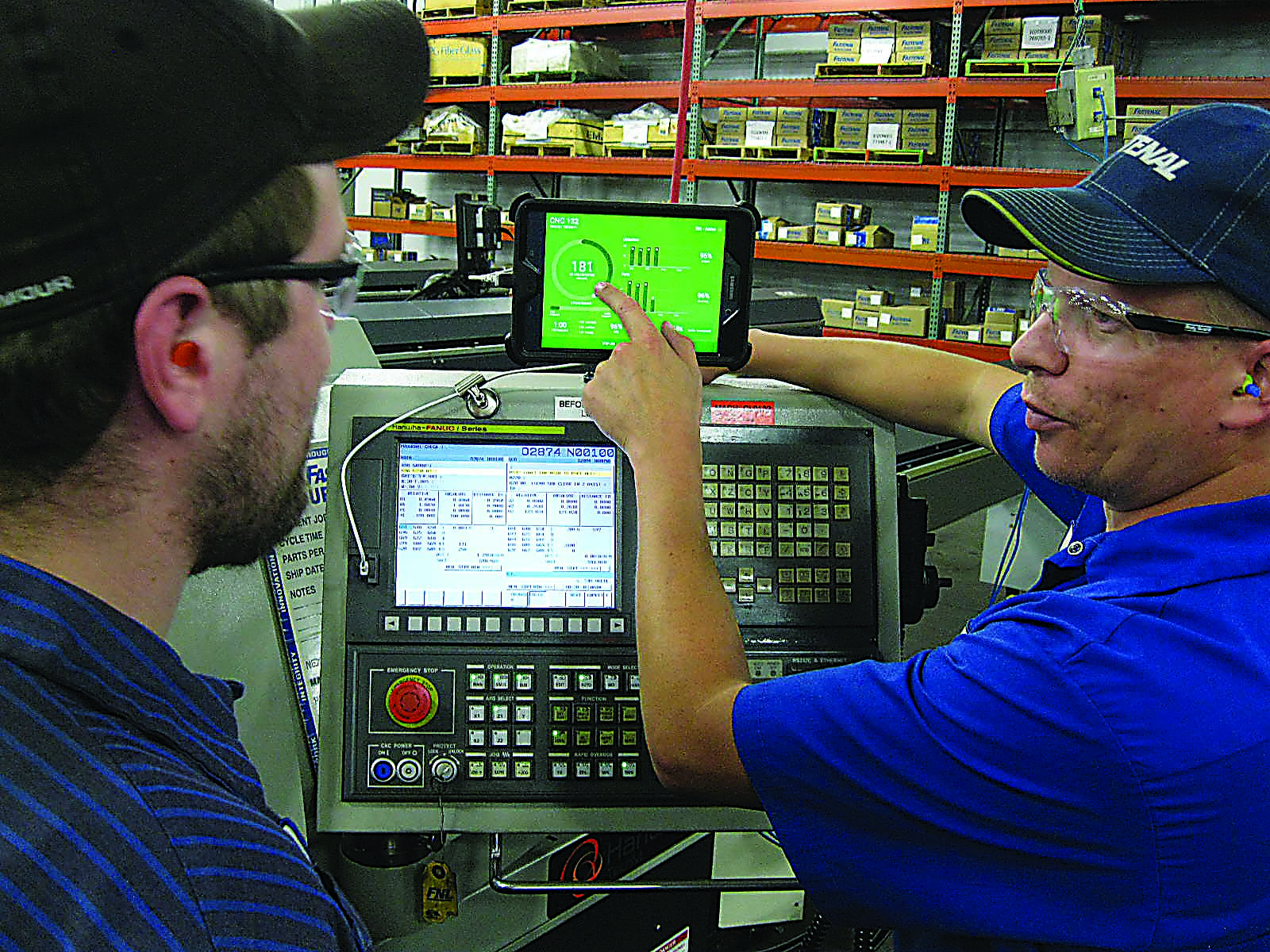
MachineMetrics monitoring system in use at Fastenal’s Winona, Minn., facility. Image courtesy of MachineMetrics.
That system, called Machine-Metrics, acts as a historian for machine data, with the ability to export all of a machine’s event history for any period of time. The timeline is useful for analyzing what happened and when on a machine, according to Graham Immerman, director of marketing at MachineMetrics, Northampton, Mass.
Information, including machine status, faults, programs, part cycles and job runs, is displayed on the machine timeline. Users can view the status of all their machines or drill down into a single machine for a detailed view. A report is issued that provides statistical analysis of part cycles, often uncovering part-cycle times that were potentially
underestimated.
“Unlike most machine monitoring systems, MachineMetrics doesn’t stop with just OEE (overall equipment effectiveness) but goes a step further to show you potential capacity, with stats like OOE (overall operations effectiveness) and TEEP (total effective equipment performance),” Immerman said.
How do these differ? Each statistic is based on a different definition of machine availability, he explained. OEE considers only scheduled time. If a machine is down because of maintenance and it’s not scheduled for work, OEE ignores this downtime. In contrast, OOE takes unscheduled time into account, looking at total operation time as the maximum. And TEEP considers maximum time to be all available time—that is, 24 hours a day, 365 days a year.
Fastenal Manufacturing Engineer Matthew Nelson said, “We started out using MachineMetrics to monitor 11 Swiss machines and three twin-turret machines. We installed the monitors on our shop floors so that everyone on the floor can know what’s going on—operators and managers.”
Nelson said he did a lot of the machine-operator training for the new system, and while there was some initial grumbling, the operators have come around.
“The operators had a gut reaction that was, ‘Oh, great, now you are looking over my shoulder even more.’ But the truth is, if there’s something going on, this system gives them more opportunity to be involved in solving that problem.” Operators and managers can look at historical data and implement future improvements. “Now, when we have an issue with a job, we can apply what we’ve learned from this mistake to the next time. We no longer have to be reactive.”
Operations manager Garteski said the system quickly gave management a wake-up call regarding productivity. “When we started monitoring, we thought our utilization was far better than it really was,” he said. “You talk to the production manager and he says, ‘Well, those machines are always running.’ Thanks to this system, we now know that we were only up 39 percent of the time, and we have that hard data to say, ‘Hey, the data says something else.’ Data is history. We can’t change history, but we can learn from it.”
Tim Borkowski, Fastenal’s vice president of manufacturing, credits the MachineMetrics system with enabling more accurate job quotes because of its ability to break down cycle times. “Now we can have a very structured routing time, so we can quote jobs more accurately. How close are our cycle times to quoting times? Are we even close? Now we always know. Having this information right in front of the operators allows them to improve their performance. There are jobs that we quoted out at 45 seconds, and it turned out to be a 30-second part. And vice versa.”
The Bottom Line
Shop-floor data can do more than optimize machine usage; it can be used to reduce costs by optimizing energy use and machine maintenance, to name two examples.
The University of Michigan’s Ni said Toyota Motor Corp. is one of 90 companies the university has worked with to develop better predictive-maintenance strategies based on data analytics.
“People know Toyota as a leader in lean manufacturing,” Ni said. “But while everybody else was chasing lean, Toyota was considering, ‘What comes after lean?’ When they joined us 10 years ago, they told us they had a corporate strategy called MR 50. It refers to a goal of maintenance reduction by 50 percent.”
The company wanted to change maintenance activities from being a cost center to a profit center, Ni explained, by using analytics of the shared machine data to know when to maintain a CNC machine before it breaks down and to maintain it at a time that is minimally disruptive to its use. The strategy is working, he added.
The advantage for companies as large as Toyota or as small as the archetypal mom and pop shop in using data from a connected shop floor is that any resulting cost savings “go straight to the bottom line. If you can use advanced analytics to improve your OEE by 5 percent, for example, that’s huge,” Ni said. “Because it comes without needing any capital investment. You really have a net gain.”
See Sidebar, “In Digital Manufacturing, the Product is Intellectual Property.”