



FMSes uncork bottlenecks: Turning Performance
Top managers at three manufacturers weigh in on the merits of flexible manufacturing systems.
Many shops follow a well-worn growth path. The owner buys an affordable 3-axis, 40-taper vertical machining center, works long days and weekends until the business is stable, and then continues adding one VMC after another until a long row of verticals stands along one wall. Every machine or two has an operator standing in front of it or them. Countless hours have been spent building tooling and programming parts. Everyone knows which job goes where and how to set it up, and the shop mentality is firmly entrenched in “vertical thinking.”
There’s a lot to be said for this approach. It’s relatively safe and steady, and thanks to the popularity of VMCs, finding a qualified machinist is probably easier than for other, less common machines. Yet it’s far from perfect. Machining multiple sides of a workpiece on a VMC requires an indexer or trunnion, which increases costs and consumes table real estate. Unless a pallet system is incorporated (another expense), the spindle is idle while parts are loaded.
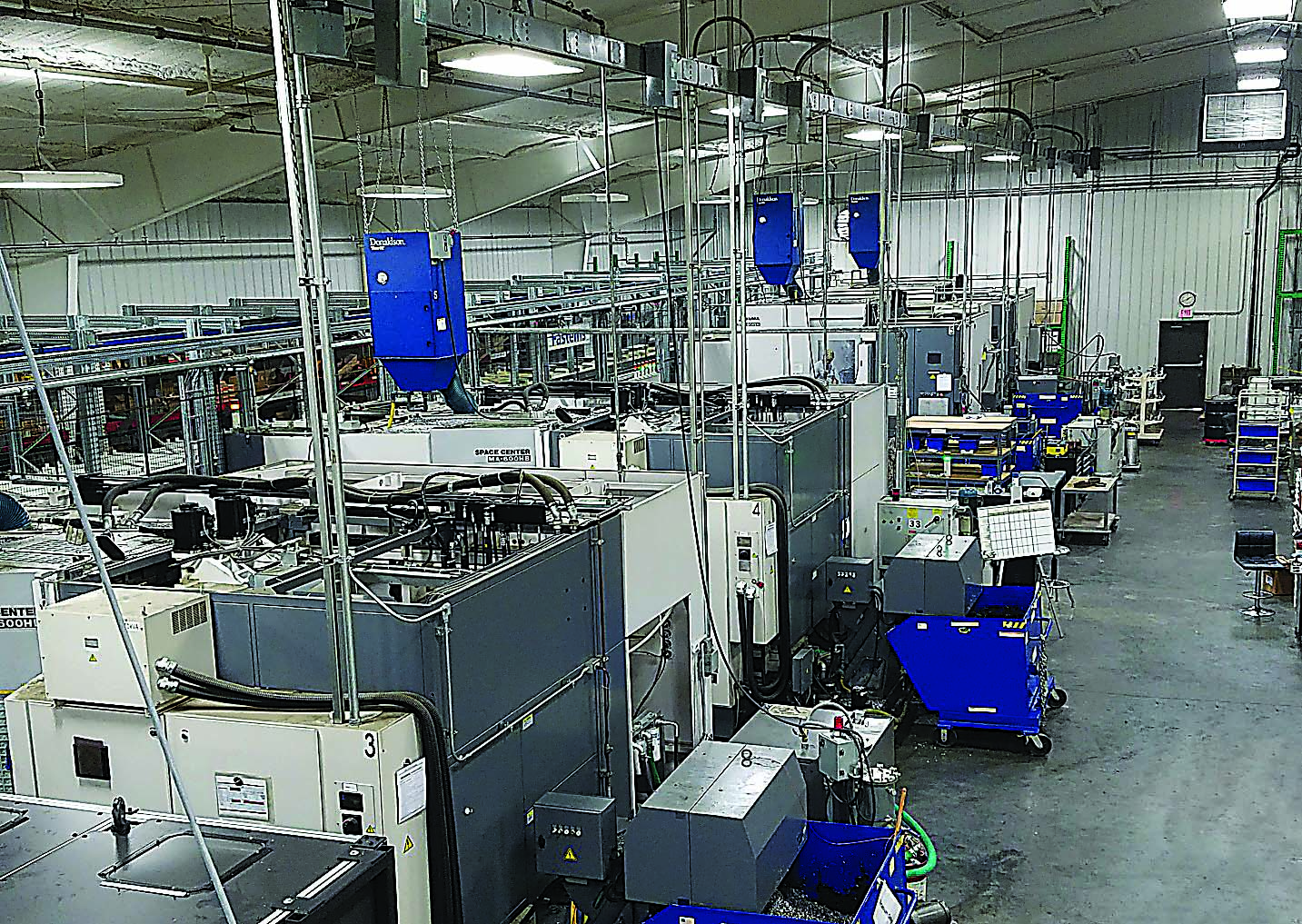
Within 4 years of installing its first flexible manufacturing system, Steelville Manufacturing employed three times as many workers. Image courtesy of Steelville Manufacturing.
Moreover, chips fall back onto the part, making chip recutting a concern. And while a robot might be used for unattended loading and unloading, it mandates automated fixturing, which is impractical unless part quantities are in the thousands.
Tripled Growth
“Before our first FMS, we did everything on our verticals,” said John Bell, vice president of engineering at Steelville (Mo.) Manufacturing Co., a machine shop specializing in aerospace parts. “To be fair, we did have a stand-alone horizontal machining center, and we loved it for all the obvious reasons. But when one of our customers asked if we’d be interested in a prove-it-and-move-it program, which meant replicating their FMS line so we could take over production following an internal runoff, we jumped at the chance.”
For those unfamiliar with the concept, in this context, an FMS line is comprised of one to six, or more, horizontal machining centers attached to a linear pallet system (LPS). The flow of work to each HMC is managed by a cell controller, which receives scheduling and priority instructions from its human master. Each machine tool has hundreds of tool positions, and the LPS contains perhaps hundreds of pallets, each with a fixture or tombstone.
When the controller instructs the FMS to load a new job, the system’s rail-mounted robot retrieves the appropriate pallet and carries it to whichever machine is available. The same robot brings completed pallets to a load/unload station, where a human or another robot removes finished parts and loads raw material for the next job.
When presented with an opportunity to purchase an FMS, don’t approach it lightly, Bell warned. “Know your costs, really figure out what you’re doing, and then explore all the options. And be prepared for growth. When we installed our first FMS 10 years ago, we had around 55 people. Within 4 years, we employed three times that. And a large part of that is because of the switch to flexible manufacturing.”
It wasn’t a matter of just hiring 100 more machine operators. Steelville needed more programmers, manufacturing engineers, shipping and receiving people, and even janitors. “When you buy an FMS, it’s pretty incredible what happens,” Bell said. “The business just expands upon itself. But you do need to change your mind-set to get the full value.”
Some examples include changes to workholding, setup procedures and programming.
Any Part, Any Machine, Anytime
Today, Steelville has two FMS lines, with a total of 10 machines between them. Bell said spindle utilization averages 80 percent throughout the year, with periods of 97 percent utilization not being unusual.
Morgan Hill, Calif.-based Micro-Mechanics Inc., a multinational supplier to the semiconductor and other high-tech industries, has seen similar results with its pair of FMS lines.
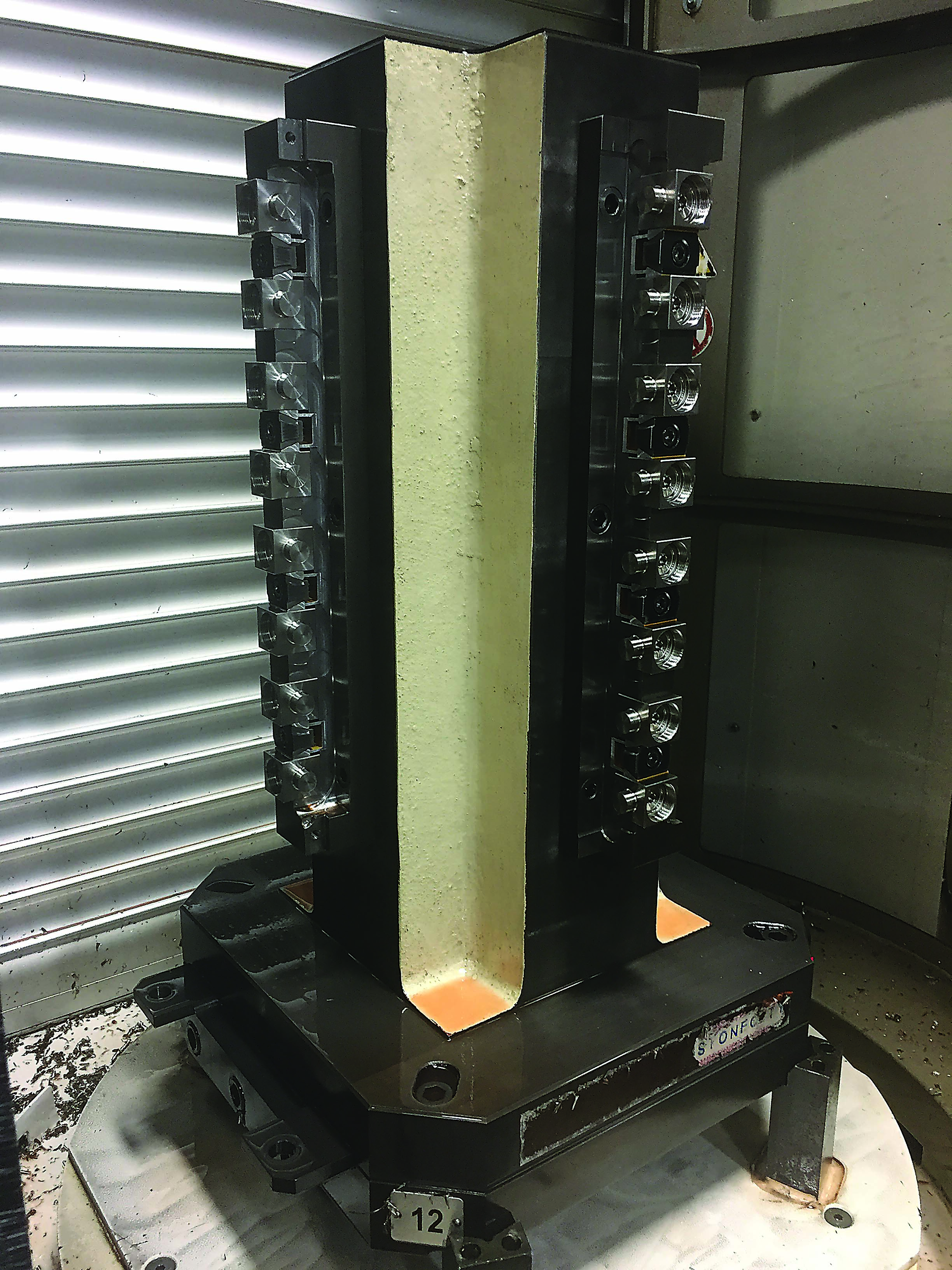
With their integral pallet-changing capabilities, horizontal machining centers offer tremendous flexibility. Image courtesy of Machine Technologies.
“Our production line has four machines,” said the company’s CEO Chris Borch. “We usually have one or two people operating that line for the first two shifts and run a third shift unattended. That gives us roughly 22 hours per day of spindle time, or just over 90 percent utilization. Considering that most verticals produce about half that, we’d need at least 10 machines and 20 operators to achieve an equivalent output. That’s the power of an FMS.”
Granted, Micro-Mechanics has invested nearly $10 million in its two systems, including hundreds of pallets and thousands of toolholders. Support equipment includes offline presetters, shrink-fit and balancing equipment, toolpath simulation software and radio-frequency identification toolholder tags.
Also, a team of engineers sets up and proves out each job on the other FMS line, which is reserved during the day for that purpose. Once a job has been approved, it moves to the “production” system. And when everyone has gone home for the day, the engineering line is put to work running previously proven jobs.
That’s a lot of cash and effort. The return on investment, however, is simple. Micro-Mechanics can call up and run any one of 500-plus part numbers anytime, with zero setup time.
Still, it wasn’t easy. “If you’re going to be successful at this, you have to completely change your way of doing things,” Borch said. “You need to develop interchangeability and repeatability to avoid the bottlenecks that so many shops with a floor full of verticals face. Because what inevitably happens in that situation is that a shop supervisor realizes, ‘Oh, I have to run part XYZ on machine No. 12, and there’s already 3 weeks’ work sitting in front of it.’ So you’re already dead. We don’t have those constraints. Our motto now is ‘Any part, any machine, anytime.’ You simply can’t achieve that on a vertical.”
Performance Catch-Up
Performance Machine Technologies Inc., Valencia, Calif., has taken a different, though no less fruitful, approach. Instead of the high-mix, low-volume scenarios just described, owner Dennis Moran pursued an FMS for a simple reason: His verticals couldn’t keep up with production demands.
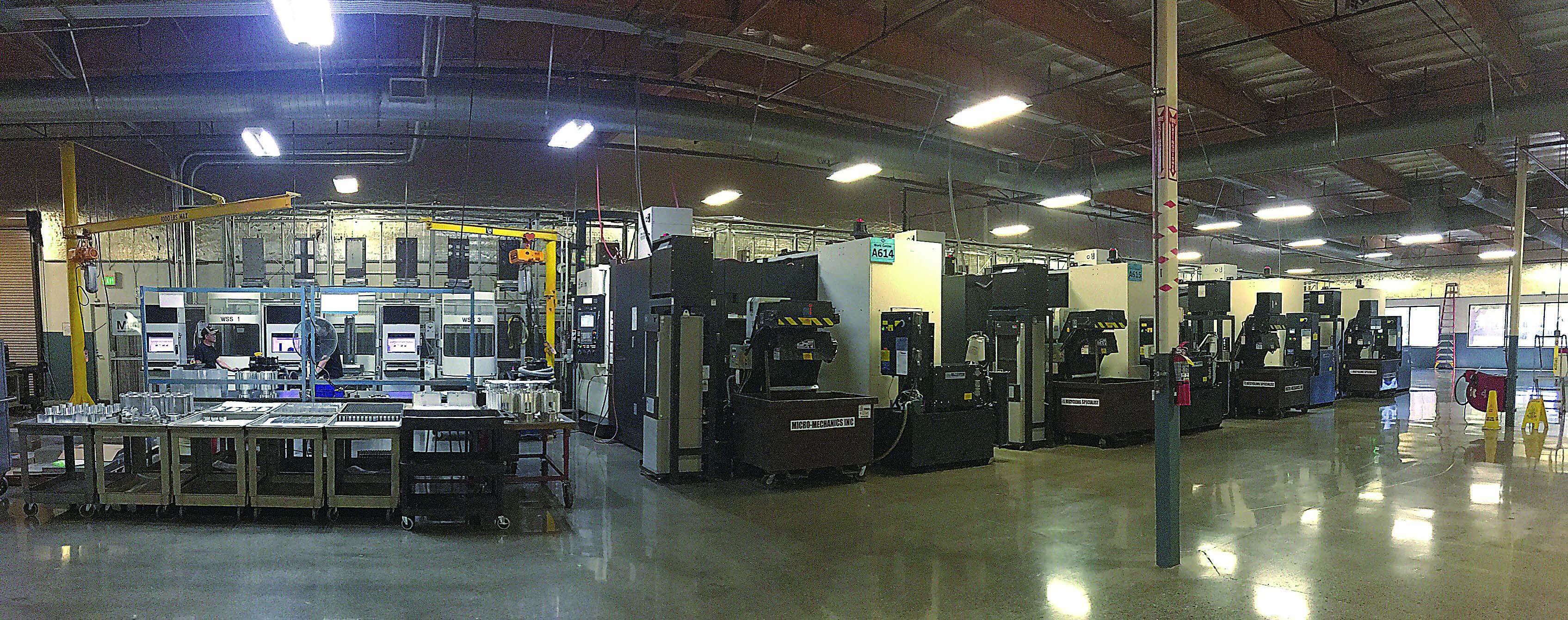
Implementing a flexible manufacturing system requires a quantum shift in a shop’s management approach. Image courtesy of Micro-Mechanics.
“We tried to grow as much as we could, but even when you load them up with tombstones and fixtures and indexers, you get to a point where you’re still limited as to how much you can expect from verticals. We have a number of parts that we routinely run thousands at a time. We managed to achieve 7 hours per cycle unattended and had up to 72 parts on a single fixture, but it still wasn’t enough to stay ahead.”
Because Moran and his team had already adopted tombstone-style fixturing on their trunnion-equipped VMCs, it was a simple move to flip their programs 90° and move everything to the FMS.
Moran said: “At one point, I realized we couldn’t go any further with our legacy approach. I said, ‘All right, let’s go.’ We ordered new tombstones, additional tooling, and it wasn’t long after the FMS was installed that we were running 24 hours a day, 7 days a week, but with people on-site for only four of those days. It was a nice jump in production and profitability.”
The increased throughput, however, created problems elsewhere in the shop. Because the parts being machined on the FMS start in the turning department, Moran found himself needing to upgrade that equipment as well. He has since replaced “pretty much” every lathe and installed a robot to keep one of them running around the clock.
“I had to make sure I could keep the FMS fed,” he said. “It came down to a simple choice: Hire more people, work longer hours and more days, or automate. So aside from the robot, we also added a pair of turn-mill machines with bar feeders making blanks for the horizontal. Taken all together, it was a big move. But for us, there was no way around it. The FMS has really uncorked our production bottleneck.”
Glossary terms in this article
Related




Subscribers can use MFGAxis notes, saves and discussion tools with their innoNET account.


