

Convertible headstocks becoming the norm on Swiss-style machines
When convertible spindles for Swiss-style CNC lathes were introduced a decade or so ago, many in the industry said they were only a fad. Yet those naysayers have been proven abundantly wrong, as headstocks that can be converted from sliding to fixed are becoming the norm on Swiss machines.
When convertible spindles for Swiss-style CNC lathes were introduced a decade or so ago, many in the industry said they were only a fad. Yet those naysayers have been proven abundantly wrong, as headstocks that can be converted from sliding to fixed are becoming the norm on Swiss machines.
“In the near future, all of our machines will be convertible,” said Brian Such, customer support group manager at Marubeni Citizen-Cincom Inc., Allendale, N.J. “Right now, our M series is the only one that’s not.”
Such said convertible headstocks offer many benefits. Lower part cost is one. Because any out-of-roundness in bar stock held in a guide bushing is translated to the workpiece, bars must be centerless-ground to a roundness tolerance greater than that of the finished part.
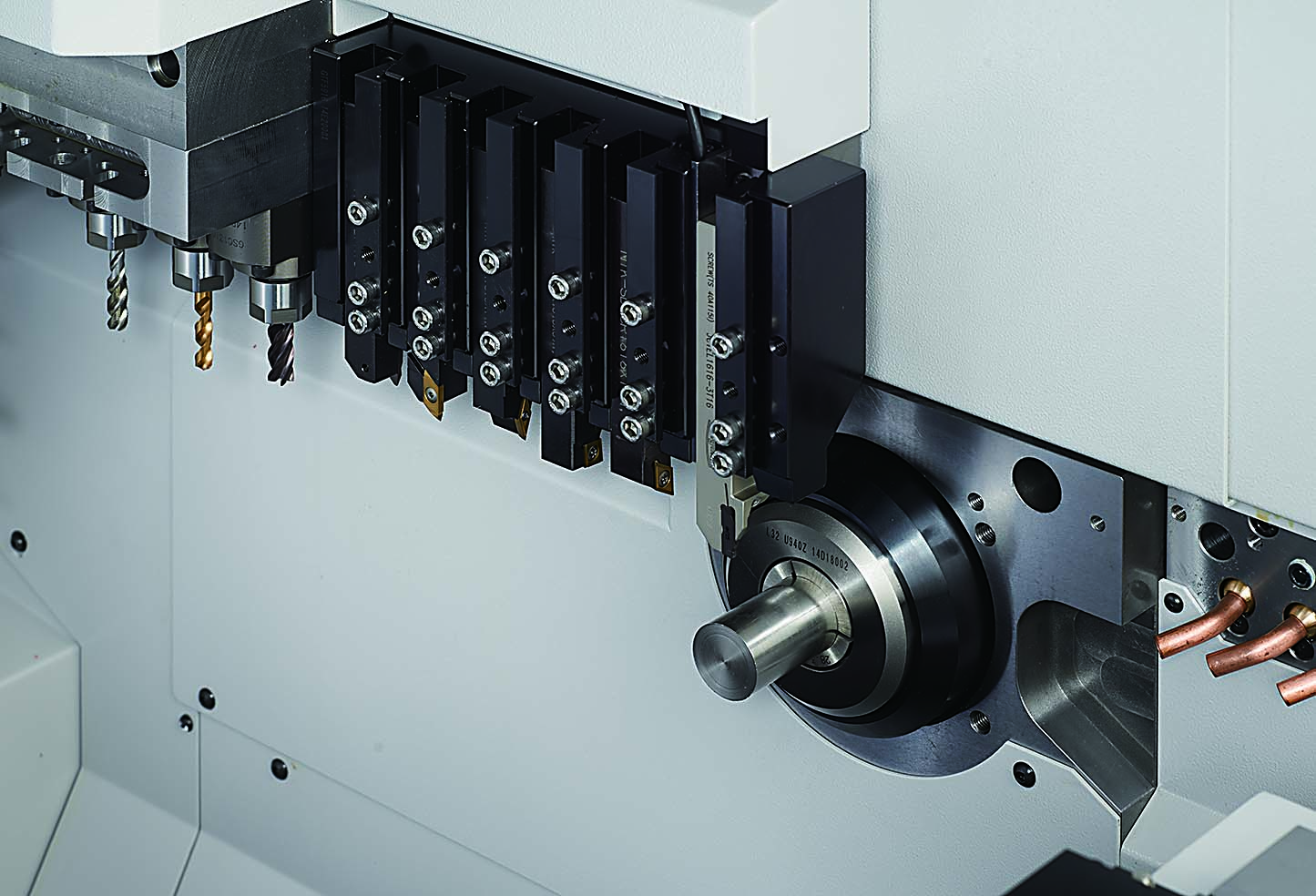
With the guide bushing removed on a convertible Swiss-style machine, the remnant material is reduced and parts can be turned “more round” without the need for ground bar stock. Image courtesy of Marubeni Citizen-Cincom.
The up charge for ground bar stock may account for only a small percentage of the raw material cost, but it can quickly add up for automotive and consumer product manufacturers, where job quantities number in the hundreds of thousands.
The other complaint frequently heard among sliding-headstock users is about the cost of the bar remnant. Throwing away the 6″ (152.4mm) or so of leftover material between the guide bushing and collet is no big deal with relatively inexpensive, 12′-long (3.7m) bars of steel or even stainless steel, but for medical machine shops turning ultraexpensive, yard-long bars of PEEK (polyetheretherketone) or platinum, it’s a profit killer.
A fixed headstock reduces the remnant length to about 1½” (38.1mm). Also, there’s no need to grind the bar stock. Parts will be as round as the lathe’s spindle bearings and accurate to whatever the machine is capable of (usually in the range of tenths).
The only caveat about convertible spindles concerns limited part length. Because the guide bushing is eliminated while in fixed-headstock mode, there’s no possibility of turning the long, slender workpieces to which Swiss users are accustomed. “A good rule of thumb is a length-to-diameter ratio of 3:1, the same as any other conventional lathe,” Such said.
Somewhat surprisingly, that’s OK with Swiss-style machine buyers. Ed Garber, regional manager for Star CNC Machine Tool Corp., Roslyn Heights, N.Y., said he carries a box of sample parts to show potential customers and at least 40 percent of the parts fall into the less than 3:1 length-to-diameter category.
Review the print ads from this magazine to continue
This quick advertiser review unlocks the rest of the article and keeps the full-screen reader focused on the ads instead of the page chrome.
Advertisers included in this article experience
Print placements connected to this article
Imts Registration Now Open.
International Manufacturing Technology Show September 10 - 15, 2018 | McCormick Place | Chicago, IL
SIGN UP AT IMTS.COMI REG.
International Manufacturing Technology Show September 10 - 15, 2018 | McCormick Place | Chicago, IL IMTS REGISTRATION NOW OPEN. SIGN UP AT IMTS.COMI REG
Visit Imts Registration Now Open. View this placement in the issue recordPrint ads from this magazine
SIGN UP AT IMTS.COMI REG.
International Manufacturing Technology Show September 10 - 15, 2018 | McCormick Place | Chicago, IL IMTS REGISTRATION NOW OPEN. SIGN UP AT IMTS.COMI REG
Continue reading
December 2017
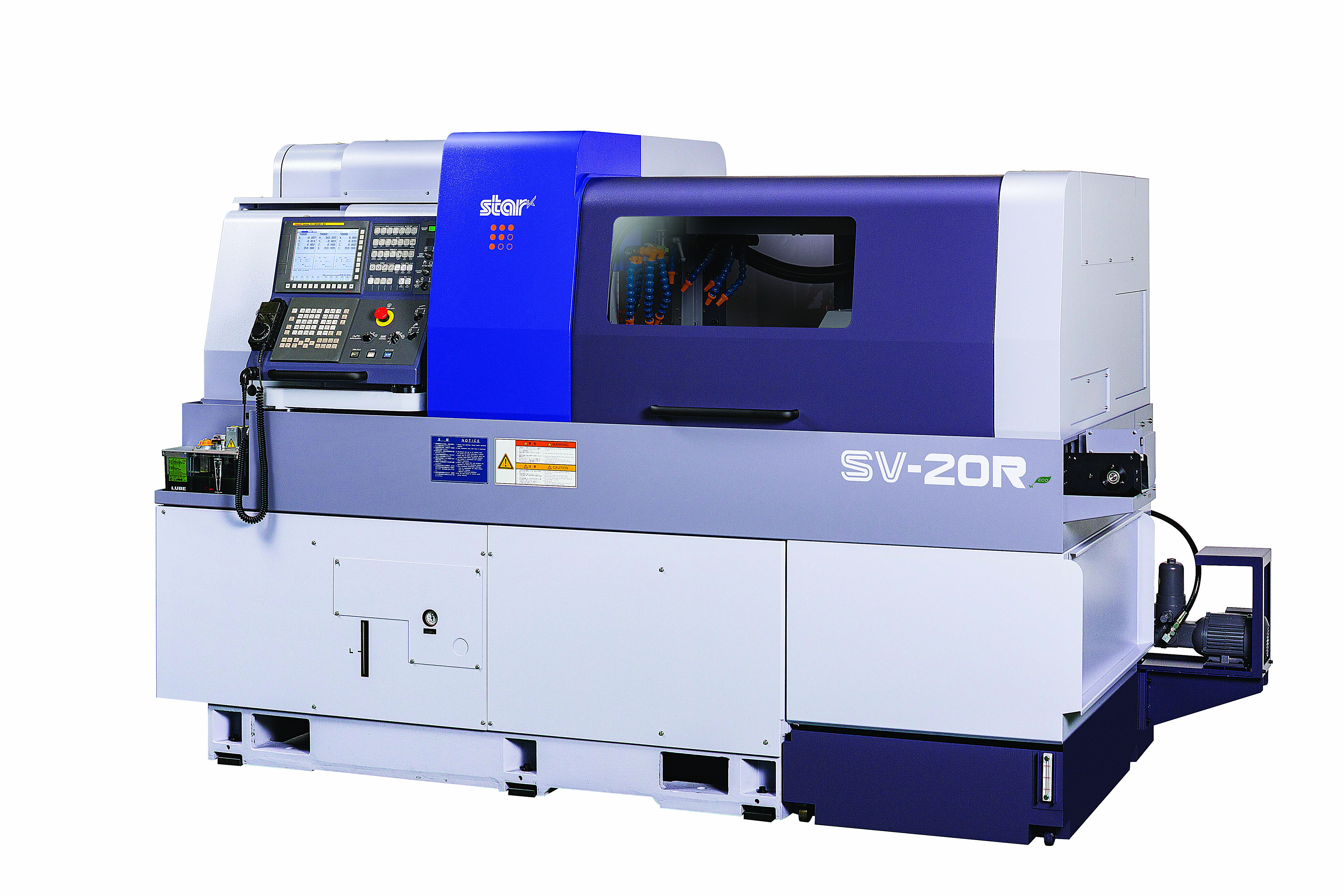
The option to switch between collet and guide bushing is standard on most Swiss-style turning machines, such as this one from Star CNC Machine Tool. Image courtesy of Star CNC Machine Tool.
The majority of Star’s machines are also convertibles. “The extreme length-to-diameter demand isn’t what it used to be,” Garber said. “Most customers are more concerned with getting parts done in as few operations as possible.”
Of course, most customers are also concerned about setup time. The good news is that switching from a sliding headstock to a fixed one takes 15 to 60 minutes. Users remove some screws and the guide bushing unit, flip a switch or change a parameter setting, and the machine is as ready to make parts as its now-converted alter ego.
In addition, Garber pointed out that Swiss machines are substantially faster than turret-based CNC lathes. This makes convertible machines competitive with turn-mill machines and multitaskers, especially on very small parts.
“Swiss machines can go from chip to chip very quickly,” he said. “For example, within 3 seconds, we’re able to fully synchronize our subspindle and ready to cut off a part. You can’t do that on a conventional fixed-headstock lathe.”
Another thing you can’t do on a conventional lathe is run the spindle up to 8,000 rpm or higher, even when running bar stock 1½” in diameter. The ability to run higher spindle speeds has long been an advantage of Swiss-style lathes, and it hasn’t changed with the move to convertibles.
Perhaps the only downside to convertible Swiss machines is the learning curve. Processing parts will be somewhat different for those shops steeped in Swiss methodology.
“A shop that’s used to conventional turning is going to have an easier time with this, but it’s not all that difficult either way,” Such said. “It’s a great option for shorter parts, where accuracy is critical or where raw material costs are high.”
Related


 MFGAxis Discussion
Be part of the shop-floor conversation
Like, save, or comment on this CTE story.
MFGAxis Discussion
Be part of the shop-floor conversation
Like, save, or comment on this CTE story.


MFGAxis Discussion