

Look Ahead: Securing robots’ ‘personal space’
Collaborative robotics has three aspects: the human, the robot and the workspace where the task is to be completed. Much of the media coverage has focused exclusively on the robots themselves.
Collaborative robotics has three aspects: the human, the robot and the workspace where the task is to be completed. Much of the media coverage has focused exclusively on the robots themselves—the efficient Baxter and the distinctively green FANUC robots, for example.
With human safety in mind, these machines may be purposely limited in weight and speed and are given a soft surface in case they accidentally contact a mortal co-worker. They have trip torque sensors that stop the collaborative robot, or cobot, as soon as it is touched.
But is that enough? No robot stops instantly, as Newton’s laws make clear. Relying on the cobot’s ability to stop after it’s touched involves risk. Once a cobot collides with a human, it’s too late. But at the same time, setting the torque trip at a low threshold may render a cobot too slow to be useful.
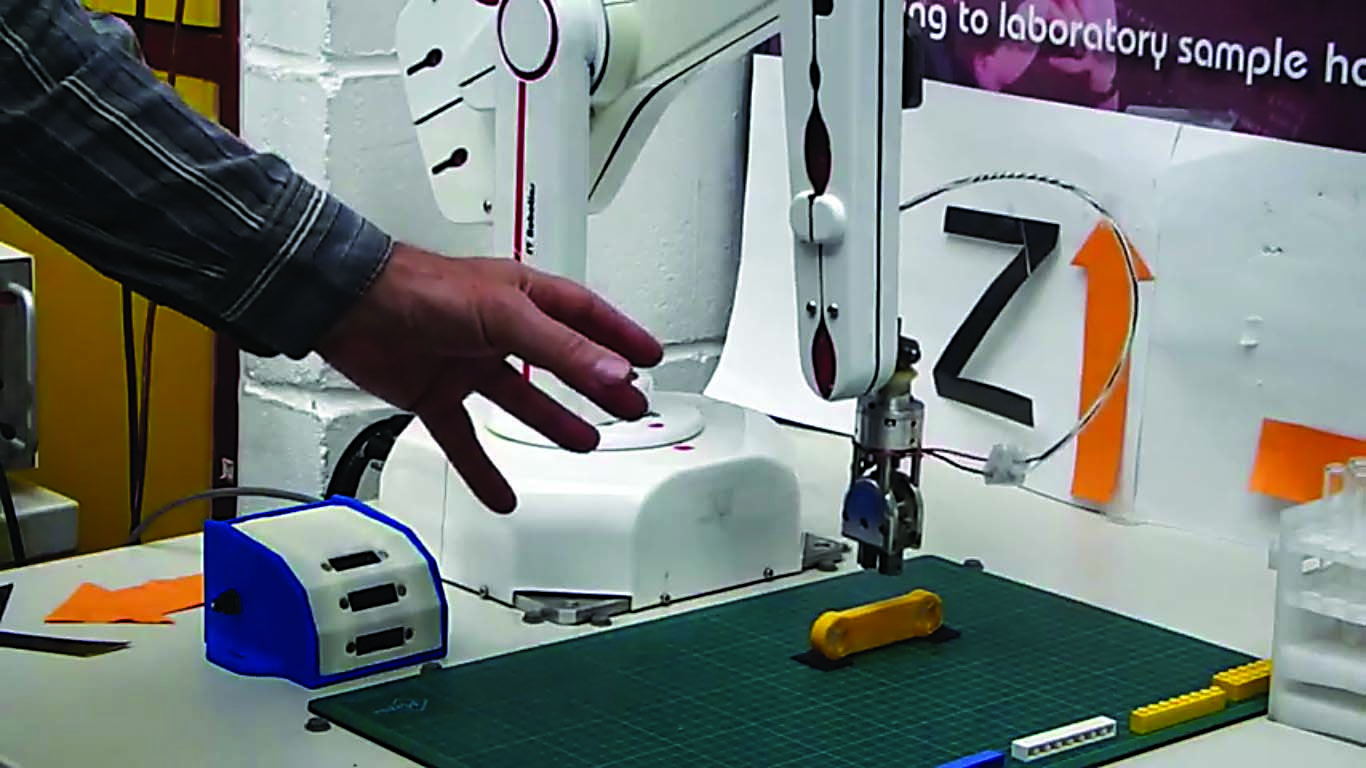
The ST Robotics Workspace Sentry system uses infrared scanning to monitor a cobot’s work area. Image courtesy of ST Robotics.
These concerns are addressed in ISO/TS 15066 on collaborative operation, which provides guidelines for the design and implementation of a collaborative workspace that reduces risk to people. And a new collaborative robotics system is the first one specifically designed to meet those safety specifications.
Review the print ads from this magazine to continue
This quick advertiser review unlocks the rest of the article and keeps the full-screen reader focused on the ads instead of the page chrome.
Advertisers included in this article experience
Print placements connected to this article
Toolflo
API Threading Specialist!
API Inserts Chasers Many API threadforms in stock! API Threading chasers! • Buttress • WW • NPT • Rounds... Superior coatings! Scarfing Tools For internal and external scarfing operations Holders & Bars We have standard holders and bars in stock! Special forms and chip breakers We can make any special you need! for your application!
API Threading Specialist! API Inserts Chasers Many API threadforms in stock! API Threading chasers! • Buttress • WW • NPT • Rounds... Superior coatings! Scarfing Tools For internal and external scarfing operations Holders & Bars
Visit Toolflo View this placement in the issue recordPrint ads from this magazine
API Inserts Chasers Many API threadforms in stock! API Threading chasers! • Buttress • WW • NPT • Rounds... Superior coatings! Scarfing Tools For internal and external scarfing operations Holders & Bars We have standard holders and bars in stock! Special forms and chip breakers We can make any special you need! for your application!
API Threading Specialist! API Inserts Chasers Many API threadforms in stock! API Threading chasers! • Buttress • WW • NPT • Rounds... Superior coatings! Scarfing Tools For internal and external scarfing operations Holders & Bars
Continue reading
October 2017
The ST Robotics Workspace Sentry system is the result of stepping back from the robot itself and looking at the workspace as well. The system includes a small module that infrared-scans the cobot’s personal space. Each module has three beams set at different angles, and the distance a beam reaches is adjustable. Two or more modules can be daisy-chained to monitor a wider area. If a human puts his or her hand into the cobot’s workspace, programmable deceleration stops the cobot long before it makes contact with the person. Once the area is cleared, the cobot can continue on its way.
This approach is safer than depending on the cobot to stop only after a person comes into contact with it—particularly with larger, heavier cobots.
“A robot that is tuned to stop on impact may not be safe,” said David Sands, president and CEO of ST Robotics. “Robots where the trip torques are set at low thresholds are too slow for any practical industrial application. The best system is where the work area has proximity detectors so the robot stops before impact, and that is the approach ST Robotics has taken.”
For more information about ST Robotics, Princeton, N.J., visit www.strobotics.com or call (609) 584-7522.
Related



Subscribers can use MFGAxis notes, saves and discussion tools with their innoNET account.


