

Ask the Grinding Doc: Loading the wheel
In the August 2017 issue of Cutting Tool Engineering, Ask the Grinding Doc Columnist Jeffrey Badger, Ph.D., fields questions about spotting wheel loading, white sticking for hardened steel loading, and what causes barber pole marks during cylindrical-traverse grinding.
Dear Doc: I’m using plated CBN wheels to grind hardened steel. I might have wheel loading issues. How can I tell?
The Doc Replies: Plated wheels are one of the few types where you can successfully evaluate loading with relative ease. Using a hand-held magnifying glass and a bright light, just look at the wheel surface. If you have loading, you should see it.
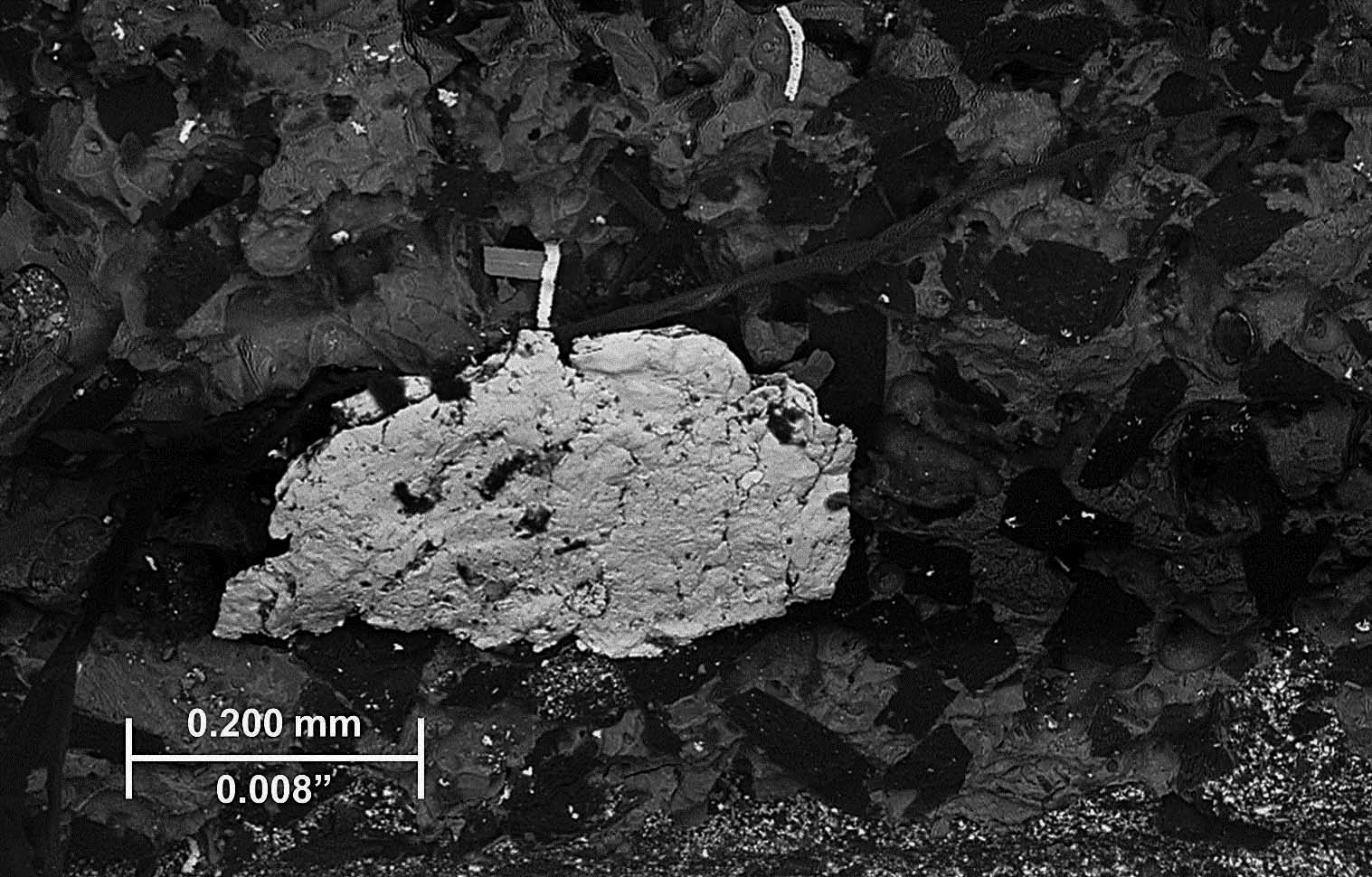
This blob formed in a CBN wheel after grinding HSS. Blob loading can typically be seen with a magnifying glass, especially in plated wheels. Image courtesy of J. Badger.
For plated CBN wheels, I divide loading into three types: in-pore, blob and smeared-on-dull-grit loading. With in-pore loading, you’ll see swarf within the pores. Swarf isn’t ideal, but it typically won’t negatively impact grinding too badly. With blob loading, successive chips compact together to form a blob, as shown in the photo. This blob will hurt you. As for smeared-on-dull-grit loading, a layer of workpiece material smears over the tip of the dull grit. This type of loading will also hurt you. It also can be trickier to see, because it might be dull grit with smeared loading or it just might be dull grit.
And on a related topic …
Dear Doc: I have hardened steel loading on a plated CBN wheel. The operator likes to “white stick” the wheel to remove it. Is this a good idea?
Review the print ads from this magazine to continue
This quick advertiser review unlocks the rest of the article and keeps the full-screen reader focused on the ads instead of the page chrome.
Advertisers included in this article experience
Print placements connected to this article
Toolflo
API Threading Specialist!
API Inserts Chasers Many API threadforms in stock! API Threading chasers! • Buttress • WW • NPT • Rounds... Superior coatings! Scarfing Tools For internal and external scarfing operations Holders & Bars We have standard holders and bars in stock! Special forms and chip breakers We can make any special you need! for your application!
API Threading Specialist! API Inserts Chasers Many API threadforms in stock! API Threading chasers! • Buttress • WW • NPT • Rounds... Superior coatings! Scarfing Tools For internal and external scarfing operations Holders & Bars
Visit Toolflo View this placement in the issue recordPrint ads from this magazine
API Inserts Chasers Many API threadforms in stock! API Threading chasers! • Buttress • WW • NPT • Rounds... Superior coatings! Scarfing Tools For internal and external scarfing operations Holders & Bars We have standard holders and bars in stock! Special forms and chip breakers We can make any special you need! for your application!
API Threading Specialist! API Inserts Chasers Many API threadforms in stock! API Threading chasers! • Buttress • WW • NPT • Rounds... Superior coatings! Scarfing Tools For internal and external scarfing operations Holders & Bars
Continue reading
August 2017
The Doc Replies: Sticking a loaded electroplated wheel is not textbook grinding. But I have seen it done successfully—as long as you’re careful. If you’re not careful, you’ve just obliterated an $8,000 wheel!
If you’re going to use this approach, work safely and gently. Put the stick in a vise—don’t stick by hand—and decrease the wheel speed. Then monitor the grinding power. If the power drops after sticking, you probably helped overcome the loading issue.
Dear Doc: We get “barber pole” marks during cylindrical-traverse roll grinding and have a heck of a time getting rid of them. What causes these marks and what can we do to minimize them?
The Doc Replies: First, the only way to minimize barber pole marks—and even this isn’t a perfect fix—is to put a slight taper on both ends of your wheel, either through dressing or sticking by hand. This taper will reduce your barber pole.
Second, what’s the cause of barber pole? The crude answer is that the ends of the wheel “dig in” to the workpiece. I’ve never liked this answer, but I don’t have a better one. The fact is, nobody truly understands the cause of barber pole. I’ve consulted my fellow grinding-expert buddies around the world and have never received a good answer.
Barber pole appears to be caused by a misalignment between the wheel and the workpiece traverse, perhaps after a crash. A slight shift in the spindle axis creates a wheel that takes a shape similar to a centerless grinder’s regulating wheel, and thus the ends of the wheel dig in. But if anybody has a solid explanation for barber pole, email me. I’d love to hear from you.
Related

 MFGAxis Discussion
Be part of the shop-floor conversation
Like, save, or comment on this CTE story.
MFGAxis Discussion
Be part of the shop-floor conversation
Like, save, or comment on this CTE story.


MFGAxis Discussion