

Look Ahead: Humanizing robotic movement
The Look Ahead column in the April 2017 issue of Cutting Tool Engineering magazine features a project to improve robot mobility as much as humanly possible.
The classic 1956 science-fiction film “Forbidden Planet” failed in one respect: The “futuristic” robot was supposed to be scary, but anyone could see that its slow, stiff legs meant no more than a push would topple it. Mobile industrial robots in the present-day world have wheels for mobility purposes. On most surfaces, wheels work fine—but, still, the mobile robots lack anything like human agility.
To advance humanoid robotics to the capability of human bodies, EOS GmbH, a Munich, Germany-based builder of additive-manufacturing systems, is working with the Swiss Devanthro Society and the Technical University of Munich on the Roboy Project. The vision is to iteratively improve models of Roboy (as in “robot boy”) until its performance is comparable to humans in dexterity, robustness and flexibility. They believe the more human a robot can be in its capabilities, the better it can replace workers who do dangerous or repetitive tasks, or both.
The project’s first prototype, Roboy Junior, has artificial muscles and tendons in its joints rather than motors. The complete skeletal body structure, which encases “bones” and “muscles,” was built with an EOS system for plastic additive manufacturing.
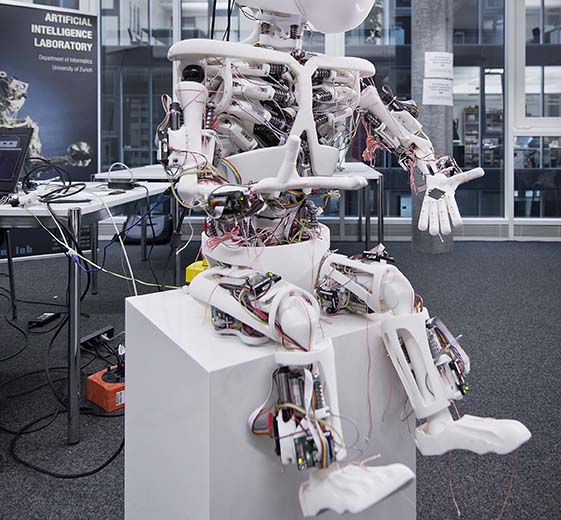
Roboy Junior has artificial muscles and tendons rather than motors in its joints. Image courtesy of Devanthro Society.
Building complex, functional geometries without classical fabrication constraints allows the project team to implement functionality directly into the geometrical parts.
Review the print ads from this magazine to continue
This quick advertiser review unlocks the rest of the article and keeps the full-screen reader focused on the ads instead of the page chrome.
Advertisers included in this article experience
Print placements connected to this article
Visit www.AMAMCOTool.com/ready-to-ship.
READY TO SHIP:
composite routers THE RIGHT TOOL…RIGHT NOW! Some of our most popular designs are now in stock, ready to ship when you need them
READY TO SHIP: composite routers THE RIGHT TOOL…RIGHT NOW! Some of our most popular designs are now in stock, ready to ship when you need them. Visit www.AMAMCOTool.com/ready-to-ship. Or call: 800.833.2239
Visit Visit www.AMAMCOTool.com/ready-to-ship. View this placement in the issue recordPrint ads from this magazine
composite routers THE RIGHT TOOL…RIGHT NOW! Some of our most popular designs are now in stock, ready to ship when you need them
READY TO SHIP: composite routers THE RIGHT TOOL…RIGHT NOW! Some of our most popular designs are now in stock, ready to ship when you need them. Visit www.AMAMCOTool.com/ready-to-ship. Or call: 800.833.2239
Continue reading
April 2017
Consequently, the complexity of building Roboy Junior was reduced and, according to EOS, many of the otherwise necessary assembly steps could be omitted. For example, Roboy Junior’s hands and forearms were manufactured in one piece, including several joints and individual phalanxes for each finger.
“In software development, rapid development cycles allow software improvement by testing it ‘in the wild,'” noted Rafael Hostettler, Roboy project leader. “Additive manufacturing allows us to apply this approach to robotics, enabling a rapid development to find optimal functional parts in a fraction of the time.”
The Roboy team also collaborates with the European Union’s Human Brain Project, which plans to simulate the human brain. It’s hard for science fiction to stay ahead.
For more information about Devanthro Society, Ennetbaden, Switzerland, visit www.roboy.org or email info@devanthro.org.
For more information about EOS, visit www.eos-usa.com or call (800) 886-9177.
Related




Subscribers can use MFGAxis notes, saves and discussion tools with their innoNET account.


