

Look Ahead: Stiff competition: General Industry Coverage
The Look Ahead column in the April 2017 issue of Cutting Tool Engineering magazine features a portable 5-axis machine tool made from carbon composites.
Stiffness is a must in precision machining. Traditional machine tools depend on massive structures and large beds and footprints to enhance stiffness. But the massiveness that ensures predicable stiffness all the way to the end of the cutting tool also ensures that the machine itself isn’t easily moved. For example, a 5-axis machine able to drill accurate 50mm (1.97″) holes in titanium could weigh as much as 20 tons (18,184 kg) and have a 3-sq.-m (9.84-sq.-ft.) footprint.
Robot arms used in assembly and other operations are much easier to move, but lack the necessary stiffness needed for precision machining. Robot arms and machine tools traditionally work as a series of serial links between the base and the end effector, which, in the latter’s case, is the cutting tool. The more links, the less stiffness.
The goal of parallel kinematics machines (PKMs), which have been in development since the mid-1990s, is to provide the stiffness necessary for highly precise machining without as much mass as conventional machines. PKMs have parallel rather than serial links between the base and the working end. The links that control the X-, Y- and Z-axis movements of the end effector aren’t connected serially, with one stacked on the other. Rather, they each have their own connection to the end effector, which allows improved stiffness with much less mass.
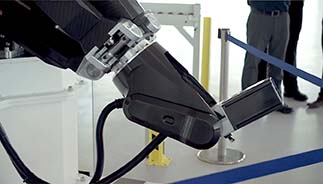
Three composite-constructed, parallel-sequenced arms are separately linked to the machining head of the XMini. Image courtesy of Exechon Enterprises.
(Imagine four acrobats standing on each other’s shoulders. The one at the bottom has to be strong, but no matter how strong he or she is, the acrobat at the top isn’t going to want to thread a needle up there. Now imagine three acrobats on the ground, working together to hold the fourth one up as if they were the legs of a stool. That’s a rough approximation of serial vs. parallel kinematics.)
Review the print ads from this magazine to continue
This quick advertiser review unlocks the rest of the article and keeps the full-screen reader focused on the ads instead of the page chrome.
Advertisers included in this article experience
Print placements connected to this article
Nachiamerica
US ries
e w Se N ck o St AQUA DRILL EX CARBIDE DEEP HOLE DRILLS 10D, 15D, 20D, 25D, 30D, 40D New Sizes Now Available Metric and Fractional.
US ries e w Se N ck o St AQUA DRILL EX CARBIDE DEEP HOLE DRILLS 10D, 15D, 20D, 25D, 30D, 40D New Sizes Now Available Metric and Fractional
Visit Nachiamerica View this placement in the issue recordPrint ads from this magazine
e w Se N ck o St AQUA DRILL EX CARBIDE DEEP HOLE DRILLS 10D, 15D, 20D, 25D, 30D, 40D New Sizes Now Available Metric and Fractional.
US ries e w Se N ck o St AQUA DRILL EX CARBIDE DEEP HOLE DRILLS 10D, 15D, 20D, 25D, 30D, 40D New Sizes Now Available Metric and Fractional
Continue reading
April 2017
Exechon Enterprises LLC, Abu Dhabi, United Arab Emirates, has introduced the XMini PKM, which merges the flexibility and high dynamics of an articulated-arm robot with the stiffness and accuracy of a rigid machine tool. The machine can apply 7-kN tool force, offers 3G acceleration and maintains a positioning accuracy of ±10µm. At the same time, it is made of carbon fiber and is modular. It can be broken into five modules, each of which is manageable to carry by one or two people, and be reassembled inside spaces traditionally hard to access by machines or people.
XMini is equipped with a flexible frame, XFrame, and frame-integration software, XFIS, which reportedly allow it to adapt to any existing jig or fixture. Exechon asserts that a factory can go from identifying a need to starting the XMini in 72 hours.
PKM pioneer Kalle Neumann, who designed the XMini, said Boeing and Airbus each approached him in 2012 for help in doubling their respective production capabilities by 2020 without doubling floor space and employee head count. The result was Exechon Enterprises LLC—a joint venture comprised of U.A.E.-based Injaz National, U.S.-based Lockheed Martin and Sweden-based Tecgrant AB—and the XMini.
“The paradigm shift is in taking the machine to the part instead of bringing the part to the machine,” Neumann stated.
For more information about Exechon Enterprises LLC, Negaunee, Mich., visit www.exechon.com or call (906) 458-0463.
Related



Subscribers can use MFGAxis notes, saves and discussion tools with their innoNET account.


