



Productive Times: Brushing away chamfering
END USER: Zodiac Engineering, www.zodiaceng.com. SOLUTION PROVIDER: Brush Research Manufacturing Co. Inc., (323) 261-2193, www.brushresearch.com. CHALLENGE: Reduce programming and cycle time, and eliminate the need to regrind or replace chamfering tools when deburring part edges. SOLUTION: Apply in-line abrasive nylon disc brushes.
END USER: Zodiac Engineering, www.zodiaceng.com
SOLUTION PROVIDER: Brush Research Manufacturing Co. Inc., (323) 261-2193, www.brushresearch.com
CHALLENGE: Reduce programming and cycle time, and eliminate the need to regrind or replace chamfering tools when deburring part edges.
SOLUTION: Apply in-line abrasive nylon disc brushes.
There’s a variety of ways to finish sharp edges between two faces of a part. Hand finishing and vibratory tumbling are two options, but they can be inconsistent and ineffective. Chamfering tools can provide a transitional edge at 90° angles, and also be used for deburring. For some contract manufacturers, however, eliminating the chamfering step proves valuable when deburring.
That has been the case for Zodiac Engineering, a contract manufacturer in Orange, Calif. It typically applies a 90° solid-carbide chamfering tool when there is a specified edge-break size or angle callout, said company owner Ken Spaulding. But when he just needs to deburr the edges, chamfering tools add programming and machining time. They must be either reground or replaced when worn.
In addition, Spaulding wanted a tool that could effectively smooth feed lines on the knife blades that Zodiac manufactures.
Spaulding viewed some videos online that showed NamPower abrasive nylon disc brushes from Brush Research Manufacturing Co. Inc., Los Angeles. Spaulding then purchased a 60mm-dia. (2.36″) Dot-style brush.
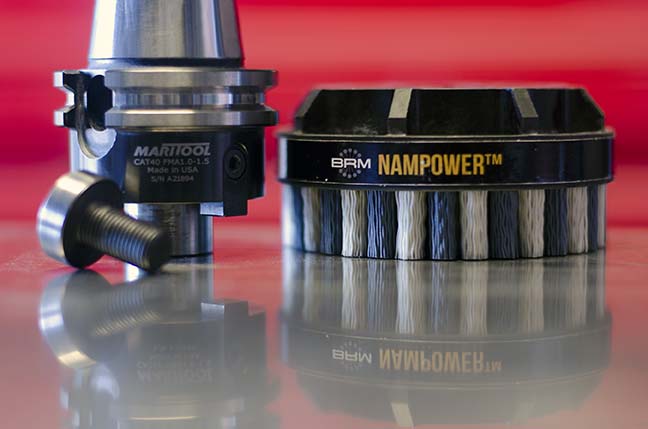
The NamPower disc brushes are composed of flexible nylon filaments bonded to a fiber-reinforced thermoplastic base. Image courtesy of Brush Research Manufacturing .
The brush proved to be effective, and Spaulding added to his tool library 60mm- and 100mm-dia. (3.94″) Dot-style brushes with a variety of grit sizes, including 320, 180, 120 and 80. “With a little trial and error, I figured out which brush works the best for me for different applications,” he said.
“I run our abrasive nylon brushes over any fairly flat part I have going in the mill,” he added. “I don’t want to use a chamfer tool for edge breaking or deburring if it’s not necessary.”
The disc brushes, which are composed of flexible nylon filaments bonded to a fiber-reinforced thermoplastic base, incorporate a combination of ceramic and silicon-carbide abrasives.
The abrasive filaments work like flexible files, conforming to part contours, wiping and filing across part edges and surfaces. They are suitable for a host of workpiece materials, including nonferrous metals, cast iron, mild steel, ductile iron, stainless and alloy steels, titanium and nickel-base superalloys.
Zodiac makes some aerospace parts and molds. The majority of the company’s machining work, however, is producing pocketknives and components for BMX road and mountain bicycles. Spaulding sells products of his own design and performs contract manufacturing.
Spaulding applies the NamPower abrasive discs on his CNC and manual milling equipment for light deburring and surface finishing. For the pocketknives, the types of metals include stainless steel for blades and titanium and zirconium for frames and handles. For the bikes, the metals include 6061 aluminum for stems and 7000-series aluminum for sprockets.
“With the brushes, I get a very predictable and consistent edge break and surface finish,” Spaulding said. “I can do it in-line, and it is a lot more predictable and reliable than breaking edges by hand.”
He added that, as the brushes wear, the bristles fracture and expose new abrasives. This enables the tools to stay sharp.
For the cycle sprockets, for example, Spaulding runs the brushes over the teeth in a single pass on each side of the part. “The brushes deburr pretty much every side of the tooth, so I don’t have to run a chamfer tool around the edges. Also, tumbling doesn’t really get inside the teeth the way the brush does,” Spaulding explained.
Even when chamfer tools are specified, part edges may still require deburring.
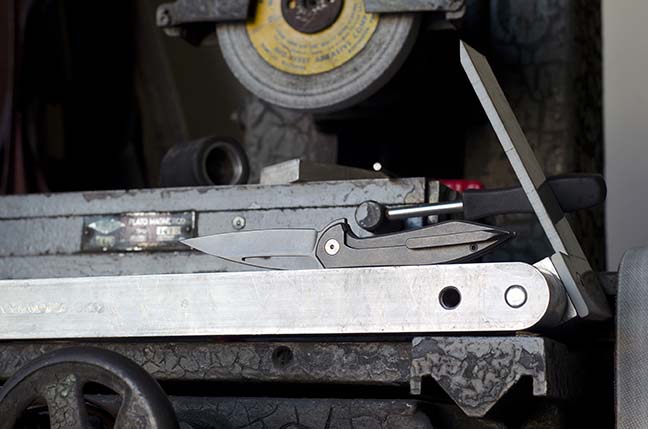
Zodiac Engineering applies NamPower brushes to smooth feed lines on the pocketknife blades that it produces. Image courtesy of Zodiac Engineering.
“Chamfering tools are just half of the puzzle,” he said. “The other half is some sort of abrasive method, such as tumbling. However, tumbling can be impractical for larger parts or anything that needs to remain dimensionally unaffected.”
Instead, he finds that the abrasive nylon brushes are complementary not only to 45° chamfering tools, but also to chamfered holes.
According to Brush Research, the brushes are available in two fill configurations: The Dot style for general-purpose deburring and surface finishing, and the Turbine style, which has a higher-density fill, for more-aggressive deburring action.
In addition to 60mm and 100mm, 125mm and 150mm (4.92″ and 5.90″) diameters are available at trim lengths of 18mm or 38mm (0.709″ and 1.496″).
“With the different grits, diameters and trim lengths, the abrasive nylon brushes are extremely versatile, as long as you have a few different sizes and styles,” Spaulding said, adding that he applies only brushes with 18mm trim lengths.
Glossary terms in this article
Related


Subscribers can use MFGAxis notes, saves and discussion tools with their innoNET account.


